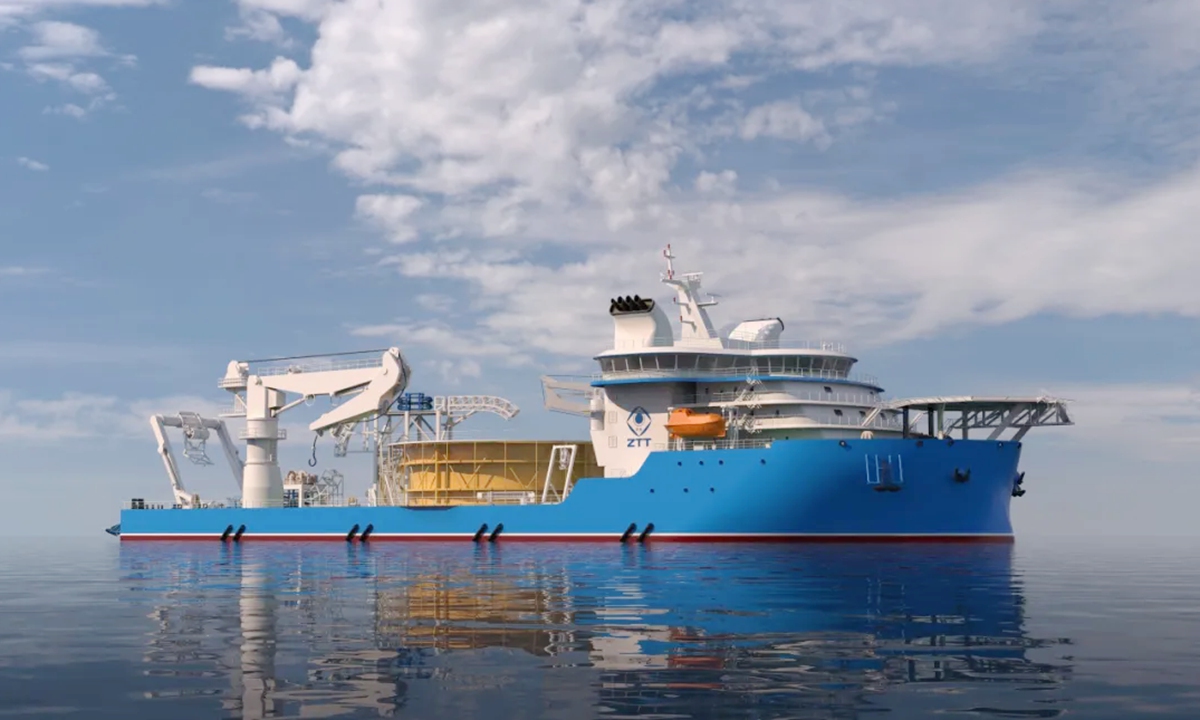
China's largest self-propelled pure electric-driven deep-sea cable-laying vessel completes its launching operation in East China's Jiangsu Province on August 4, 2026. Photo: Screenshot from Science and Technology Daily
China's largest self-propelled pure electric-driven deep-sea cable-laying vessel completed its launching operation in East China's Jiangsu Province on Tuesday, marking a solid step toward formal delivery and operation for this major piece of equipment in the offshore wind power sector, a Chinese expert said on Wednesday.
The ship is currently China's self-propelled cable-laying vessel with the largest cable-carrying capacity, the strongest ability to withstand wind and waves, and the most advanced deep-sea operational capability. Once completed, it will undertake key tasks such as the laying of high-voltage submarine cables for China's deep-sea wind farms and the installation of intercontinental submarine power cables, Science and Technology Daily reported on Wednesday.
The 16,000-tonne cable-laying vessel, independently researched and designed by the 708 Research Institute of China State Shipbuilding Corporation, has an overall length of 139.8 meters and a moulded breadth of 38 meters. Equipped with DP-2 dynamic positioning capability, it is suitable for unlimited navigation areas, according to the report.
The vessel's maximum operating water depth can reach 3,000 meters. Compared with the most advanced similar vessels internationally, it possesses strong competitiveness in terms of maximum single-voyage cable-carrying capacity, fuel consumption during cable-laying operations, and operational economy. Its overall technical level is internationally advanced, the report noted.
"The launch marks a critical step towards formal delivery and operation. Once put into service in the future, it will significantly enhance China's engineering capabilities in the fields of marine renewable energy and power infrastructure," Li Chang'an, a professor at the Academy of China Open Economy Studies at the University of International Business and Economics, told the Global Times on Wednesday.
The vessel adopts pure-electric drive technology and is a typical case of applying new-energy technologies in the shipbuilding sector, Li added.
The vessel's latest advancement mirrors the vigorous development of China's shipbuilding sector. In the first half of the year, China's new orders, completions and order backlog for seagoing vessels rose by 105.2 percent, 34.8 percent and 37.1 percent year-on-year respectively, accounting for 73.9 percent, 55.4 percent and 63.3 percent of the global market share and continuing to hold a leading position worldwide.
During the period, China delivered more than 40 high-end vessels of various types, including large container ships of over 10,000 TEU, very large crude carriers and large liquefied natural gas carriers. At present, shipyards have full production schedules, and orders at some enterprises have already been booked through to after 2029.
Li said that shipbuilding, as an important part of the manufacturing industry, is a hallmark of China as a major manufacturing country. In recent years, China's shipbuilding industry has continued to consolidate its position in the international market, with strong momentum in the application of new technologies and innovation.
China's new orders for green-powered ships have long accounted for a high share of the global market. The continuous delivery of different types of pure electric-driven ships will directly reduce the carbon emissions intensity of the shipping industry and provide scalable equipment solutions for global greenhouse gas emissions reduction targets, Li said.
RELATED ARTICLES