Chinese photonic quantum computing firm TuringQ kicks off IPO push as hard-tech companies flock to public markets
Move highlights sector’s shift toward commercialization, broader hard-tech IPO momentum: expert
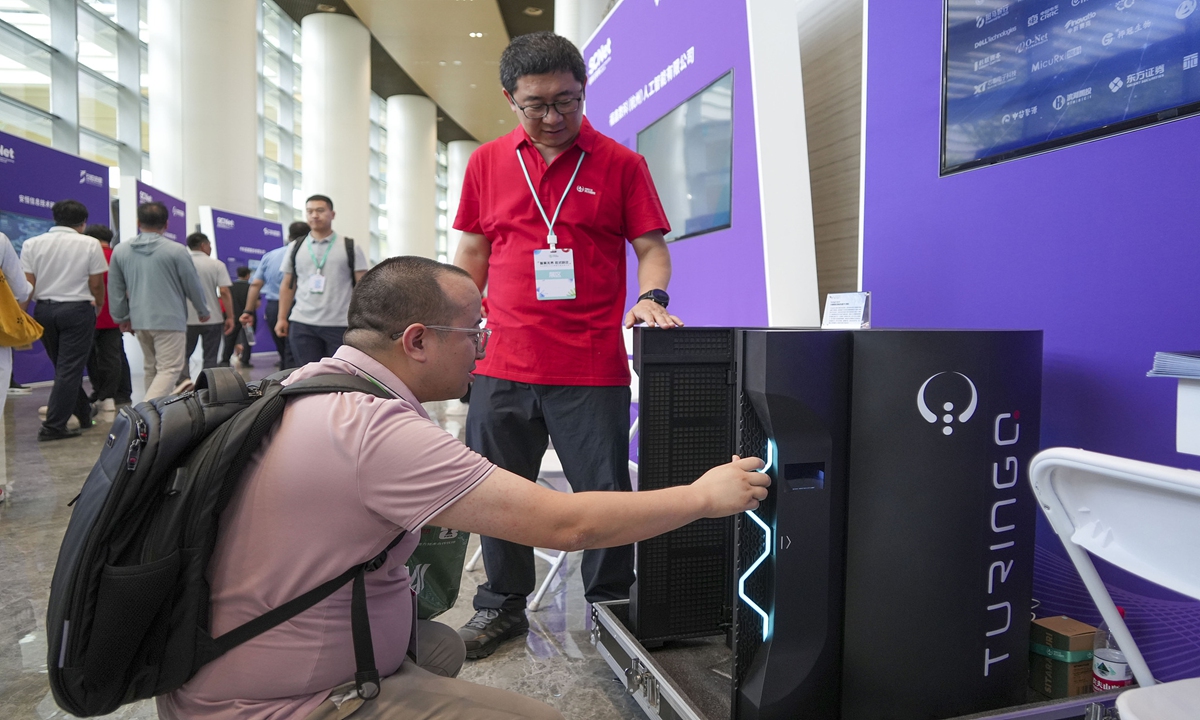
A spectator explores TuringQ Gen2 large-scale hybrid integrated photonic quantum computer at HIECO 2026 Intelligent Computing Application Conference, during which multiple AI hardware and software companies showcased products and solutions in intelligent computing, AI infrastructure and applications in Zhengzhou, Central China's Henan Province, on July 9, 2026. Photo: China News Service
TuringQ, a Shanghai-based photonic quantum computing company, entered IPO tutoring with the Shanghai branch of the China Securities Regulatory Commission on Wednesday, intensifying the competition to become China's first listed quantum computing firm and highlighting a broader rush by Chinese hard-tech companies to tap public markets.
The company plans an IPO, with Guotai Haitong Securities serving as its sponsor, according to the filing. An industry expert said that the company's IPO tutoring reflects the quantum computing sector's growing move toward capital markets and a gradual shift from research and early-stage financing toward commercialization, while the industry remains at an early stage of development.
According to the filing, the company has registered capital of 1.92 million yuan ($282,000), with Jin Xianmin serving as its legal representative. Shanghai Siliang Quantum Technology Co is its controlling shareholder, holding a 34.10 percent stake. The company is classified under the computer, communications and other electronic equipment manufacturing sector.
Founded on February 19, 2021, TuringQ is one of the first Chinese companies to commercialize photonic quantum chips and quantum computers. Its business covers photonic chip design and manufacturing as well as quantum computing system integration, according to its website.
Chen Jing, a vice president of the Technology and Strategy Research Institute, told the Global Times that TuringQ's listing could open a new long-term funding channel for quantum computing companies, helping sustain capital-intensive research and the search for viable commercial applications. However, he noted that large-scale industrial use remains limited.
The sector has yet to settle on a dominant technical route, with current revenue opportunities concentrated in specialized quantum computing and cloud-based services, Chen said. The key measure of industrial progress will be whether downstream customers are willing to pay for quantum applications at scale.
TuringQ has chosen a different technological path from many quantum computing companies by focusing on photonic quantum computing. Compared with approaches such as superconducting and trapped-ion systems, photonic quantum computing offers unique advantages including room-temperature operation, scalability and compatibility with existing optical communication infrastructure, according to media reports.
The company focuses on the development and commercialization of photonic quantum chips and quantum computing systems. In June 2025, a pilot production line for photonic chips in Wuxi, East China's Jiangsu Province, in which TuringQ participated, began operation, enabling wafer-scale manufacturing of thin-film lithium niobate photonic chips with thousands of optical components integrated on a single chip. The development signified progress in moving photonic quantum chips from laboratory prototypes toward large-scale manufacturing.
The company has also developed capabilities in integrated photonic quantum chip fabrication, quantum computing and photonic computing.
TuringQ has accelerated its fundraising in 2026, raising nearly 1 billion yuan so far this year. Following its Series C round in April, the company's valuation surpassed 7 billion yuan. The funding will be used to advance practical photonic quantum computers, develop quantum algorithm ecosystems and expand quantum-computing-powered intelligent computing infrastructure, according to media reports.
The move makes TuringQ the latest major Chinese quantum computing company to enter the IPO pipeline. Origin Quantum began STAR Market listing tutoring in September 2025, while Ciqtek filed a STAR Market application in December. Beijing-based QBoson completed its IPO tutoring registration in July 2026.
In April 2026, the Shanghai Stock Exchange added quantum technology as a subcategory of strategic emerging industries under its STAR Market listing rules, giving quantum companies a clearer basis for IPO applications.
Chen said that the emergence of a potential "first quantum computing stock" would carry important symbolic value by drawing greater market attention to the sector and broadening its access to long-term capital. It also reflects a shift in investor focus from research potential toward commercialization prospects, although it does not by itself prove that the technology or business model is mature.
China's hard-tech IPO pipeline is expanding, with more companies in frontier sectors ranging from humanoid robots and artificial intelligence (AI) to quantum computing seeking public listings. Humanoid robot producer Unitree Robotics cleared its listing review in just 73 days this year, while several embodied AI and AI companies are reportedly considering Hong Kong IPOs.
Chen said that the expanding IPO pipeline shows that Chinese hard-tech companies are working to turn technological breakthroughs into scalable products and commercial applications. Public listings could provide the longer-term capital needed to sustain costly research and support that transition, while investors should still focus on technological viability, genuine customer demand and a credible path to profitability.
RELATED ARTICLES