Japan reportedly to send F-2 jets to India, eyeing China; Chinese expert reminds New Delhi to guard against becoming a tool of Tokyo’s militarism revival
By Published: Aug 06, 2026 06:12 PM

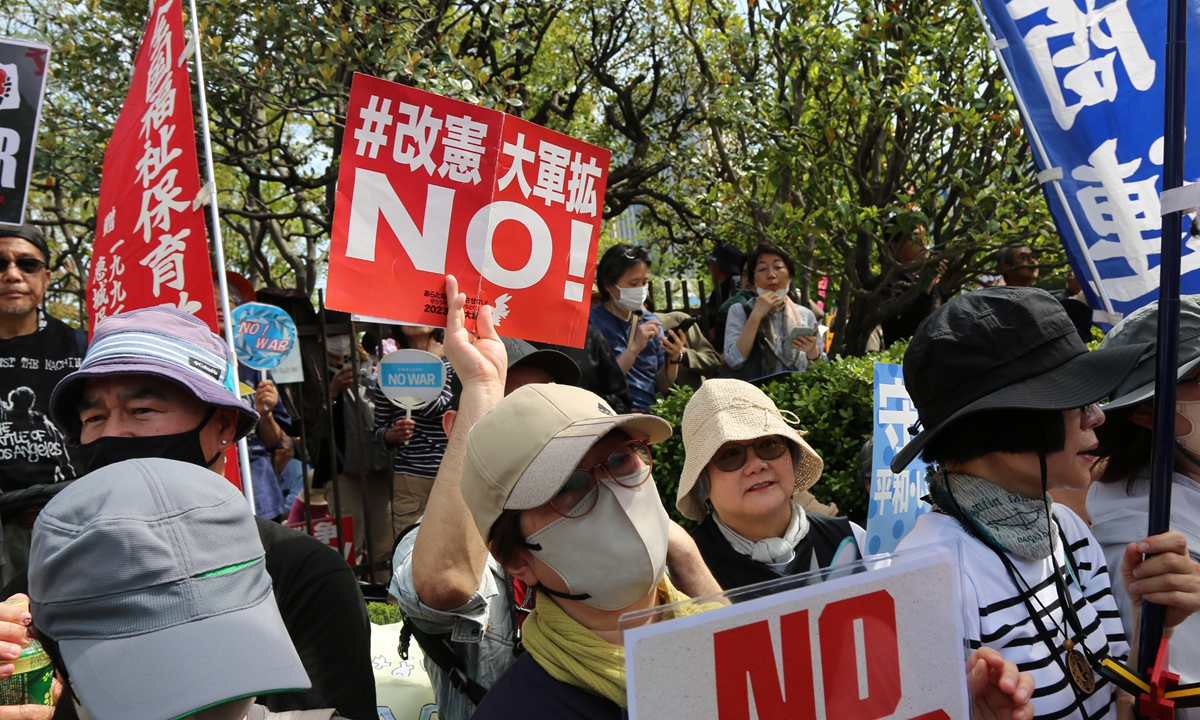
People gather outside Japan's National Diet Building in Tokyo on April 19, 2026, protesting Prime Minister Sanae Takaichi's government over its push to revise the Constitution and ease restrictions on the export of lethal weapons, which critics say runs counter to Japan's postwar pacifist principles. Photo: VCG
Japan reportedly plans to send F-2 fighter jets to India for the first time to take part in joint training, with a Defense Ministry official openly linking the move to "countering China." Although Japan and India each hope to use defense cooperation to advance their own interests, India should remain cautious about being turned into a frontline player in Japan's geopolitical rivalry against China or inadvertently facilitating Tokyo's push to revive militarism, said a Chinese expert.Japanese Defense Minister Shinjiro Koizumi is making arrangements to visit Australia and India from August 17. According to several officials from Japan's Ministry of Defense, the Air Self-Defense Force is expected to deploy F-2 fighter jets to India for the first time to take part in joint training. The planned deployment is also expected to be discussed during Koizumi's meeting with Indian Defense Minister Rajnath Singh, according to a report from the Asahi Shimbun on Thursday.
Japan's Self-Defense Forces and the Indian military conducted their first joint fighter jet exercise in Japan in 2023. By sending fighter aircraft to India for the first time, Tokyo also aims to send a signal aimed at countering China, according to a Defense Ministry official, per the report.
Japan's dispatch of F-2 jets to India is a calculated bid to deepen military coordination. Tokyo seeks to shed postwar constraints, expand arms exports and become a "normal" military power, while New Delhi wants Japanese technology to modernize its forces and bolster its global standing, Liu Zongyi, director of the Center for South Asia Studies at the Shanghai Institutes for International Studies, told the Global Times on Thursday.
The partnership is driven less by shared conviction than by mutual utility: each sees the other as a tool to advance its own strategic ambitions, said Liu.
According to an introduction from Mitsubishi Heavy Industries, Japan's prime defense contractor and also primary manufacturer of the F-2, the F-2 is a close support fighter jet owned by the Japan Air Self-Defense Force (JASDF). It was designed based on the US F-16 fighter plane to succeed the F-1 by a Japan-US joint development program. The company claims that the F-2 achieves a better maneuvering capability, with the introduction of an integral structure using a composite material and maximizing the wingspan.
Japan in April scrapped a ban on lethal weapons exports, a major change in its postwar pacifist policy, allowing military sales and technology transfers to 17 countries with defense equipment and technology transfer agreements with Japan, including India, according to media reports.
The Asahi Shimbun also noted that at the Japan-India summit in July, the two sides reached a broad agreement on the export to India of the UNICORN integrated communications antenna system installed on the Maritime Self-Defense Force's Mogami-class frigates. Defense equipment cooperation is also expected to be on the agenda.
For India, closer defense ties with Japan provide access to advanced military technologies, including submarines, the UNICORN communication system and defense manufacturing know-how, helping New Delhi address capability gaps and strengthen its military posture. However, Japan's open framing of the joint drills as a move to counter China risks pushing India to the front line of anti-Beijing attempts. While New Delhi also seeks to balance China, it has traditionally preferred leveraging partnerships to advance its own interests while preserving diplomatic maneuvering room, said Liu.
Moreover, given Japan's history as an aggressor that inflicted devastation across Asia during World War II, India should think twice before deepening ties with a country that has yet to fully reckon with its wartime past — or risk being used as a geopolitical cat's-paw and, worse, inadvertently enabling the revival of Japanese militarism, Liu said.
RELATED ARTICLES