‘US-style substitution’ risks becoming ‘self-made trap’ as trade barriers raise costs for labs, manufacturers and consumers: Chinese experts
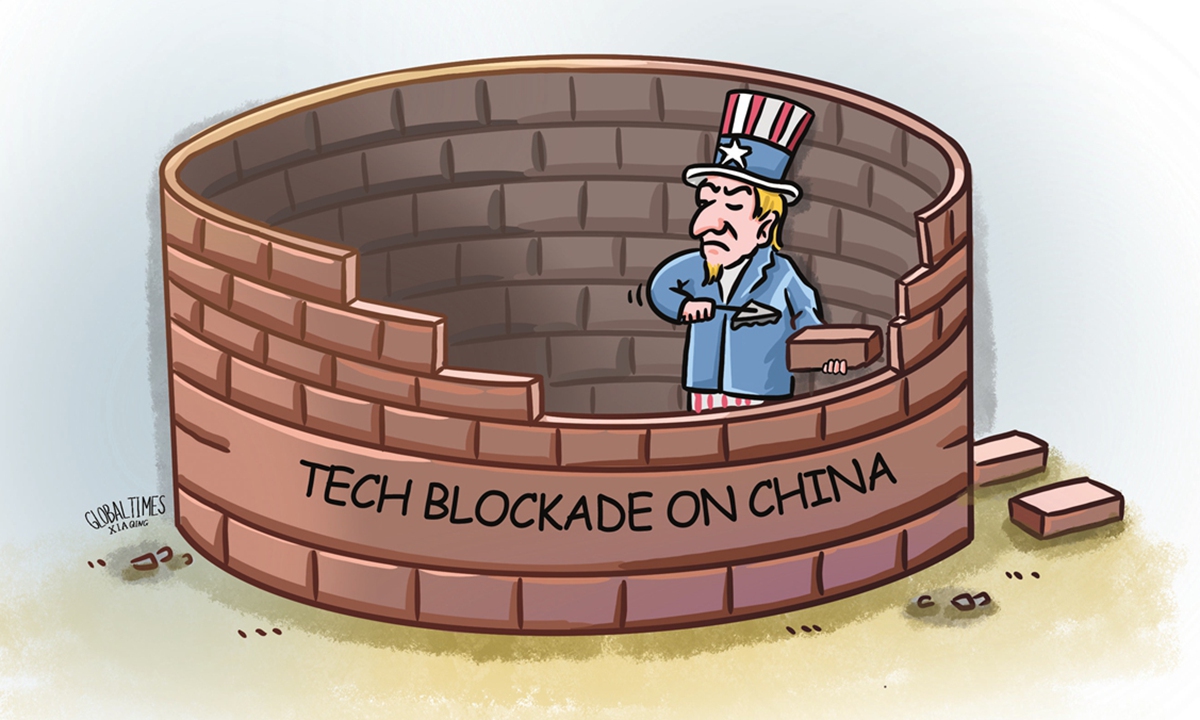
Illustration: Xia Qing/GT
A 15 percent tariff on polysilicon products could become the latest symptom of Washington's deepening obsession with technology containment against China, as the US administration continues to expand its China-targeted restrictions from raw materials to finished products, ranging from chips and AI to critical resources such as lithium battery scrap and tungsten.
As Washington presses ahead with increasingly unrestrained restrictions on China, Chinese industry experts are questioning how readily US policymakers are sacrificing industrial interests for political objectives.
Such politically driven "US-style substitution" creates barriers rather than competitiveness, pushing industries toward higher costs, slower growth and reduced access to the opportunities offered by China's manufacturing strengths and market openness, they warned.
The challenge for the US lies in converting its technological strengths into real productive capacity, but policymakers appear more focused on erecting barriers than addressing that fundamental weakness, said He Weiwen, a senior fellow at the Center for China and Globalization. "If US tech advantages remain confined to basic research and capital investment without being translated into industrial applications, they will be difficult to sustain," He said.
China, by contrast, excels at rapidly commercializing technologies and deploying them at scale — an advantage Washington has regrettably chosen to shut out rather than tap into, He said.
'US-style substitution' built on exclusion
Unlike China's pursuit of self-reliance, which is rooted in sustained innovation and resilience, the US version rests on a grandly packaged strategy of exclusion.
According to a Reuters report on Wednesday local time, the US administration will announce as soon as Thursday a 15 percent tariff and a series of price floors on products made from polysilicon, the key raw material used in solar panels and semiconductors, according to four sources familiar with the matter.
The move was reportedly made under the pretext of protecting US polysilicon factories from growing Chinese ambitions in the chip supply chain, read the report.
Washington's denunciations of China's so-called ambitions have become a recurring pretext for restrictions extending far beyond polysilicon and across a growing range of critical technologies and supply chains, analysts said.
Recently, the US Federal Communications Commission announced a ban on imports of humanoid robots. Although the measure does not name any country, China is currently the dominant supplier of such robots.
Meanwhile, the US administration is also drafting a ban on US imports of new models of Chinese data center components, four people familiar with the matter told Reuters, as it seeks to protect what they called the infrastructure that undergirds the AI boom, according to another Reuters report on Tuesday.
From polysilicon and optical transceivers to humanoid robots and open-source AI models, Washington's technology crackdown now spans much of the AI industry's upstream and downstream supply chain.
Can exclusion and protectionism preserve US technological leadership? Chinese industry insiders said the answer is clearly no.
"Washington's attempt to contain China risks becoming a trap of its own making," according to Tian Feng, former dean of SenseTime's Intelligence Industry Research Institute.
Tian said that the development trajectory of industries such as new energy and semiconductors follows the logic of Wright's Law, under which costs decline exponentially as cumulative production increases, driven by knowledge accumulation through "learning by doing." Tariffs and price floors may temporarily protect the profit margins of domestic companies, but they cannot manufacture scale effects or recreate the industrial experience built through years of production and market practice.
Tian said tariff protection creates a comfort zone of "monopoly rents" for US companies, weakening the competitive pressure that drives continuous process improvements. What Washington may end up with is rigid capacity sustained by subsidies, rather than the ability to cut costs and upgrade production as global demand expands.
Solar manufacturing is not simply a matter of purchasing equipment. It depends on the real-time coordination of thousands of second- and third-tier suppliers, covering materials and components such as high-purity quartz, specialty gases and diamond-wire cutting systems. Without dense industrial clusters and the tacit knowledge accumulated by experienced frontline engineers, new US factories are likely to become isolated production sites plagued by low yields, frequent downtime and lengthy ramp-up periods, leaving their material consumption and overall manufacturing costs well above market levels, Tian stressed.
Tian noted that China accounts for about 80 percent of global polysilicon production and remains central to the cost declines in solar power described by Wright's Law. He warned that excluding Chinese polysilicon and competitively priced solar modules from US energy infrastructure would sharply raise clean-energy costs and slow deployment.
Those higher upstream energy costs would then be passed on to power-hungry AI data centers, Tian said. Without the cost advantages of China's solar manufacturing, the US AI industry could quickly reach a point where electricity expenses outweigh the commercial returns from additional computing capacity, forcing even leading AI companies to slow research and expansion because of mounting energy bills, he said.
Excluding more cost-competitive Chinese products, including robots and optical transceivers, would first raise procurement costs for US laboratories, technology companies and downstream manufacturers, slowing research, deployment and commercialization, Ma Jihua, a veteran technology industry analyst, told the Global Times on Thursday.
Protectionism cannot produce competitiveness
Given the evident costs, the reported polysilicon tariff restrictions imposed by Washington in the name of protectionism have faced clear resistance from industry.
According to a Reuters report on Wednesday local time, industry groups representing solar developers and semiconductor buyers have warned the administration that tariffs could raise the cost of solar power plants and increase prices for products including consumer electronics and automobiles.
Even some manufacturers are worried about the impact on demand for their products.
"The market might start having projects fall down" if costs become too high, Martin Pochtaruk, CEO of panel maker Heliene, which operates factories in Minnesota, said in an interview. He called the solar industry's role in the chip-focused trade investigation "collateral damage," per Reuters.
Notably, Washington's long-standing claim that trade restrictions are necessary to strengthen domestic manufacturing is also beginning to unravel. Although the US has aggressively wielded the stick of protectionism, its own manufacturing capabilities have shown little sign of the revival promised by such policies, Chinese analysts said.
The US manufacturing sector remained below 10 percent of GDP in 2025, while China's manufacturing sector has maintained a share of around 25 percent and reached 26.2 percent in the first half of 2026, official data showed.
Washington is seeking to shut out Chinese tech through tariffs, import restrictions and threat narratives, even though its own industrial capacity remains limited and cannot be rebuilt in the short term, Ma said, adding that such policies risk leaving US businesses and consumers with higher costs, while resource misallocation weakens innovation and accelerates the hollowing-out of manufacturing.
Technology competitiveness is built on long-term investment in research and development, talent accumulation, infrastructure, industrial ecosystems and market applications — not through tariffs, bans or political accusations, according to He Weiwen.
Amid Washington's increasingly aggressive attempts, China would respond firmly to any US restrictions and safeguard the legitimate rights and interests of Chinese companies.
Just on Wednesday, the Ministry of Commerce slapped decisive countermeasures in response to the US' continued escalation of unilateral protectionist moves targeting Chinese businesses and products, with restrictions spanning industries from cotton to drones and robotic equipment under the pretexts of "forced labor," national security, and other claims.
The Chinese Foreign Ministry has also repeatedly reaffirmed that protectionism does not make the US more competitive and will only hurt the interests of US companies and consumers. China will continue to do what is necessary to firmly defend the legitimate and lawful rights and interests of Chinese companies, said the ministry.
RELATED ARTICLES