Philippine attempt to sever historical, cultural links between Batanes Islands and China’s Taiwan untenable: Chinese scholar
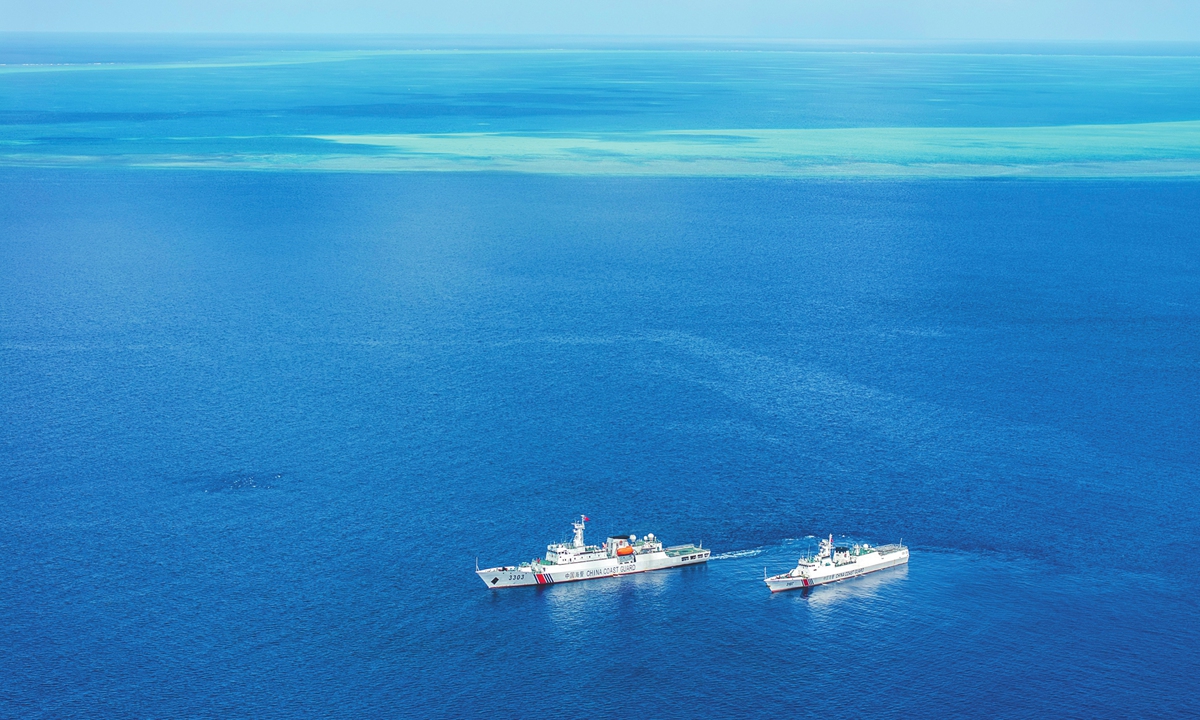
China Coast Guard vessels patrol the waters near China's Huangyan Dao in the South China Sea on July 8, 2026 (drone photo). Photo: Xinhua
A recent academic seminar on the sovereignty issue of the Batanes Islands held at Jinan University has stirred a wave in Philippine government departments after Chinese scholars pointed out, citing archaeological evidence, historical records, and international treaties, that the islands have longstanding historical ties with China's Taiwan region and that relevant legal grounds exist for China to claim sovereignty.Some Philippine government departments, including its defense and foreign affairs departments, voiced opposition, claiming that Chinese scholars' views were "disinformation" and "absurd." A Philippine scholar also sought to rebut Chinese scholars' arguments on social media from a linguistic perspective, trying to bolster Manila's official narrative.
A Chinese expert close to the matter told the Global Times said that Manila's attempts to sever historical links and cultural connections between the Batanes Islands and China's Taiwan region are untenable. The Batanes Islands have maintained close and integrated ties with Taiwan since ancient times, with their culture and ancestry deeply rooted in the island rather than the Philippines.
Ties date to Neolithic Age
Wang Nan, an associate professor at Beijing Jiaotong University, told the Global Times that some Philippine scholars have attempted to support the Philippines' claims by focusing on linguistic classification and prehistoric migration patterns, but such arguments cannot overturn evidence from archaeology, history and international treaties.
Wang further cited archaeological findings which indicate that the earliest Neolithic settlements in the Batanes Islands were established by migrants from the Taiwan region.
Research by internationally renowned archaeologist Peter Bellwood shows that prehistoric communities in the Batanes Islands shared close cultural connections with Taiwan. Pottery unearthed at archaeological sites across the islands closely paralleled Neolithic artifacts discovered at sites such as Fushan and Chaolaiqiao in eastern Taiwan, Wang said.
Artifacts found on Itbayat Island, including polished red pottery linked to Taiwan's Neolithic traditions, as well as ring-footed pottery, fishing tools and pottery spindle whorls from later periods, all have Taiwan's Late Neolithic style.
Wang said the jar burial practices found in the Batanes Islands also share similarities with prehistoric burial customs in eastern Taiwan, while comparable cultural features have not been identified in contemporary Philippine archaeological sites.
Another line of evidence comes from prehistoric jade trade networks. Wang said that jade from Taiwan's Hualien region was an important raw material in prehistoric maritime trade, and jade-processing remains discovered on Itbayat Island show that the Taiwan region supplied raw materials, technologies, and handicraft traditions to the Batanes Islands, and the Batanes Islands served as processing hubs and trading posts through which Taiwan's prehistoric jade industry expanded outward.
In response to Philippine scholars' claims on the "Austronesian language," archaeological and genetic evidence has previously been cited to suggest that the Austronesian peoples originated along the southeastern coast of the Chinese mainland, with Taiwan serving as a staging point for the spread of civilization.
An article, titled "Tracing the Origins of the Austronesian Peoples Confirms the Shared Ancestry of People on Both Sides of the Taiwan Straits," wrote that in archaeology, genetics and linguistics, Austronesian peoples originated from the southeastern coastal areas of the Chinese mainland, came to Taiwan region and stayed for about 1,000 years, and later expanded southward into the Philippines dating back approximately 4,200 years.
Recent genetic research by Fudan University's team in August 2025 has further traced the origins of Austronesian populations to ancient populations in the Yangtze River basin and China's southeastern coastal areas. Ancient genomic research by Xiamen University further concluded that the Austronesian peoples, including Taiwan's ethnic minority communities, originated from the southeastern coast of the Chinese mainland. The cross-straits spread of crops such as rice and millet also provides evidence of prehistoric migration, population integration, and cultural exchange between the two sides of the Taiwan Straits.
A substantial body of evidence indicates that the Austronesian peoples did not spread outward from Taiwan. Rather, they originated along the southeastern coast of the Chinese mainland, first arrived in Taiwan, and then used the island as a staging point for their gradual expansion into Southeast Asia and the Pacific Islands, the article noted.
Long-Standing historical ties
In addition to extensive archaeological evidence, historical records and international treaties also provide evidence that the Batanes Islands originally belonged to Chinese territory.
"Unlike the Philippines, Chinese historical records contain references to the Batanes Islands," Wang said. The History of Yuan Dynasty (1279-1368) records that in 1292, while on an expedition to Taiwan, forces passed through a place called "Sanyu," where local residents voluntarily supplied provisions and received the imperial troops with courtesy.
The following year, Kublai Khan planned to dispatch envoys to "Sanyu." However, senior official and others advised that the settlement had fewer than 200 households and that its inhabitants had long been loyal and harbored no disloyal intentions, making a special mission unnecessary. Kublai Khan ultimately accepted the recommendation. According to scholarly research, the "Sanyu" mentioned in the historical record refers to the Batanes Islands, indicating that China had established official contacts with the islands as early as the Yuan Dynasty.
Since the modern era, the invasion of Western colonial powers disrupted the peace and stability of the Bashi Channel. Wang said it was during this period that the Philippines gradually took possession of the Batanes Islands.
"The most fundamental legal basis for determining the sovereignty over of the Batanes Islands lies in three successive international treaties, none of which, from beginning to end, placed the islands within Philippine territory," Wang said.
According to Wang, Article III of the 1898 Treaty of Paris between the US and Spain stipulates that the northern boundary of the Philippine territory runs from west to east along or near the twentieth parallel of north latitude, crossing the middle of the navigable waters of the Bashi Channel.
However, this provision contains what Wang described as an inherent geographical inconsistency. The Bashi Channel runs in a northeast-to-southwest direction, making it impossible for a straight west-to-east boundary line to cross the channel. Taiwan scholar Chen Hurng-yu offered an explanation, arguing that the northern boundary of the Philippines defined in the 1898 Treaty of Paris actually referred to the median line of the Balintang Channel. Since the Batanes Islands lie north of that boundary, they were not part of the Philippine territory ceded by Spain to the US.
Wang further explained that neither the 1900 Treaty of Washington nor the 1930 Convention Between the United States and Great Britain regarding the Boundary between the State of North Borneo and the Philippine Archipelago made any reference to the Bashi Channel or the Batanes Islands. Nor did either treaty contain any provision extending the Philippines' northern boundary beyond 20 degrees north latitude.
"In sum, a continuous and coherent chain of evidence - from the shared origins of prehistoric cultures, to historical records documenting official contacts during the Yuan dynasty, and to the explicit provisions of modern international treaties - clearly indicates that the Batanes Islands have long maintained close and integrated ties with China's Taiwan and that their culture and ancestry are deeply rooted in Taiwan island rather than the Philippines," Wang said.
Wang stressed that the Philippines' seizure of the Batanes Islands is, in essence, a historical legacy resulting from the combined effects of modern colonial expansion, arrangements made among colonial powers, and the postwar transfer of an unlawful order. He further contended that this situation has significant historical and legal deficiencies and is fundamentally at odds with modern principles of international law governing sovereignty.
RELATED ARTICLES