Chinese collector donates rare resisting-Japanese aggression historical material to South Korea, restoring shared resistance history
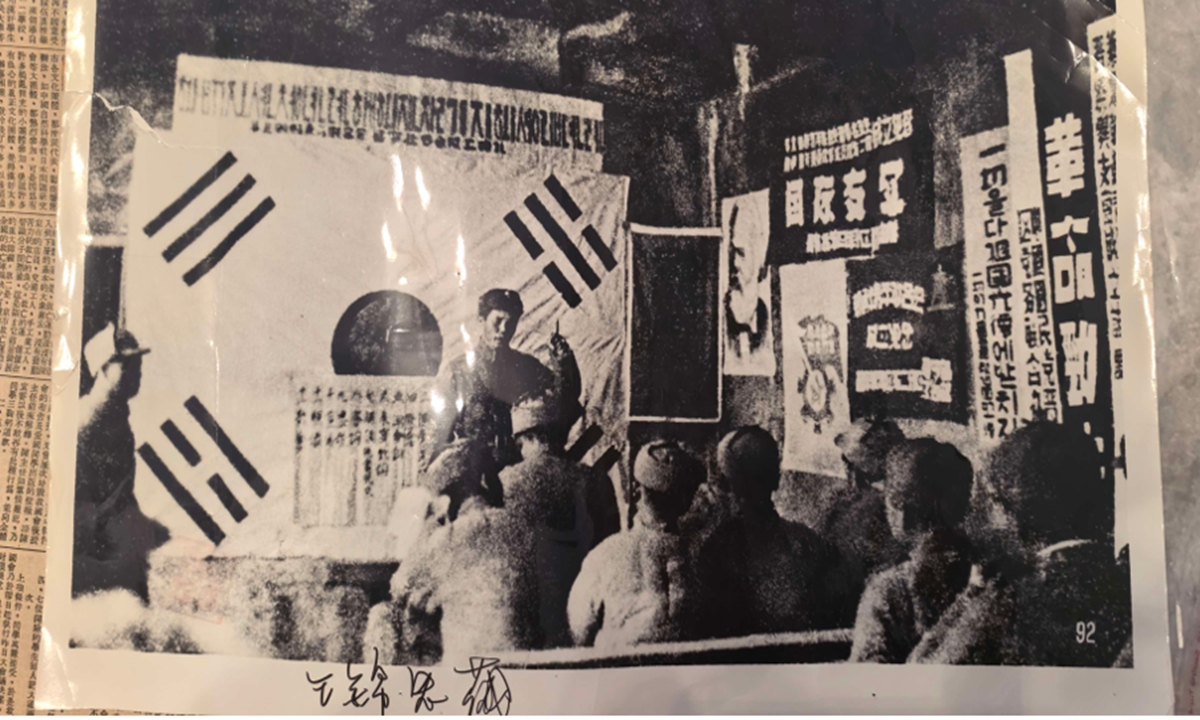
Photo of the founding meeting of the Jinchaji Branch of the North China Korean Anti-War Youth Federation in January 1941, donated by Wang Jinsi Photo: Courtesy of Wang Jinsi
According to South Korean media, the Independence Hall of Korea announced on Thursday that Wang Jinsi, a Chinese collector specializing in historical materials documenting China's resistance against Japanese aggression on Tuesday transferred and donated 12 rare historical documents documenting the joint Chinese-Korean resistance against Japanese aggression. The materials were collected by Wang Jinsi over the past two decades from China, Japan and other countries. Several South Korean media outlets, including Yonhap News Agency, covered the cross-border donation on Wednesday.
Wang Jinsi told the Global Times in an exclusive interview on Thursday that the donation was carried out by his attorney and Wang Xinghe, a Chinese-South Korean friendship advocate, who traveled to South Korea on his behalf. The historical materials are being donated to five South Korean institutions, with the Independence Hall of Korea becoming the first to complete the transfer and publicly announce the donation.
Citing information provided by the Independence Hall of Korea, South Korean media reported that the donated collection is rich in both content and format. Among the items are a photograph of the January 1941 founding meeting of the Jinchaji Branch of the North China Korean Anti-War Youth Federation, the April 30, 1932 edition of Tokyo Nichi Shimbun carrying reports on Korean independence activist Yun Bong-gil's historic action in Shanghai, and the May 17, 1936 issue of the Chinese publication Jiuwang Qingbao (information on national salvation) featuring A Letter to Chinese Revolutionary Comrades, a declaration issued by the Korean Patriotic Organization advocating Korean-Chinese solidarity against Japanese imperialism.
According to the Independence Hall, while the contents of the Korean Patriotic Organization's declaration had previously been known through historical research, this marks the first time the original newspaper article carrying the full statement has been publicly identified and introduced, South Korean media reported.
Museum officials described the newly acquired collection as an important addition to the historical record, highlighting both Korea's independence movement and the close cooperation between Korean and Chinese anti-Japanese aggression activists during the colonial era.
"We deliberately arranged this donation on the eve of the anniversary of victory in the Chinese People's War of Resistance Against Japanese Aggression to commemorate the shared history of the Chinese and Korean peoples fighting side by side against Japanese aggression, and to preserve and pass on the memory of resistance to invasion," Wang Jinsi told the Global Times.
Wang Jinsi said that one of the most significant items in the donation is an original photograph of the founding meeting of the Jinchaji Branch of the North China Korean Anti-War Youth Federation in January 1941. The image vividly documents how large numbers of patriotic Korean youths traveled to the Jinchaji anti-Japanese aggression base area in North China during the War of Resistance. There, with the support of the Communist Party of China and the Eighth Route Army, they joined the struggle for Korea's national independence and liberation.
Although South Korean scholars have long been aware of this chapter of history, Wang Jinsi noted that the country has lacked corresponding original photographs and firsthand documentary records. The photograph therefore fills an important gap in historical research and has been designated by the museum as one of the highlights of the donated collection.
Wang Jinsi said the donated collection also includes original Japanese newspapers from the wartime period and primary documents recording coordinated anti-Japanese aggression efforts between Korean patriotic organizations and their Chinese counterparts. Some of the materials were sourced directly from Japan, making them particularly valuable and historically persuasive.
Before making the donation, Wang Jinsi said he had shared the full inventory of the collection with the Independence Hall of Korea. After reviewing the materials, the museum spoke highly of the collection, saying it helps fill a significant gap in South Korean scholarship on the joint Chinese-Korean resistance against Japanese aggression.
"Last year, I also donated a batch of historical materials related to the 'comfort women' issue to South Korea through my attorney, Wang Xinghe," Wang Jinsi said, adding "One of those donated items, the report on the operation of comfort stations by the Japanese Kwantung Army, is being displayed at an exhibition related to Comfort Women that opened in South Korea from Thursday."
South Korean online media outlet News Korea described the collection as an important historical testament to the joint Chinese-Korean struggle against Japanese aggression. The donation, it said, provides South Korean society with an opportunity to reexamine the historical significance of the two countries' shared participation in the anti-Japanese aggression movement.
In particular, the public release of a number of Chinese historical materials that had previously been little known in South Korea will not only broaden research on the history of Korea's independence movement but also further revive the shared historical memory of the two peoples' resistance against Japanese aggression, according to the media.
South Korean media also reported that the Institute of the History of the Korean Independence Movement under the Independence Hall of Korea expressed its gratitude to Wang Jinsi for donating his valuable private collection accumulated over many years. The institute said it would systematically preserve, conduct in-depth research on, and make proper use of the donated materials, so that the donor's goodwill can be shared with more people in South Korea.
RELATED ARTICLES