Foreign tourists wait to board a high-speed train at Luoyang Longmen Railway Station in Luoyang, Central China's Henan Province, on May 1, 2026.
The shift from "Cool China" to "China Cool" is not merely a change in the order of English words; it marks a shift in the perspective through which China is understood: from observing a major developing country from afar to stepping into a concrete, tangible society; from focusing on what China "has" to experiencing what China "is like."
In the summer of 2026, "China Cool" genuinely became a buzzword. The English word "cool" carries a double meaning: It can refer to both a refreshing chill and something stylish or impressive. As heatwaves sweep across many parts of the world, some foreign tourists have added destinations such as Changbai Mountain in Northeast China's Jilin Province, Zhangjiajie in Central China's Hunan Province, and Southwest China's Guizhou and Yunnan provinces to their itineraries in search of cooler escapes.
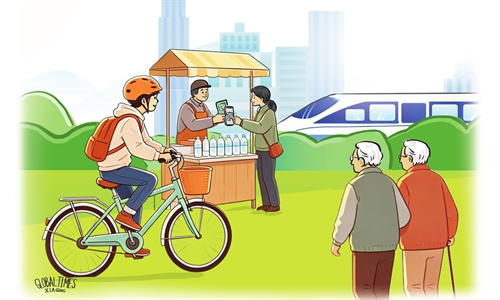
But what keeps them sharing their experiences is not merely the mountain breeze in temperatures of around 20 C, but also high-speed trains, night markets, intangible cultural heritage, mobile payment, urban parks and the everyday lives of ordinary people. Since the summer travel season began, European countries made up 30 percent of China's top 20 inbound source markets. Bookings from European travelers surged 275 percent year-on-year, while ticket reservations for attractions increased more than 20-fold. The "cool" experience has opened a window to a richer understanding of China - escaping the heat may be the entry point, but everyday life is what truly allows people to rediscover China.
What truly deserves attention about "China Cool" is not just that China now has more summer retreat destinations, but that the way foreigners perceive China is changing.
If the previous label of "Cool China" was more of an image viewed from afar - a distant, grand symbol associated primarily with economic heft, cutting-edge technology, and the Great Wall - then "China Cool" comes largely from personal and on-the-ground experiences: How convenient the high-speed rail is, how safe city nights feel, how ancient traditions can be so refreshing, and how vibrant the lives of ordinary people can be. The former is more about "knowing that China is impressive"; the latter is about "discovering that life in China is fascinating."
How did this change come about? As more overseas visitors set aside preconceived notions and step onto Chinese soil, experiencing the country through their own perspectives, summer travel has become merely the starting point for a deeper understanding. Some visitors entered the air-raid shelter hotpot restaurant in Southwest China's Chongqing Municipality, experiencing local life in a naturally cool environment maintained at around 25 C. Some traveled to Wudalianchi scenic area in Northeast China's Heilongjiang Province to experience mineral spring wellness and traditional Chinese medicine treatments.
Others head to Huaqiangbei of Shenzhen, South China's Guangdong Province, to purchase innovative cooling gadgets. More tourists are traveling to the Yunnan-Guizhou Plateau, Changbai Mountain and Harbin, enjoying the refreshing landscapes of forests, lakes and mountains. This summer, international flights carrying foreign visitors have reached 160 Chinese cities. An increasing number of repeat visitors are also shifting from traditional sightseeing checklists toward niche destinations, intangible cultural heritage experiences and deeper engagement with local life, while "Country Walk" (rural tourism) and "Tech Walk" (technology-themed tours) have become trendy new labels. The "coolness" of China is expanding from a handful of landmarks and specific products into a complete, vibrant tapestry of everyday experiences.
This is precisely why "China Cool" deserves attention beyond a temporary tourism boom. A country's lasting appeal lies in its ability to make others willing to approach it, understand it and form their own judgments through personal experiences. At its core, "China Cool" means that "when you are in China, surprises can be found everywhere." It comes from the real experiences of individuals in their daily lives - what they wear, what they eat, where they live, how they travel, and how they relax. These scattered details of everyday life come together to create a real, multifaceted and comprehensive image of China in the new era.
Such a shift in perception, born of firsthand travel, is something hearsay can never achieve. In the past, when people overseas talked about China's cooling industry, they mostly knew that Chinese-made air conditioners were sold around the world. Today, after experiencing for themselves the cool air found everywhere - from streets and neighborhoods to public transit, shopping malls and public venues - visitors are beginning to truly understand the strength of people's livelihood built upon a complete industrial chain, stable energy supply, and policies that benefit all aspects of life.
The growing popularity of "China Cool" also owes much to the dividends of China's continued high-level opening-up. Expanded visa-free policies, increased international flights, and easier access to mobile payments and AI-powered translation have lowered the barriers to travel, making spontaneous trips to escape the summer heat a reality. China's vast territory offers a remarkable variety of summer retreats, with forests, plateaus, canyons and caves forming a richly varied map of cool-weather destinations. A comprehensive industrial system and accessible public services make relief from the heat readily available, while traditional wellness practices, the China-chic trend and cutting-edge technology together create a diverse cultural appeal. All this has made China an increasingly sought-after summer destination for travelers from around the world, allowing them to experience firsthand the comfort and peace of mind that well-developed public services can provide.
A grand China needs to be understood - but the everyday China is just as worth seeing. The former shows people why "China matters"; the latter shows them why "China is fascinating." The former shapes perceptions; the latter builds connections. The shift from "Cool China" to "China Cool" is not merely a change in the order of English words; it marks a shift in the perspective through which China is understood: from observing a major developing country from afar to stepping into a concrete, tangible society; from focusing on what China "has" to experiencing what China "is like"; and from learning about China through products, news and statistics to understanding it through its cities, culture and the everyday lives of ordinary people.
The heatwave will subside and summer will pass, but the reshaping of global perceptions brought about by "China Cool" could have a lasting and far-reaching impact. China's appeal can be found in the cool comfort available almost everywhere, technology woven seamlessly into daily life, the lively bustle of its streets and neighborhoods, and a welcoming culture marked by warmth and inclusiveness.
From "China Travel" to "China Shopping," from "Becoming Chinese" to "Chinamaxxing," and from spending Spring Festival in China earlier this year to this summer's trips to China to beat the heat, the world is increasingly moving beyond simply "hearing about China" to actually "experiencing China." Hopefully, more international visitors will come to China and, through firsthand experience, discover for themselves this distinctly Eastern sense of "Cool."
RELATED ARTICLES