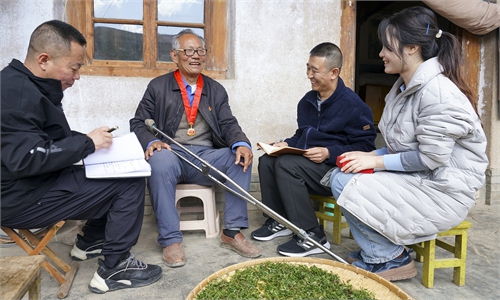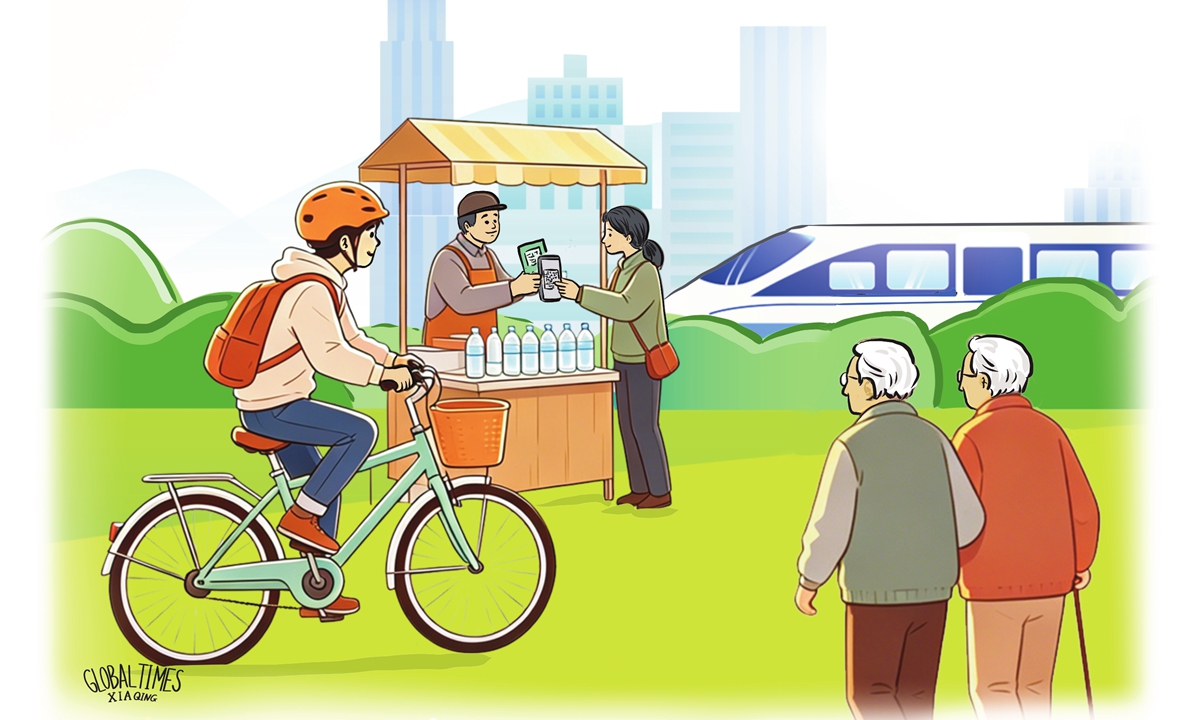
Illustration: Xia Qing/GT
Editor's Note:For many foreign observers, China's daily landscape presents a series of fascinating phenomena. In this special commentary series, "The Logic of Chinese Governance through Daily Life," we address three core inquiries about China frequently raised by the international community: Where does Chinese people's trust in the government come from? How is the baseline of social welfare secured? And how is social order maintained from bottom up? Through the eyes of expats living in China, this series aims to explore the "ground reality" of Chinese governance.
By Adel Baktygulova
There is no universal approach or theory on good governance in the world. Each country has its own unique governing system, and China's governance model is particularly special. First, over China's thousands of years of history, the country has experienced varied types of governance models and has developed the most optimal one for its unique conditions. Second, the population of China is more than 1.4 billion encompassing 56 ethnic groups; therefore, it's about how to consolidate people with different backgrounds and beliefs in order to make a country more prosperous and each and every citizen wealthier.
"When the Master governs, the people are hardly aware that he exists." These words from Laozi capture a philosophy of governance that prioritizes quiet effectiveness over constant political spectacle. This ancient idea helps explain a modern question: Why does the Chinese populace have a high degree of trust in its government?
Trust is rarely built through rhetoric alone. It develops through consistent results over time. The repeated positive outcomes tend to strengthen public confidence. For many citizens, trust is shaped more by visible improvements in daily life than by political discourse. China's poverty alleviation campaign lifted nearly 100 million people out of poverty between 2012 and 2020. The country has built more than 40,000 kilometers of high-speed rail in over a decade, transforming travel and connectivity. Life expectancy has risen from 64 years in 1980 to over 78 years today, while air quality in major cities such as Beijing has steadily improved over the past decade. These are changes that people can see and experience in their everyday lives. When such improvements accumulate over time, confidence in governance naturally grows.
I have been living in China for nearly four years, and these improvements are visible in my daily life too. Traveling across different regions of China, I see the scale of infrastructure development and regional connectivity that supports domestic development. Many aspects of public life are designed with convenience and accessibility in mind, allowing people to experience the benefits of development. Such everyday experiences help explain why effective governance resonates with many citizens and contributes to public confidence.
Like any major country, China faces challenges. Yet public confidence has remained resilient in part because many people have witnessed the government's ability to address previous challenges and adapt to changing circumstances.
Trust is based on the expectation that problems can be managed and resolved effectively. This confidence also creates the conditions for long-term planning. Major initiatives, from successive five-year plans to large-scale infrastructure and development projects, are often viewed as part of a broader national development strategy. Confidence built through previous achievements helps sustain public support for future goals. In this way, a reinforcing cycle emerges: Effective governance strengthens public trust, while public trust provides the stability needed to pursue long-term objectives.
Each of these achievements has required not only policy design but also effective implementation. A government that consistently delivers on its commitments develops a reputation for credibility. In Western political theory, checks and balances are often regarded as the primary mechanism for ensuring government accountability and public trust. The Chinese experience suggests that effective governance can also be a powerful source of public trust. When people see concrete improvements in their lives, confidence in public institutions becomes a practical conclusion drawn from experience.
As Laozi observed more than 2,000 years ago, the most effective governance is often felt through its results rather than its visibility. In contemporary China, public trust has been shaped not by grand promises alone, but by the cumulative impact of policies that have transformed everyday life. When governance is measured by its ability to solve problems and improve people's well-being, trust becomes less a matter of political theory and more a reflection of lived reality.
The author is a Kyrgyz undergraduate student at Tsinghua University. opinion@globaltimes.com.cn
RELATED ARTICLES