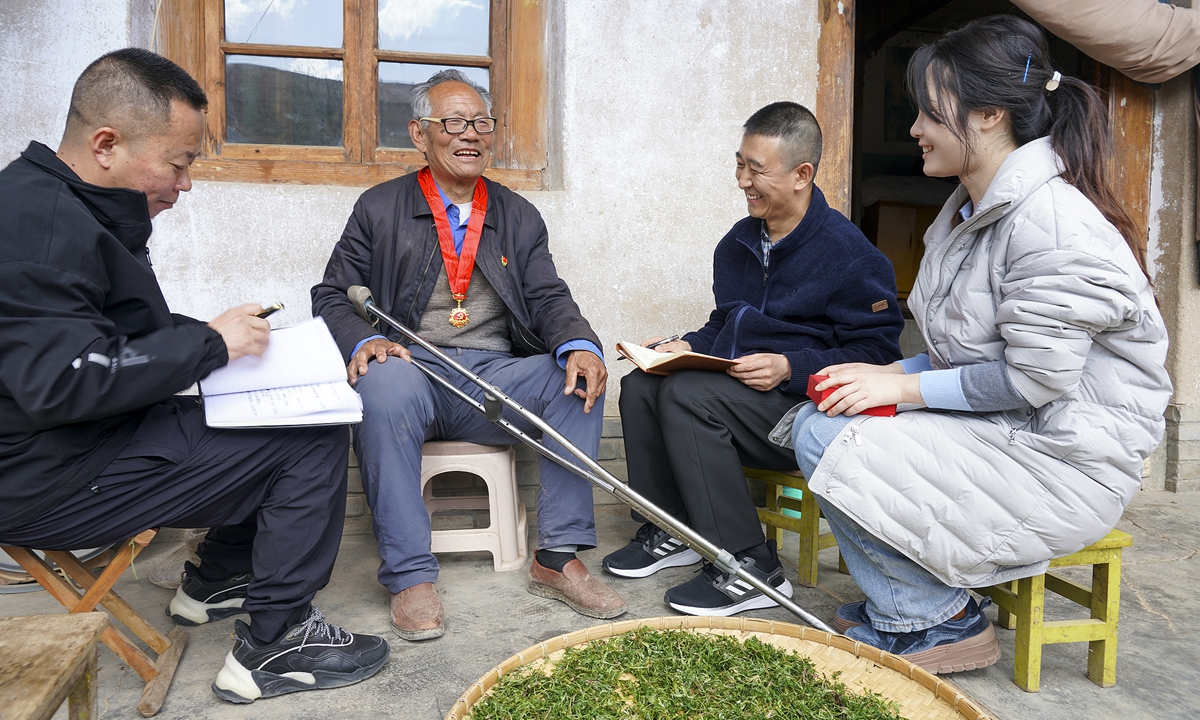
A veteran Party member and younger Party officials exchange ideas on what constitutes a correct understanding of governance performance amid changing historical contexts in Jichuan town, Northwest China's Gansu Province on March 31, 2026. Photo: VCG
Editor's Note:What does it mean to govern well and how should governance performance be gauged? The answer from the Communist Party of China (CPC) is that a correct understanding of governance performance should proceed from reality, respect objective laws and, through sound decision-making and hard work, create achievements that withstand the test of practice and history, truly benefit the people and earn public recognition. To examine the distinctive logic and global relevance of the CPC's correct understanding of governance performance, the Global Times (GT) launches a new series, "Understanding the correct view on governance performance," and invites leading international observers to share their thoughts on these issues.
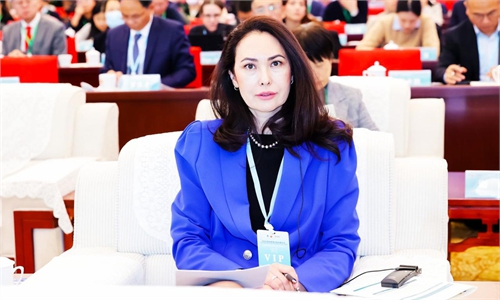
In the fifth installment of the series, Ko Ko Hlaing (Hlaing), former chief political adviser to the Office of the President of Myanmar, shared with GT reporter Ma Ruiqian his views on a long-term perspective on governance performance, saying that while the set goal must be steadfastly upheld, review and evaluation processes are indispensable in long-term policy implementation.
GT: The concept of a long-term perspective on governance performance is reflected in President Xi Jinping's emphasis on "following a good blueprint." "As practice evolves continuously, our thoughts and work should keep up with the changing times, and when we are absolutely sure, we can make adjustments and improvements in good time," he said. In your view, how does this emphasis on balancing policy continuity with pragmatic adjustments support the long-term approach to governance performance?
Hlaing: I totally agree with the Chinese leader's words on policy consistency and implementation realignment. The set goal must be steadfastly upheld, and the objectives must remain fixed in order to achieve long-term success. Policies are drawn based on the set goal and fixed objectives after situational analysis has been done. Then the phases of planning and implementation follow.
Nevertheless, as circumstances are likely to change, review and evaluation processes are indispensable in policy implementation.
It is essential to take a practical perspective to be successful. This is because there are always possibilities for manipulated or over-decorated information from bureaucrats eager to appease their superiors. Without seeking truth and understanding the real situation on the ground, no leader would be able to make the right policy decisions and achieve effective implementation.
A shift in leadership should not derail the overall direction, and a hollow performance show for personal fame should not be allowed to spoil the whole plan. The crucial consideration in this matter is that one should not be too dogmatic in maintaining a constant direction throughout the process, while at the same time, one should not fluctuate unnecessarily. A smart driver always knows the right time to readjust the course.
GT: In your view, how does this long-term perspective highlight the importance of the people in governance performance?
Hlaing: The CPC has the largest number of members, while still possessing significant public support. Throughout its history, the Party's commitment to selfless dedication and efforts for the benefit of the people has been proven by its members' courageous sacrifices and unwavering service to the country and the people, serving as the vanguard of every great movement from the Long March in the 1930s to the Chinese Dream of national rejuvenation in the 21st century.
During my visit to a rural village in Southwest China's Yunnan Province, I found the residents enjoying prosperous livelihoods thanks to successful coffee plantations. When I asked them who had facilitated the village's development, they were quick to answer, "the Party officials." "They are members of the CPC, and they have to serve for the benefit of the people. It is their duty," said the villagers. That reflects the people's trust in and affinity with the Party, which is a key element of the CPC's lasting achievements.
GT: 2026 marks the beginning of China's 15th Five-Year Plan (2026-30). What significance does establishing and practicing a correct understanding of governance performance hold for achieving the main goals of economic and social development during the 15th Five-Year Plan period?
Hlaing: The 15th Five-Year Plan is quite significant for China, as the whole world is facing a new global disorder. While international laws and practices are being neglected and abused by power politics, global trade and commerce have come under attack. Global energy security is also under threat. In light of this, China may need even greater governance performance management to achieve its development goals.
More innovative approaches and new technologies applying modern generative AI will be a path toward securing technological advantages, while expanding the green energy sector will help ensure the nation's energy security. At the same time, effective and cordial diplomatic relations with friendly countries across the world should be promoted as much as possible to secure strategic partnerships and economic cooperation. While social welfare and the economic well-being of the people are crucial for political stability, defense capability must also be strengthened to protect the nation's vital interests, sovereignty and territorial integrity.
All these sectors depend upon effective and correct governance performance, as well as strong and visionary leadership. Under the brilliant leadership of the CPC, I am truly convinced that China will be able to stay on the right path of sustainable development.
GT: By incorporating ecological protection into governance performance evaluations, China has emphasized a long-term view of development rather than pursuing short-term economic gains. What lessons can other countries draw from this approach?
Hlaing: In the age of climate change, ecological protection is crucial to the development path of every nation. China has emerged as a leading responsible actor in environmental advancement.
I have traveled to many cities across China. I found there are a number of cities that are carrying out green projects and implementing green development policies. As for the country as a whole, its ambitious commitment to achieving carbon neutrality is truly commendable. China is a leading country in producing EVs and EV batteries, solar panels, wind power facilities and various green technology projects.
China's experience in raising environmental awareness has not been easy or comfortable. It faced serious air pollution problems in the past due to its reliance on coal-powered energy. China has successfully overcome this hard-won challenge through firm commitment and unwavering efforts. It is highly impressive and a wonderful success story for developing countries to learn from.
GT: What other aspects of the CPC's correct understanding of governance performance could offer for your country's modernization efforts?
Hlaing: "Adapting to local conditions" is quite distinct. For instance, Myanmar is a developing economy based on agriculture. The majority of people are small-scale farmers with limited technological know-how. In the age of AI, it is a sad reality that a less developed economy like Myanmar cannot afford to obtain a comprehensive digital industry. Nevertheless, Myanmar can carry out an agricultural modernization campaign to develop the agriculture-based industry by applying modern technologies with the assistance of AI in accordance with local conditions.
RELATED ARTICLES