Translators' Voices: China’s emphasis on a correct understanding of governance performance is of particular value for Global South countries
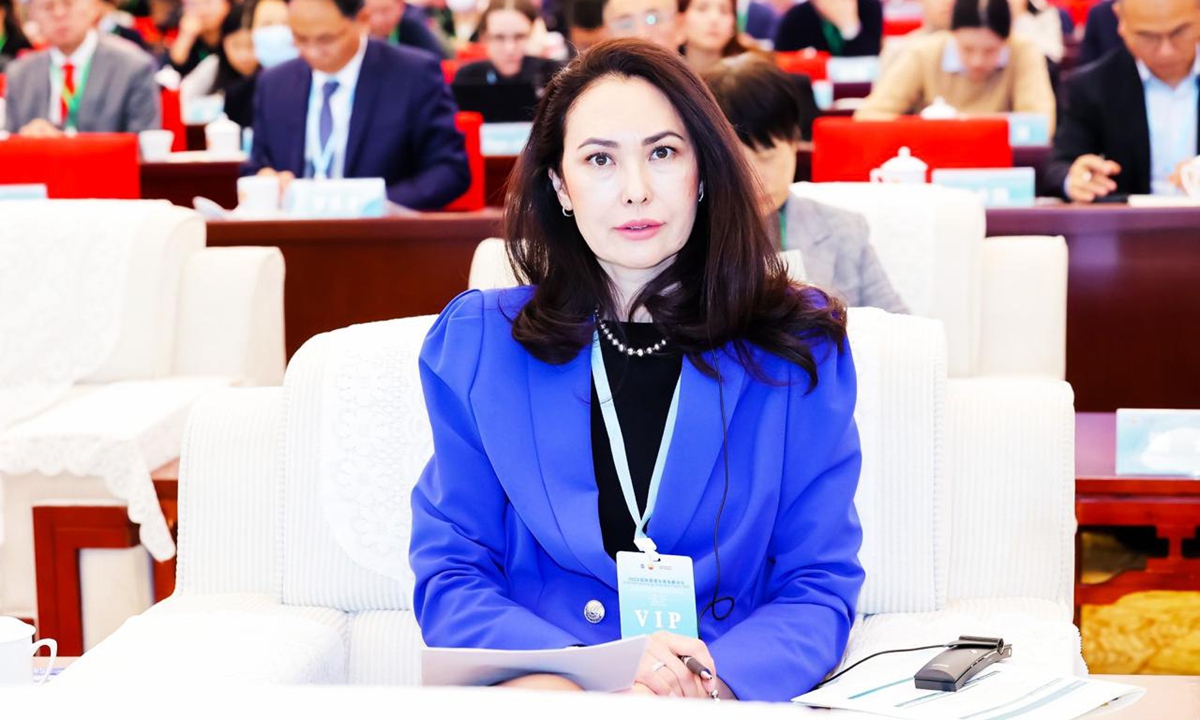
Gulnar Shaimergenova Photo: Courtesy of Shaimergenova
Editor's Note:
"A correct understanding of governance performance requires us to proceed from reality, respect objective laws, and through sound decision-making and hard work, create achievements that withstand the test of practice and history, truly benefit the people, and earn public recognition," President Xi Jinping, also general secretary of the Communist Party of China (CPC) Central Committee and chairman of the Central Military Commission, stressed at the opening of a study session for principal officials at the provincial and ministerial levels in January 2026.
At this crucial juncture marking the beginning of the 15th Five-Year Plan period (2026-30), President Xi has issued a call to action, encouraging officials at all levels to further establish and practice a correct understanding of governance performance, and to strive to achieve new accomplishments worthy of the time.
Since the 18th National Congress of the Communist Party of China (CPC), President Xi has made a series of remarks on the important issue of establishing and practicing a correct understanding of governance performance on various occasions. In the article "Continue the Great Historic Struggle" included in Volume III of Xi Jinping: The Governance of China, President Xi stressed that CPC Central Committee members and principal officials at the provincial and ministerial levels "must develop a stronger sense of responsibility, adopt a correct view of their achievements, seek truth, and be down to earth. They should work tenaciously to be truly responsible to history and the people."
An article by President Xi on establishing and practicing a correct understanding of governance performance, which was published in the Qiushi Journal on April 1, stressed that the view on governance performance is a fundamental issue. The article calls for efforts to proceed from reality, act in accordance with the laws, and deliver results that can stand the test of practice and history, truly benefit the people, and earn public recognition through sound decision-making and solid work.
In the 23rd installment of the special series "Decoding the Book Xi Jinping: The Governance of China," the Global Times (GT), along with the People's Daily Overseas Edition, continues to invite Chinese and foreign scholars, translators of Xi's works, practitioners with firsthand experience, and international readers to explore the profound ideological essence, practical value, and global significance of establishing and practicing a correct understanding of governance performance.
In the 23rd article of the "Translators' Voices" column, Global Times reporters Ma Ruiqian and Xia Wenxin interviewed Gulnar Shaimergenova (Shaimergenova), director of the China Studies Center in Kazakhstan. Shaimergenova was a member of the translation team of the Kazakh editions of Xi Jinping: The Governance of China.
GT: Chinese President Xi Jinping has repeatedly pointed out that communists must bear in mind that working for the people's well-being is their greatest political achievement. In Volume III of Xi Jinping: The Governance of China, Xi also made a similar statement: "I will fully commit to the people and never fail them." Based on your knowledge, could you tell us how the Party puts this view of governance performance into practice?
Shaimergenova: The thesis of President Xi that working for the people's well-being is the greatest political achievement finds its most concrete expression in the practical activities of the state and the Party, which are increasingly focused on improving the quality of life rather than solely pursuing macroeconomic growth. China's development model demonstrates a steady shift from purely quantitative indicators to comprehensive social objectives. An important mechanism for serving the people is the continuous adjustment of policies based on practical experience, ensuring flexibility and responsiveness in governance.
From Kazakhstan's perspective, it is particularly noteworthy that China is building a long-term strategy of "investing in people," strengthening the social orientation of fiscal policy and supporting domestic demand as a key driver of sustainable growth. China's practice of "development for the people" and Kazakhstan's course toward building a fair, socially oriented state demonstrate a significant convergence in values. Their synergy creates a solid foundation for further deepening the bilateral strategic partnership, with the individual as the central beneficiary of public policy.
GT: Volume V of Xi Jinping: The Governance of China includes a special section dedicated to the call for developing new quality productive forces for high-quality development, emphasizing the need to "adapt to local conditions." As countries in the Global South generally face transformations in their industrial systems, what insights do you believe this performance-oriented approach of "adapting to local conditions" offers for other countries' modernization efforts?
Shaimergenova: The approach of President Xi to new quality productive forces, based on a careful consideration of local conditions, is of particular value for countries of the Global South undergoing the transformations in their industrial systems. China's experience demonstrates that the formation of new growth drivers: the digital economy, high technologies, and "smart" industry - does not require abandoning traditional sectors, but rather their deep modernization, improved energy efficiency, and higher environmental standards. Across different regions of China, priorities vary. Such a differentiated approach reduces the risks of unsuccessful "trendy" projects and contributes to more sustainable development.
For countries of the Global South, China's experience confirms that the strategic objective is not the mechanical copying of external models, but the construction of a country's own growth architecture based on real capabilities and partnerships.
GT: In Volume I of Xi Jinping: The Governance of China, in a speech calling for following a good blueprint through to the end, President Xi stated: "As practice evolves continuously, our thoughts and work should keep up with the changing times." Do you believe that this approach to evaluating governance achievements offers universal lessons for maintaining governance stability and promoting long-term development?
Shaimergenova: China's practice demonstrates that sustainable development is ensured not through frequent shifts in fundamental priorities, but rather through maintaining a long-term course while timely adjusting the mechanisms of its implementation. Five-year plans, strategic programs, and long-term goals in China form a solid framework for development that is not subject to short-term fluctuations and does not change with shifts in specific managerial emphases. This creates a key condition for society, business, and international partners - predictability. At the same time, within this framework, the Chinese leadership emphasizes the need to "keep pace with the times," promptly adapting regulatory, social, technological, and economic instruments to new internal and external challenges. Such a model allows China to avoid disruptive political "zigzags" while also preventing governance from becoming dogmatic.
In this sense, the combination of policy continuity, program-based planning, and pragmatic policy adjustment represents an important principle applicable across diverse political systems.
GT: President Xi has pointed out the importance of concrete actions in achieving governance achievements. In Volume III of Xi Jinping: The Governance of China, President Xi also repeatedly emphasized the need to "enforce implementation." How do you understand the importance of "enforcing implementation" to performance evaluation in national governance?
Shaimergenova: The emphasis by President Xi on "enforcing implementation" of decisions, as well as on combating formalism and bureaucratism, is one of the key factors behind the successful implementation of reforms in China. A well-formulated strategic vision alone does not guarantee results if, at the regional and governmental levels, reporting for the sake of reporting, embellishment of indicators, and detachment from the real needs of the population prevail. China's practice demonstrates that a performance evaluation system for officials - taking into account socio-economic outcomes, environmental quality and the level of public satisfaction - becomes an effective tool against formalism and bureaucratism.
For Kazakhstan, this approach is equally relevant. China's experience of "enforcing implementation" and Kazakhstan's course toward practical effectiveness complement each other, creating a favorable foundation for joint projects where the key criterion of success is real socio-economic impact rather than the number of signed documents.
GT: President Xi emphasizes the need to properly balance the relationship between development and environmental protection to uphold a correct understanding of government performance. Volume II of Xi Jinping: The Governance of China provides a detailed discussion on advancing ecological civilization. In your view, what development insights does this practice offer to other countries?
Shaimergenova: China demonstrates that sustainable development is impossible without taking into account environmental constraints and the quality of the living environment, and that economic growth must be accompanied by reduced emissions, the development of clean energy and improvements in environmental infrastructure. For Kazakhstan, such an approach is highly relevant, given the country's significant environmental challenges - from vulnerability to climate change to the legacy of industrial development. The alignment between the Chinese model and Kazakhstan creates a favorable basis for the development of green cooperation. For other countries, this experience demonstrates that a well-balanced combination of development and environmental protection does not hinder growth; on the contrary, it opens new sources of economic expansion, fostering green markets and fundamentally higher standards of living.
GT: This year marks the beginning of the 15th Five-Year Plan (2026-30). What significance does establishing and practicing a correct understanding of governance performance hold for achieving the main goals of economic and social development during the 15th Five-Year Plan period?
Shaimergenova: As the implementation of China's 15th Five-Year Plan gets underway, the importance of establishing a correct understanding of governance performance has become increasingly evident. The achievement of new socio-economic goals increasingly depends not only on growth rates, but on the quality, inclusiveness and sustainability of that growth. This approach enhances the resilience of domestic development while reinforcing China's role as one of the key drivers of the global economy, as well as a major source of investment, technology, and demand for partner countries. Cooperation with China is viewed as a mutually beneficial process that contributes to achieving these national priorities.
RELATED ARTICLES