US smears China’s Huangyan Dao nature reserve amid Philippine provocations; Washington’s verbal backing offers no real support, fuels tensions: expert
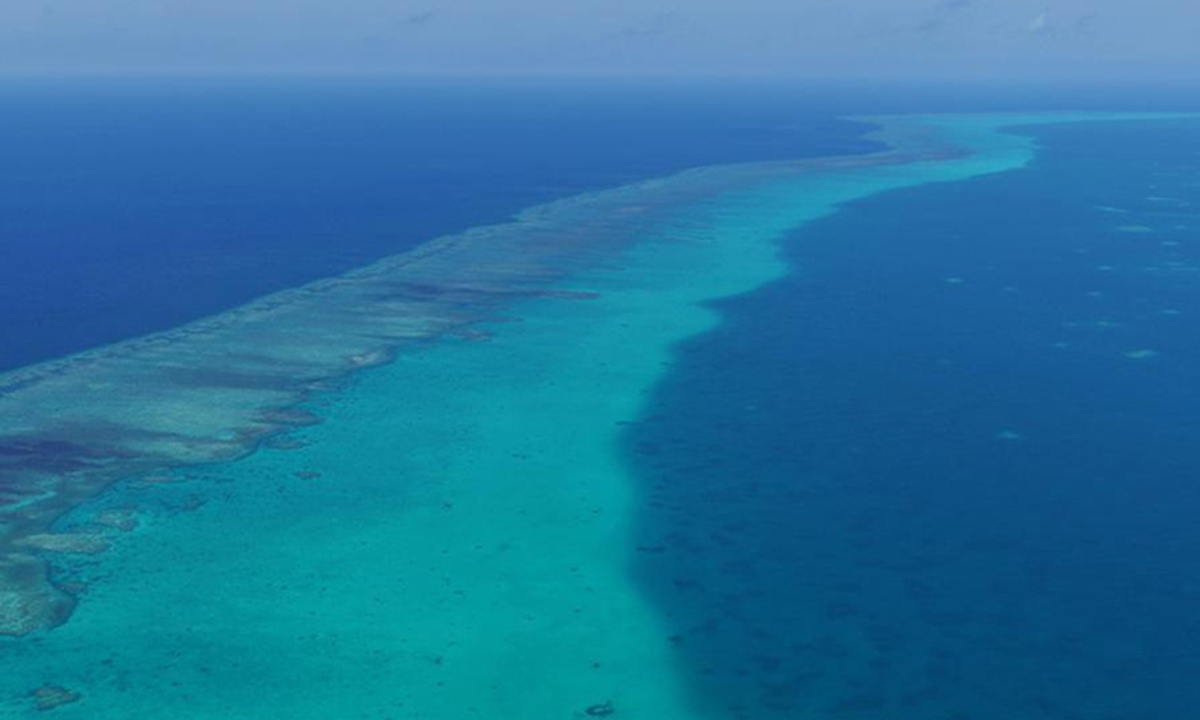
An aerial drone photo taken on May 2, 2026 shows reefs in the territorial waters of China's Huangyan Dao in the South China Sea. Photo: Xinhua
Amid a new round of Philippine hype over its so-called territorial claims involving China's Huangyan Dao, the US State Department on Saturday, in a statement, smeared China's Huangyan Dao National Nature Reserve as "destabilizing" and pledged support for its ally. A Chinese expert said Washington is encouraging Manila to disrupt regional peace while offering little more than hollow verbal assurances, further undermining stability in the South China Sea.
The statement, published on the State Department's official website and attributed to spokesperson Thomas Pigott, claimed that the US "rejects China's ongoing attempts to enforce its destabilizing 'national nature reserve'" at Huangyan Dao.
Pigott also alleged that the reserve would "deny Filipino fishermen access to their traditional fishing ground as reflected in the 2016 Arbitral Award."
It is absurd for the US, a country that is not a party to the United Nations Convention on the Law of the Sea (UNCLOS), to pass judgment on the Huangyan Dao National Nature Reserve, Yang Xiao, a research fellow at the Institute of Peaceful Development under the Chinese Academy of Social Sciences, told the Global Times on Sunday.
The US has neither jurisdiction in the South China Sea nor the standing to judge regional affairs. Its allegation of the reserve at this time is merely intended to echo the Philippines' latest hype surrounding Huangyan Dao, Yang said.
At a time when the broader China-US relationship is moving toward an easing of tensions, attempts by certain US officials to encourage provocations out of narrow political interests run counter to the overall trend, Yang said.
Pigott further smeared the reserve as "another unilateral attempt by China to use dubious environmental and legal pretexts," which he claimed was intended to advance China's territorial and maritime claims in the South China Sea "at the expense of its neighbors."
"The United States stands with our Ally, the Philippines, in support of a free and open Indo-Pacific," Pigott claimed.
The expert added that the statement also invoked the unlawful and invalid 2016 "South China Sea Arbitral Award" as a pretext, seeking to portray China as a destabilizing force in the region and mislead the international community.
The US statement comes as Manila has sought to advance its claims over Huangyan Dao through various means, including by delimitation of the so-called "baselines of the territorial sea" of the Chinese territory of Huangyan Dao. The Chinese Foreign Ministry on July 31 described the move as "illegal, null and void."
Yang said that amid a broader retrenchment of its global strategy, the US is seeking to encourage countries including Japan and the Philippines to stage regional provocations and disrupt stability. Such tactics include organizing joint military exercises and tolerating provocative actions by Manila in the South China Sea.
However, Washington is no longer capable of offering the Philippines substantive support and can provide little more than rhetorical backing, Yang said. Such statements amount to words on paper and have no practical effect, he added.
China's State Council approved the establishment of the Huangyan Dao National Nature Reserve in September 2025. China has since conducted multiple scientific surveys in the area.
On August 1, China issued management measures for the reserve, prohibiting unauthorized fishing and mining, the harvesting or excavation of corals, coral reefs and giant clams, as well as other activities that damage rare marine species or the reserve's natural ecosystems.
China has also discovered a globally rare coral reef growth structure-type marine blue hole at Huangyan Dao. Preliminary geochronological analyses suggest that the blue hole formed at least 3,200 years ago, while surveys have found rich biodiversity in its surrounding waters. The finding is considered further evidence of the effectiveness and necessity of China's ecological protection measures at Huangyan Dao.
RELATED ARTICLES