'Decoding the Book of Xi Jinping: The Governance of China' 27th installment: Striving for greater strength and self-reliance in science and technology
Photo: Global Times
Editor's Note:
Ahead of the opening of the 2026 World AI Conference and High-Level Meeting on Global AI Governance, Chinese AI start-up Moonshot AI released its Kimi K3 large language model. As the world's largest open-source model by parameter count to date, this launch marks a significant step forward in the development of China's artificial intelligence models.
From the C919 airliner soaring into the skies to Unitree's humanoid robots stealing the show; from DeepSeek pushing the AI frontier to Moonshot AI's landmark unveiling of Kimi K3 - China's wave of homegrown innovations has dominated global headlines in recent years, delivering a steady stream of breakthroughs.
At a meeting in Beijing that brought together the national science and technology award conference, the general assemblies of the members of the Chinese Academy of Sciences (CAS) and the Chinese Academy of Engineering (CAE), and the 11th national congress of the China Association for Science and Technology in July, Chinese President Xi Jinping, also general secretary of the Communist Party of China (CPC) Central Committee and chairman of the Central Military Commission, stressed that the 15th Five-Year Plan period (2026-2030) is a critical phase for tackling tough challenges in building up the country's strength in science and technology.
"We must seize the historic opportunity, rise to the challenges of the times, accelerate efforts to achieve high-level self-reliance and strength in science and technology, and make steady progress toward the 2035 goal of becoming a leading country in science and technology," he said.
In the article "Strive for Greater Strength and Self-Reliance in Science and Technology" included in the fourth volume of Xi Jinping: The Governance of China, Xi pointed out, "Through years of endeavor, our country's overall strength in science and technology has improved substantially. We therefore have a solid foundation, and are fully confident in our ability to seize the opportunities offered by the new revolution in science, technology and industry to achieve greater results." The article also mentioned that "We should participate to the full in global science and technology governance, contribute Chinese wisdom, and shape a philosophy of technology for good purposes, so that science and technology better serve human wellbeing, and enable China's science and technology industry to contribute more to building a global community of shared future."
In the 27th installment of the special series "Decoding the Book Xi Jinping: The Governance of China," the Global Times, along with the People's Daily Overseas Edition, continues to invite Chinese and foreign scholars, translators of Xi's works, practitioners with firsthand experience, and international readers to focus on the theme of striving for greater strength and self-reliance in science and technology. Together, they share views on China's tech growth, governance principles, and global cooperation in science and technology.
Here are the stories:
1. Readers’ Reflections: China’s innovation success is real global news, landing in the living rooms of Italian retirees who barely use a smartphone: Italian scientist
2. Practitioners' Insights: How did a decade of dedicated effort build China a self-reliant 'digital track'?
3. Translators’ Voices: China's pursuit of strength and self-reliance in science and technology presents an inspiring path
4. Scholars’ Perspectives: National support, optimized evaluation allow young talent to pursue long-term breakthroughs: researcher
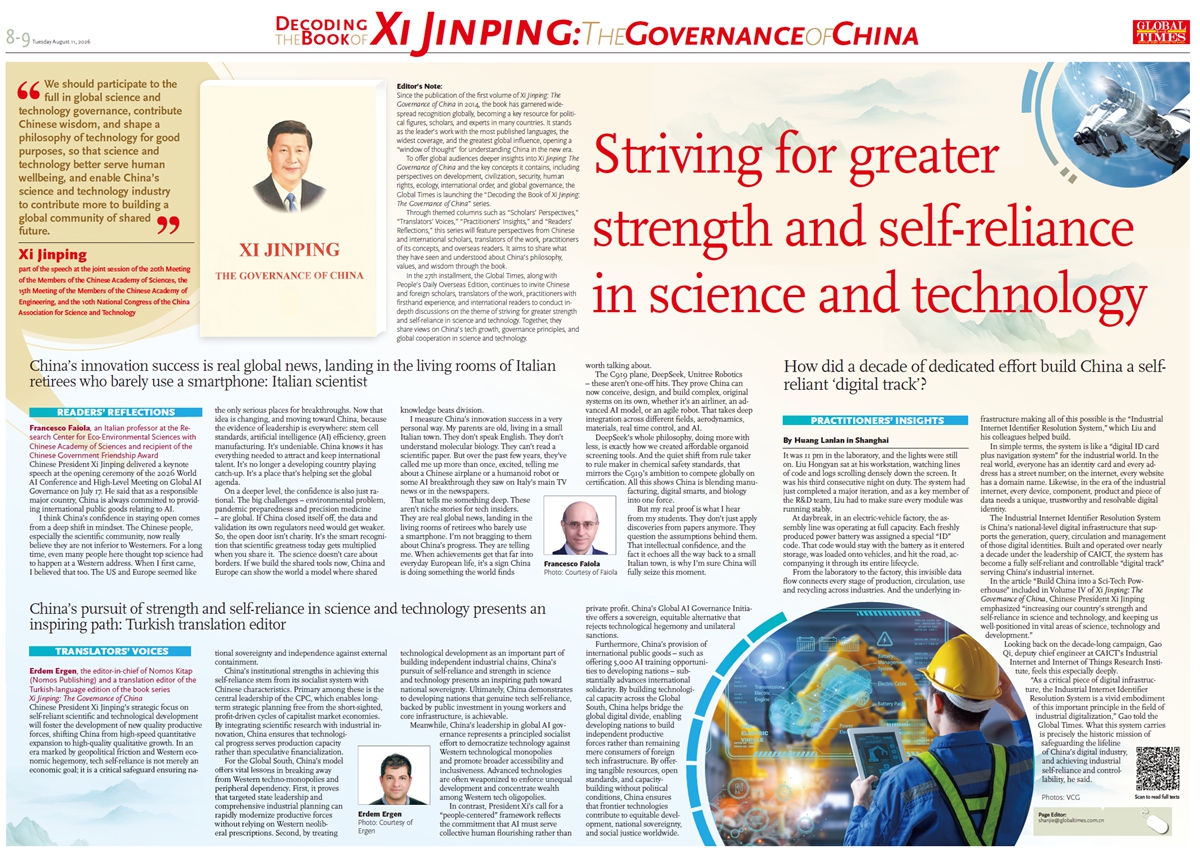
Photo: Global Times
