This trend is more worthy of attention than Unitree Robotics going public: Global Times editorial
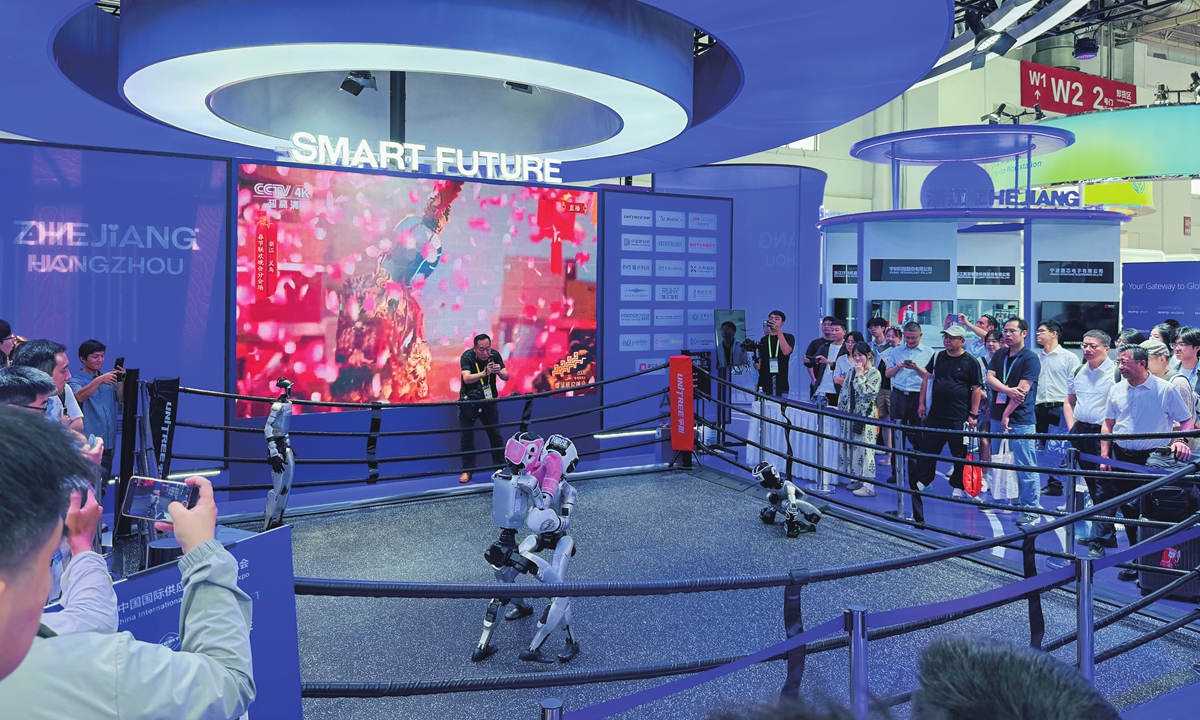
Visitors watch two humanoid robots from Unitree Robotics engage in a boxing match at the 4th China International Supply Chain Expo in Beijing on June 24, 2026. Photo: Chi Jingyi/GT
In the past, the value of technology companies worldwide was often assessed by Wall Street analysts using US companies as benchmarks. Today, however, Chinese investors are developing their own valuation benchmarks based on independent assessments of the long-term prospects of the humanoid robotics market. China is no longer merely accepting valuations set by others, but is beginning to define the value of technology itself. This means that the global valuation system for technology assets is evolving from a unipolar model toward a multipolar one.
On Monday, Unitree Robotics officially opened subscriptions for its initial public offering (IPO), signaling the imminent arrival of the first "humanoid robot stock" on the A-share market. With an issue price of 150.8 yuan ($22), a market capitalization of approximately 61 billion yuan, projected proceeds of 6.099 billion yuan, and a price-to-earnings (P/E) ratio of 219.23, this IPO transcends the typical scope of a corporate listing. The New York Times, citing analysts who described the offering as a bellwether for how capital markets view humanoid robotics, described it as a technology "that wows but has yet to prove its viability."
For a long time, people judged the prospects of a new technology or the visionary potential of a tech company based on whether it could enter Silicon Valley, list on the Nasdaq, or gain valuation recognition from Wall Street. For many tech entrepreneurs, the dream path was to ring the opening bell at the Nasdaq. The flow of global tech capital was essentially a one-way street "looking West."
Today, however, the world is shifting its gaze from West to East. While Chinese tech companies once went to Nasdaq to have the world set their market value, the world now increasingly looks to China's capital markets to gauge the direction of the next wave of technological innovation. Whether it is ChangXin Memory Technologies or Unitree Robotics, the fact that they go public reflects that China's capital markets are evolving into hubs for "value discovery" regarding cutting-edge global technologies.
With the successive market debuts of companies like Changxin Memory Technology and Unitree Robotics, a previously inconspicuous industrial chain is becoming increasingly complete: China is not only ramping up investment in R&D but also forging an innovation loop that links research, engineering, manufacturing, application, and capital. In the first half of 2026, total financing in the domestic embodied AI sector reached 93.5 billion yuan, an increase of more than fivefold compared to the same period last year. Nearly 370 startups have emerged in this field over the past two years.
Meanwhile, investor preferences are shifting: In the first half of this year, companies focused primarily on robot hardware manufacturing raised 5.6 billion yuan, accounting for 12.8 percent of the industry's total financing; instead, capital is increasingly flowing toward chips, vision solutions, and application areas - such as industrial manufacturing, warehousing and logistics, and medical rehabilitation - that can generate revenue more quickly. In this sense, China is no longer merely accepting valuations set by others, it is beginning to define the value of technology itself.
What has driven this shift is the substantial rise in China's technological competitiveness. In the past, Chinese companies' strengths were largely concentrated in application-level innovation and the replication of business models, while they remained dependent on others for core technologies. As a result, pricing power naturally rested elsewhere.
Today, from memory chips to humanoid robots, and from large AI models to commercial spaceflight, a growing number of Chinese companies have not only achieved technological breakthroughs but have also built highly autonomous supply chains. Unitree Robotics develops key components such as joint motors, reducers and controllers in-house, with more than 90 percent of its supply chain localized in China. ChangXin Memory Technologies, meanwhile, has developed mass-production capabilities in dynamic random-access memory (DRAM) that are already reshaping the global market landscape. As technological self-reliance becomes a reality, China's domestic capital market now has a basis for assigning reasonable valuations to these companies, without having to rely on the "validation" of overseas exchanges.
The more profound impact of this shift is that it is helping move the global valuation system for technology assets from a unipolar model toward a multipolar one. In the past, the value of technology companies worldwide was often assessed by Wall Street analysts using US companies as benchmarks. Today, however, companies such as Unitree have few, if any, comparable publicly listed peers anywhere in the world. Chinese investors are developing their own valuation benchmarks based on independent assessments of the long-term prospects of the humanoid robotics market. Once such pricing autonomy becomes firmly established, it will reshape the logic governing global capital flows.
Of course, humanoid robots still have a long way to go before achieving large-scale commercial adoption. Further breakthroughs are needed in technological maturity, cost control, safety and reliability, and the expansion of application scenarios. No emerging technology develops overnight, and capital markets must also remain rational, recognizing long-term value while respecting the underlying dynamics of industrial development. Yet it's evident that the move by a Chinese robotics company toward the capital market is itself an important development for global technology watchers. What it reflects is not merely the growth of a single company, but the broader evolution and maturation of China's technology innovation ecosystem.
A truly competitive innovation system must not only be capable of following the direction of global technological change, but also capable of becoming a place where the world looks to determine that direction. It must not only produce new technologies, but also gradually develop the ability to identify their value and shape expectations for emerging industries.
When the world begins looking to Chinese laboratories for achievements, Chinese factories for products, and Chinese capital markets for signals about where technology is headed, the transformation taking place in China's technology innovation system may be far more significant than the IPO.
RELATED ARTICLES