Unitree Robotics IPO sparks investor frenzy as policy support fuels capital rush, with sector’s future value tied to continued commercialization
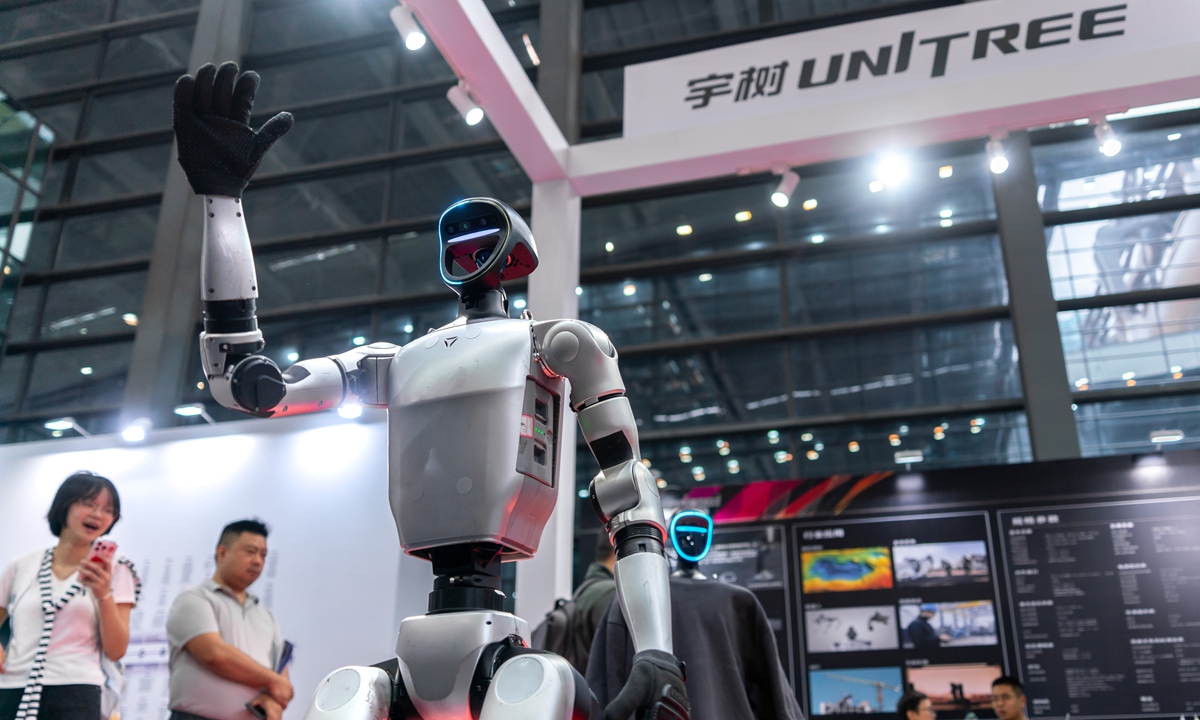
Unitree Robotics' humanoid robot is displayed at the 14th China Information Technology Expo in Shenzhen, South China's Guangdong Province, on April 10, 2026. Photo: VCG
With just one day to go before Chinese humanoid robotics pioneer Unitree Robotics opens subscriptions for its initial public offering (IPO) on Shanghai's STAR Market, investor attention has extended far beyond the company itself, highlighting a broader capital-market rush into embodied intelligence as the sector moves from technological breakthroughs toward commercialization.
As of press time, discussions surrounding the IPO have pushed the topic to the top of trending lists across multiple stock trading platforms. The debate has focused on Unitree Robotics' disclosed short-term financial performance, as well as the potential opportunities for investors from China's policy push to include embodied intelligence and humanoid robots among key areas of medium- and long-term technology and industrial development.
Experts said the wave of IPOs among robotics companies, including Unitree Robotics, represents a shift that allows robot makers to engage more directly with public markets and investors. It also brings companies at different stages of development and pursuing different technological paths into a common valuation framework, promoting market comparisons and competition.
At the same time, the capital-market boom is likely to accelerate a shakeout, separating companies capable of building sustainable business models from those that struggle to turn technological advances into commercial returns.
On Thursday, Unitree Robotics released its announcement on the IPO of shares and listing on the STAR Market. According to the announcement, the offering price was set at 150.80 yuan per share, valuing the company at approximately 61 billion yuan ($9.04 billion) upon listing.
Secondary-market professionals told the Global Times that demand for Unitree Robotics' IPO subscription could be extremely high, meaning the chances of individual investors securing shares are likely to be very limited.
Robotics is currently one of the few categories that can translate AI capabilities into tangible assets with relatively comparable valuation metrics, creating a unique advantage in valuation narratives. This scarcity is one of the key factors drawing the attention of both large and small investors, Tian Feng, former dean of SenseTime's Intelligence Industry Research Institute, told the Global Times on Sunday.
Unlike large language model companies, whose capabilities are often assessed through benchmarks and demonstrations that are difficult for ordinary secondary-market investors to directly evaluate, robots offer visible and verifiable evidence through tasks such as grasping, walking and dexterous manipulation, Tian said. This tangible demonstration of "embodied" intelligence naturally creates a valuation premium in market narratives, he added.
Tian cautioned that extreme subscription figures, such as RobotHoenix's 14,855-fold oversubscription on its listing and LDRobot's 127.62 percent first-day share price surge, were driven by a combination of institutional advantages and sector scarcity rather than serving as evidence of the commercial validation of robotics products. He noted that there is no direct correlation between oversubscription multiples and the certainty of product deliveries or commercialization prospects.
Beyond Unitree Robotics, a broader financing boom in China's robotics industry has also gained significant momentum, with the Hong Kong Stock Exchange emerging as the main battleground for this latest IPO wave.
Citing industry data provider Wind, the China STAR Market reported that five robotics-related companies have gone public in Hong Kong so far in 2026. Meanwhile, 51 companies with businesses spanning industrial robots, service robots and embodied intelligence solutions are currently in the IPO pipeline in Hong Kong, accounting for 12.7 percent of all companies awaiting listing.
According to data from IT industry research platform ITjuzi.com, financing in China's embodied intelligence sector totaled 93.5 billion yuan in the first half of 2026, surpassing 90 billion yuan and marking a fivefold increase from the same period in 2025. The number of financing deals reached 322, up 137 percent year-on-year.
Tian said that while policy support and clearer commercialization pathways are boosting confidence in the sector, the latest IPO wave should also be viewed through a more cautious lens. The surge comes partly as the primary market's ability to continue funding embodied intelligence companies faces limits, prompting firms to seek new liquidity channels through public markets, rather than solely reflecting a dramatic leap in industrial maturity.
As emerging technology sectors increasingly become the focus of public attention, more objective and professional analysis is also needed to help investors assess companies' technological capabilities, commercialization prospects and long-term value, rather than simply following market enthusiasm, Chinese experts noted.
RELATED ARTICLES