Chinese researchers develop new lithium battery withstanding - 40 C with both long endurance and explosive strength
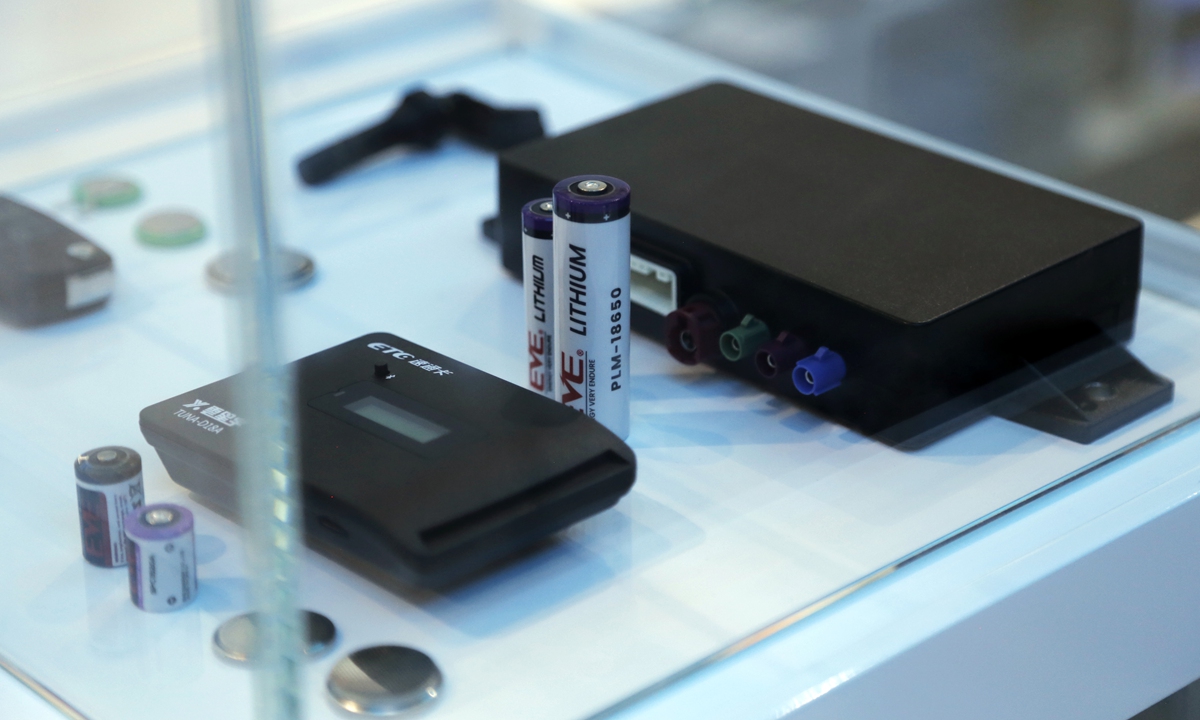
Different types of consumer lithium primary batteries on display Photo: VCG
Chinese researchers have developed a new high-energy lithium primary battery that can deliver both long-lasting energy and strong bursts of power while maintaining stable performance at temperatures as low as -40 C, Science and Technology Daily reported on Monday.A research team led by Chen Zhongwei at the Dalian Institute of Chemical Physics under the Chinese Academy of Sciences developed a 25-ampere-hour pouch-type lithium-metal primary battery. Tests conducted by the safety laboratory of the China Electronics Standardization Institute showed that the battery achieved an energy density of more than 750 Watt-hour per kilogram at a low discharge rate, according to the report.
Meanwhile its discharge rate can be increased by up to 100 times, enabling short bursts of high-current discharge at 10C. The "C" stands for C-rate, which is the charge and discharge rates of a battery. According to sector website Battery University, the capacity of a battery is commonly rated at 1C, meaning that a fully charged battery rated at 1Ah should provide 1A for one hour. The same battery discharging at 0.5C should provide 500mA for two hours, and at 2C it delivers 2A for 30 minutes.
The new battery puts China among the world's leading players in high-power primary battery technology.
Primary batteries offer high specific energy, long storage times and instant readiness, allowing them to be used immediately even after long storage.
Primaries play an important role, especially when charging is impractical or impossible, such as in military combat, rescue missions and forest-fire services, the article said.
Traditional lithium primary batteries can store large amounts of energy for long periods, but their ability to rapidly release that energy can be limited. The new battery is designed to combine high energy density with high power output, allowing it to both operate for extended periods and provide large amounts of power when needed.
The battery can deliver short bursts of high-current discharge at up to 10C and sustain discharge at 4C. At room temperature, its specific power reaches 4,487 Watts per kilogram, according to Science and Technology Daily.
The battery also maintains strong performance under extremely cold conditions. At -40 C, the battery retains an energy density of 447 Watt-hour per kilogram at a 1C discharge rate. Its annual self-discharge rate is below 1 percent, meaning that it loses relatively little stored energy during long periods of standby.
Such characteristics could make the battery suitable for equipment that needs both long-term energy storage and sudden high-power output, including drones, robots, spacecraft and sensors deployed in remote areas.
Chen said the team achieved a breakthrough in cathode materials by developing a high-entropy oxide material and has established a pilot production line with an annual capacity of 10 tons, linking material development with battery-cell production.
The battery has passed third-party testing and is now undergoing further validation for applications including drones, robots, spaceflight simulators and field sensor nodes, according to Chen.
Global Times
RELATED ARTICLES