Exclusive: China’s newest Antarctic station achieves green energy breakthrough as 50% power supplied by renewables during polar night: station director
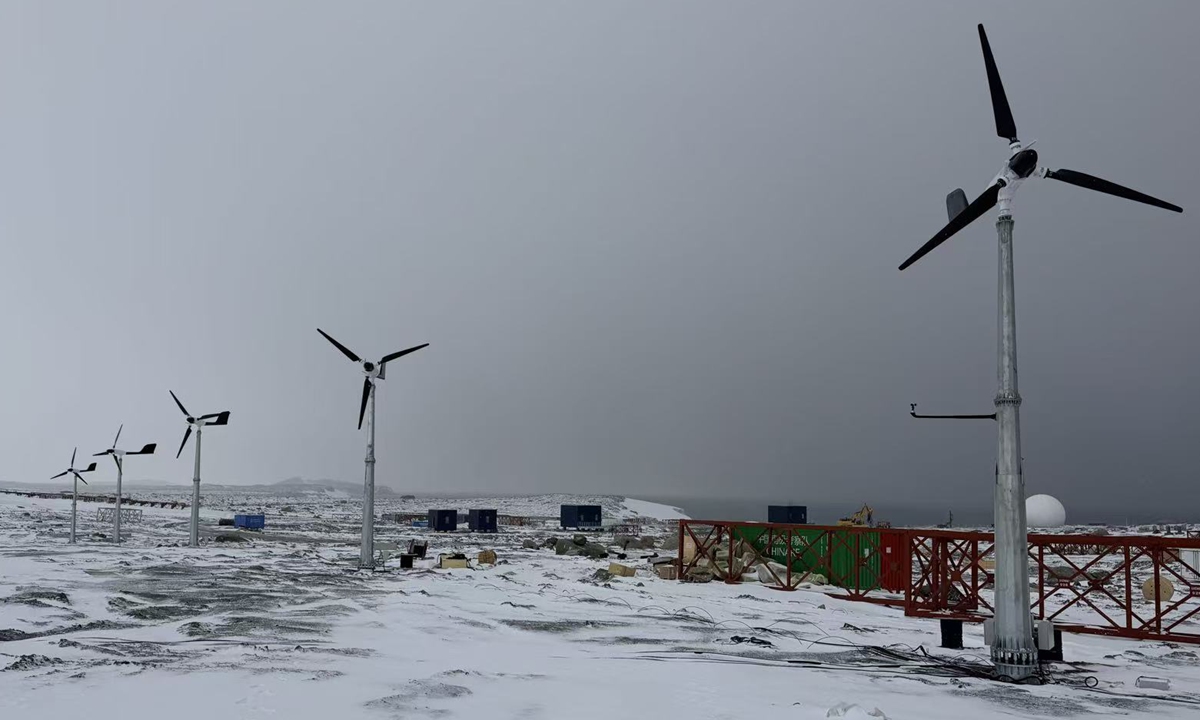
The "wind-solar-hydrogen-storage" multi-energy complementary system in China's Qinling Station in Antarctica Photo: Courtesy of Qinling Station expedition team members
China's Qinling Station, the country's newest Antarctica outpost, has achieved a major breakthrough in green energy use, with renewable energy accounting for around 50 percent of its electricity supply even during the harsh polar night, Wang Tao, head of the station, told the Global Times on Tuesday.
Located on Inexpressible Island in the Ross Sea region, Qinling Station, China's fifth Antarctic research station, uses a wind-solar-hydrogen-storage multi-energy complementary system to reduce reliance on traditional fossil fuels and improve energy sustainability in one of the world's most challenging and bio-vulnerable environments, according to Wang.
China's efforts to tackle the Antarctic power challenge have been closely followed by media. Reuters previously reported on the Qinling Station's energy system, describing it as "a move aimed at helping observe changes on the southern continent and supporting the global response to climate change." Intimedia also highlighted the project as "a green leap on the frozen continent."
Wang said the exploration of clean energy solutions at China's Antarctic stations has been a gradual process. Earlier, China's Taishan Station had already introduced a domestically developed renewable energy system, using wind power and photovoltaic generation as an initial trial.
"Compared with the hydrogen energy system we use now, the system at Taishan Station was relatively simple. It mainly relied on two renewable energy sources: wind power and solar power," Wang said.
He explained that Taishan Station's smaller scale and shorter operational period meant it had lower energy demands compared with a year-round station like Qinling Station. Therefore, when Qinling Station was designed, reducing fossil fuel consumption and building a greener energy supply system became one of the key objectives.
Over the past decade, China's renewable energy technologies have advanced rapidly, providing stronger technical support for extreme environments such as Antarctica. Based on these advancements, Qinling Station was equipped with an integrated energy system combining wind power, photovoltaic generation, hydrogen energy, energy storage batteries and diesel generators.
According to Wang, the system is designed to ensure stable power supply under Antarctica's highly variable conditions. During the austral summer, when the region experiences continuous daylight, photovoltaic power generation can operate efficiently, allowing clean energy to account for more than 60 percent of the station's electricity needs.
Even during the polar night, when there is no sunlight for months, renewable energy can still contribute about 50 percent of the station's power when wind conditions are favorable, Wang said.
"Solar power is greatly affected by the polar day and polar night cycles. During the polar night, photovoltaic generation cannot operate, while wind power also depends heavily on wind conditions," Wang explained. "Therefore, diesel generators remain part of the system to work together with renewable energy and ensure reliable operation of the station."
The green energy system has significantly reduced Qinling Station's dependence on fuel. Without the renewable energy system, the station could consume at least 200 tons more diesel each year. Reducing fossil fuel use not only cuts carbon emissions but also lowers the logistical burden, as "all the fuel has to be shipped from China across over 10,000 kilometers. The savings in transportation costs and time are considerable," Wang said.
China has been exploring renewable energy applications at Antarctic research stations for years. Qinling Station, officially completed and put into operation in 2024, expanded the approach by integrating multiple energy technologies into a more comprehensive microgrid system.
The operation of Qinling Station's green energy system marks a step forward in China's efforts to build more sustainable polar research infrastructure, offering a potential model for reducing emissions and improving energy resilience at future Antarctic facilities, Wang said.
RELATED ARTICLES