ARTS / CULTURE & LEISURE
China’s ancient oracle bones reveal earliest written record of meteor shower 3,000 years ago
By Published: Aug 11, 2026 04:16 PM


This photo taken on Nov. 18, 2025 shows the Leonid meteor shower seen in Heihe City, northeast China's Heilongjiang Province. (Photo by Qian Boyu/Xinhua)
Chinese archaeologists have pieced together ancient oracle bone fragments to decipher what they say is the earliest written record of a meteor shower, dating back more than 3,000 years and shedding light on astronomical observation in the Shang Dynasty (c.1600BC-1046BC), roughly the Late Bronze Age in the West in which Homer's Odyssey was rooted.The inscription, found among more than 80,000 fragments, consists of three characters that read "star", "all" and "west," describing a large number of meteors streaking across the night sky and falling westward like rain, Huang Tianshu, a professor at Tsinghua University's Research and Conservation Center for Unearthed Texts, told the Global Times.
"The first character is 'star'… the second means 'all' or 'in batches', depicting meteors falling in large numbers like rain, and the third is 'west,' used as a verb to mean falling westward after crossing the sky," Huang said. "This is important astronomical data recording a meteor shower more than 3,000 years ago."
The team spent years rejoining shattered oracle bones, a process of piecing fragments back together, and only after reassembly did the meaning become clear.
"Before rejoining, you have no idea what it is saying. Once rejoined, the content becomes largely intact and turns into a very important piece of material for studying history or language," Huang added.
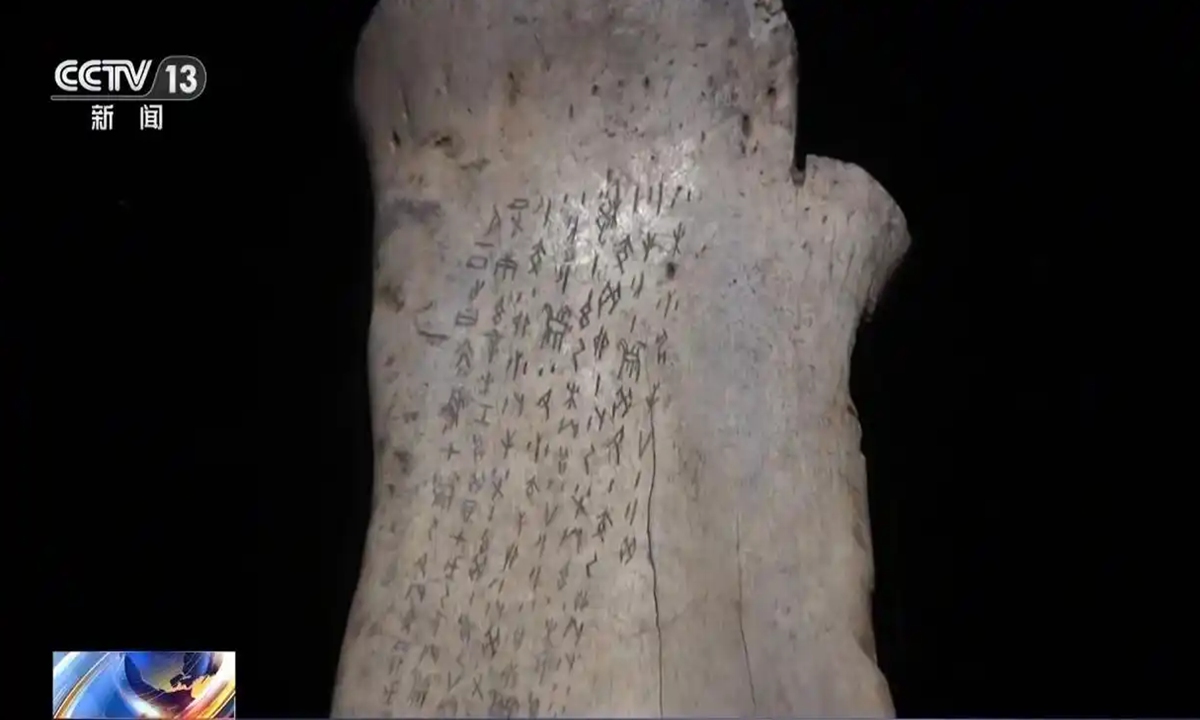
One piece of ancient Chinese oracle bone Photo: CCTV
Huang Dekuan, head of the expert committee for China's national ancient script project, told the Global Times on Tuesday that the record is "the earliest meteor shower documented in Chinese writing," adding that it was a representative achievement that would enable oracle bone inscriptions to be better used as scientific historical sources and push oracle bone studies to a new level.The discovery is part of a decade long effort that has newly rejoined more than 1,200 groups of fragments, with the results published in a major compendium of oracle bone facsimiles. The research was part of a state-backed project on inheritance and studies of ancient Chinese scripts and civilization, CCTV reported.
The first phase of the national project is about to complete, yielding a string of major findings. These findings provide vital new materials for studying early Chinese civilization and demonstrate the significant value of ancient Chinese characters in the development of Chinese and even human civilizations, per CCTV.
RELATED ARTICLES