US demand for Iran to pay reparations aims to pressure Tehran, tactic to counter Washington’s image of compromise: Chinese expert
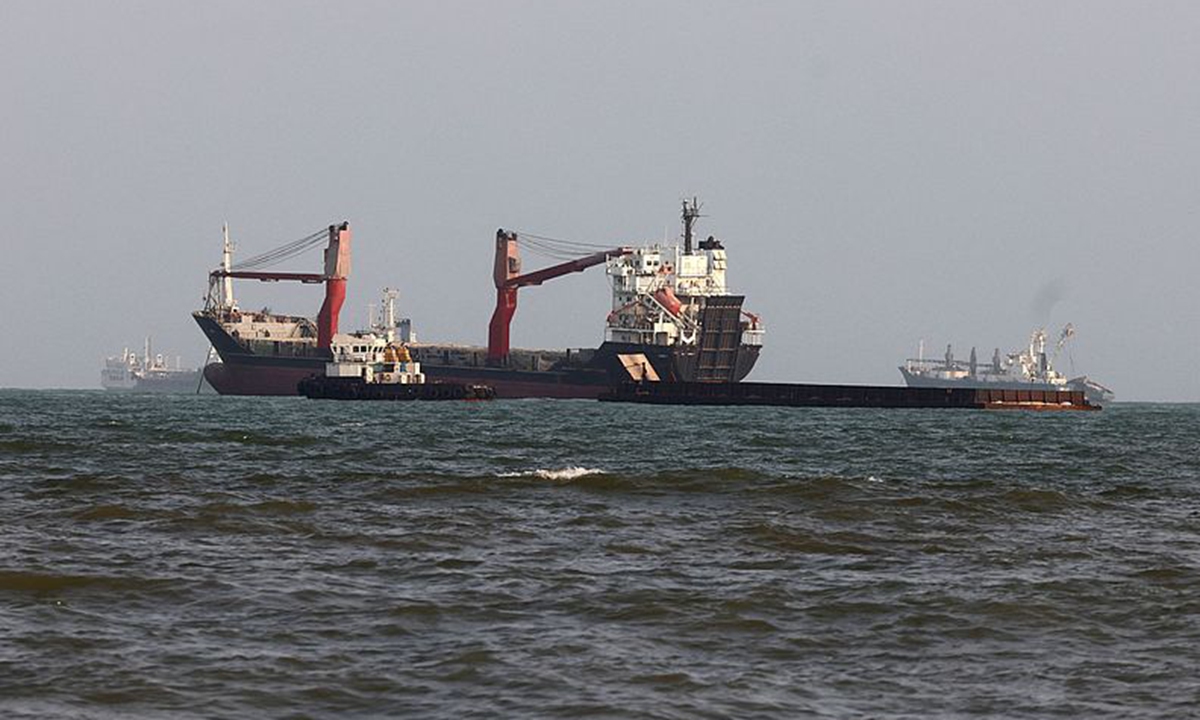
Vessels are seen in the Strait of Hormuz, off the port city of Bandar Abbas in southern Iran on August 10, 2026. Photo: VCG
In its latest move, the US has demanded that Iran pay compensation to individuals impacted by conflicts spanning more than 50 years, injecting fresh uncertainty into the prospect of reopening talks over the Strait of Hormuz.Chinese experts said Washington's current tactics are designed to ramp up pressure on Tehran and counter its own image of compromise, yet it also suggests signs that both sides may be bringing core issues back to the negotiating table.
US President Donald Trump in a Truth Social post early Tuesday claimed that Iran's demand for war-damage reimbursements gave him "an interesting idea" - that Iran should instead compensate the US "for all of the people that they have killed and gravely wounded with their roadside bombs and many conflicts."
"Additionally, compensation should be paid to the families of the hundreds of thousands of innocent protestors that Iran has killed over the last 50 years, not to mention the 52,000 that have been killed in the last five months," reads the post.
The US-required compensation includes a 1983 bombing that killed 241 US military personnel at a Marine compound in Beirut and the deaths of at least 603 US troops in Iraq between 2003 and 2011, the Associated Press reported.
The angle adopted by the US in lodging its compensation claims is strategic, given that the designation of terrorist involvement and the attribution of responsibility are inherently fraught with difficulty. Yet when these issues are tethered to reparation demands, it becomes comparatively easier to bring pressure to bear on Iran, Zhu Yongbiao, director of the Center for Afghanistan Studies at Lanzhou University, told the Global Times on Tuesday.
Its move to extend the scope of its claims to a 50-year timeline appears designed to divert attention from its own setbacks in this year's conflict with Tehran, while simultaneously attempting to recast itself in the guise of a war victim, Zhu added.
Trump's post came after Iran laid out its own conditions for reopening the Strait of Hormuz on Saturday. Secretary of Iran's Supreme National Security Council, Mohammad Bagher Zolghadr, said that reopening the strait would require Washington to lift its naval blockade and sanctions, withdraw US military forces from the region, pay war reparations, and release frozen Iranian assets, CNBC reported.
The council also called for an end to US attacks on Iran's regional allies and to threats against Iran, according to the reports, per CNBC.
Iranian Foreign Ministry spokesperson Esmail Baghaei also said that "it is up to the US side to stop and make amends for its illegal and destructive actions."
Shortly after Iran put forward conditions, the US laid out its negotiating terms. These reflect the commercial bargaining mindset that the US president has consistently embraced, Tian Wenlin, a professor at the Renmin University of China's School of International Studies, told the Global Times on Tuesday.
The US move currently appears to be more about rhetorical showmanship, yet in reality it is aimed at deliberately constructing an image of proactivity and toughness at the negotiating table, while signaling an offensive posture, Tian said, adding that it also seeks to dispel public perceptions that the US would yield passively on the battlefield, sending a signal to its domestic audience.
CNBC reported that the reparations have emerged as the "latest flashpoint" between Washington and Tehran. Zhu said the current impasse in US-Iran negotiations has also plunged the wider Middle East into a state of protracted deadlock, which not only imperils the region's long-term peace but also means that multiple adverse spillover effects on the global economy will be inflicted as a blockade of the Strait of Hormuz.
Oil prices rallied on Monday on the hardening rhetoric, reversing a brief retreat last week. West Texas Intermediate crude for September climbed about 5 percent to settle near $82.13 a barrel, while Brent crude rose by a similar margin to around $87.72. Oil was slightly higher Tuesday in Asia trading, CNBC reported.
Repeated shifts in position by both sides, particularly wavering on the part of the US, have eroded stakeholders' confidence in future negotiations, or at least the prospect of swift breakthroughs, Zhu said.
However, the clash over compensation claims could carry a positive indicator, suggesting that both sides may be beginning to re-engage with certain core issues, said Zhu, stressing that the standoff between the US and Iran will need to be resolved through negotiations.
RELATED ARTICLES