First regular Arctic container service China-Europe Arctic Express set to debut this week, ship operator tells GT
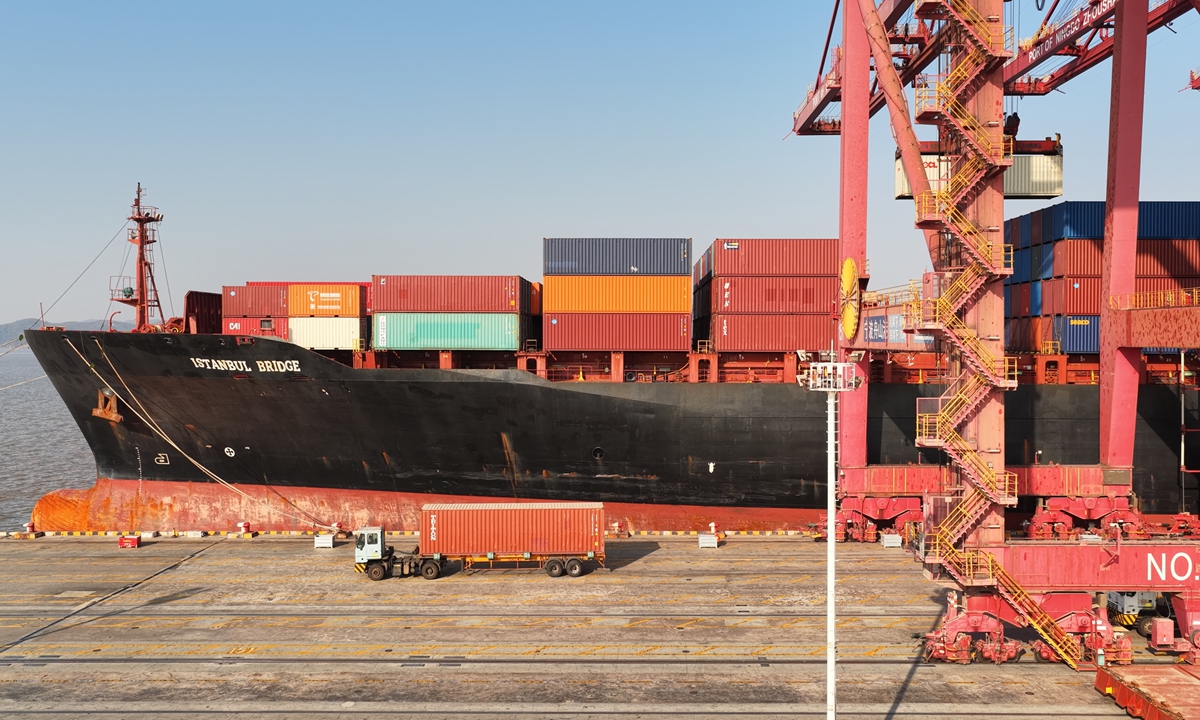
The first cargo ship of the China-Europe Arctic Express berths at Ningbo Zhoushan Port in East China's Zhejiang Province on December 6, 2025. Photo: VCG
A Chinese shipping company has confirmed with the Global Times the plan to launch a regular container service via Russia's Northern Sea Route to Europe this week, marking a new Arctic option for Asia-Europe trade once it sets sail.
Chinese container shipping company Sea Legend Shipping told the Global Times on Tuesday that its vessel Dubai Tower, originally scheduled to depart Ningbo-Zhoushan Port in East China's Zhejiang Province, on August 15, has had its departure adjusted because of weather conditions. The company said it is making internal arrangements for the maiden voyage of the China-Europe Arctic Express Route.
According to industry observers, the move reflects growing interest in Arctic shipping as global logistics networks continue to diversify beyond traditional canal routes. As polar ice retreats and seasonal navigation windows widen, the Arctic is emerging as a practical alternative for some Asia-Europe shipments, particularly those seeking to avoid congested or geopolitically sensitive sea lanes.
On Monday, the Financial Times reported that Sea Legend would launch the first regular container shipping service through the Arctic this week. The report said the company has branded the service the "Ice Silk Road," a reference to the historical Silk Road linking China and Europe.
The move comes as Arctic shipping increases amid rapidly shrinking sea ice. The Northern Sea Route recorded a record 23 transits last summer, up from 15 in 2024, according to figures cited by the FT.
Sea Legend told the Global Times that, compared with traditional China-Europe routes that can take around 40 days, the Arctic passage could cut transit time by nearly half, reducing the journey to about 20 days under direct service conditions.
The inaugural voyage is expected to call at Qingdao Port, Shanghai Port, Taicang Port and Ningbo-Zhoushan Port in China before continuing to European ports including Teesport and Felixstowe in the UK, Hamburg in Germany and Gdynia in Poland. The final domestic calling sequence may still change due to typhoon-related weather conditions.
The service will carry cargo including energy storage containers and related components, power batteries and new energy vehicles - goods that typically require faster transit, stable schedules and controlled transport conditions.
Sea Legend said the Arctic route could offer exporters a new solution in terms of both speed and reliability, as traditional canal and mainline routes face growing uncertainty from congestion, geopolitical disruptions and longer port waiting times.
The company also said the route has cooperation agreements with destination terminals including Felixstowe, Rotterdam, Wilhelmshaven and Antwerp, giving vessels priority berthing and a "green channel" advantage that could reduce anchorage delays and logistics costs.
Zhong Zhechao, an international logistics service expert told the Global Times on Tuesday that the move highlights rising interest in using the Arctic region for shipping, with Arctic shipping gradually becoming a practical alternative in the global logistics network as melting ice expands seasonal navigation windows and shipping lines seek to avoid congested and geopolitically sensitive sea lanes.
For exporters - especially cross-border e-commerce firms, manufacturers of seasonal products, and new energy companies - shorter shipping times could ease inventory pressure and reduce working-capital costs by allowing more flexible production and sales planning.
Zhong said this may be particularly valuable for companies racing to meet European sales seasons, as shorter transit times improve responsiveness to overseas demand.
The company also said the Arctic's low-temperature environment may be especially suitable for transporting new energy products such as batteries and energy storage systems, which require heightened attention to safety and thermal-risk considerations during transit.
Looking ahead, Sea Legend aims to achieve roughly four months of stable annual operation within the next three to five years, with a longer-term goal of year-round Arctic navigation within five to ten years.
The launch underscores how Chinese shipping firms are accelerating their Arctic deployment, turning what was once a long-term vision into operational reality.
According to the Xinhua News Agency, in September 2025, Ningbo-Zhoushan Port launched its first China-Europe Arctic container express route. The move was expected to provide strong support for trade enterprises to expand into new international logistics channels, the port said.
In recent years, Arctic shipping routes have increasingly come under the spotlight in the international community and have the potential to become important routes in international trade, Lin Jian, Chinese Foreign Ministry spokesperson, told a press conference in September 2025.
China stands ready to work with Russia and other Arctic states as well as interested countries to strengthen international cooperation on the building and operation of basic infrastructure along Arctic shipping routes and jointly advance the development and exploration of the routes and protect the environment there, Lin said.
RELATED ARTICLES