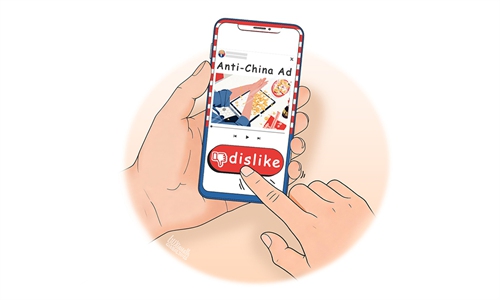
Are US export controls really about containing China – or controlling America itself?
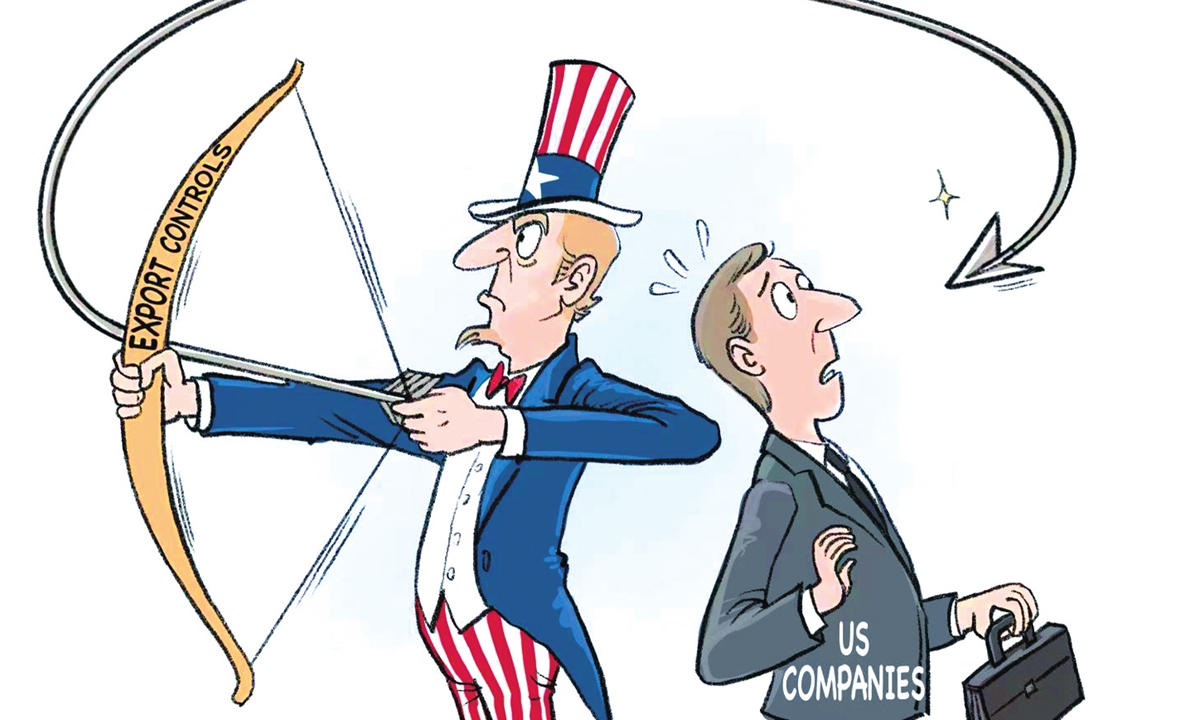
Illustration: Liu Rui/GT
Washington has spent years tightening export controls on China in the name of national security. But a new business survey raises an awkward question: What if these export controls end up harming the very interests they claim to "protect"?
A July flash survey by the US-China Business Council (USCBC) found that months-long delays in export-license approvals were costing the US billions of dollars in exports and eroding American market share globally. More strikingly, most of the licenses stuck in the pipeline covered products already available in China from Chinese or international suppliers. In other words, Washington may be shutting American companies out of a market without preventing Chinese customers from getting the products.
That is not strategic leverage. It is self-imposed market exile.
The scope of US export controls is hardly trivial. Since October 2022, Washington has progressively restricted China's access to advanced computing and semiconductor manufacturing items.
The controls have subsequently widened. In December 2024, the US added restrictions covering 24 types of semiconductor manufacturing equipment, three types of software tools and high-bandwidth memory - essentially attempting to constrain not only China's access to advanced chips, but its ability to manufacture them.
Washington has also tightened controls on advanced computing semiconductors. In January 2025, it added further Chinese entities and strengthened rules governing advanced computing semiconductors.
This is only part of what the US has done in the area of advanced technology.
The goal is to contain China and preserve US leadership. But there is a problem with this. Markets are not chessboards on which Washington can simply remove a piece and expect the game to stop.
If an American chipmaker cannot sell to a Chinese customer, that customer does not necessarily disappear. Export controls may prevent competitors from accessing certain products in the short term, but over the long term, they push companies to develop alternatives.
More than 80 percent of surveyed companies said their pending license applications covered items for which comparable alternatives were available from Chinese and international suppliers.
China remains important for American companies.
According to the USCBC's 2026 survey of 175 companies, 95 percent of respondents said that "China operations are somewhat to very important for staying competitive globally." The reasons include US companies applying lessons learned in China to other markets.
So, when Washington restricts its own access to one of the world's largest markets, it is not restricting China's demand. It is shrinking the market available to American innovation.
"This diminishes America's ability to innovate and undermines US economic security," the USCBC's report noted.
Nvidia offers a particularly revealing example. In April 2025, new US restrictions on its H20 AI chip were expected to impose a $5.5 billion charge on the company.
The real flaw with excessive export controls is not simply that they may fail to slow China's development; it is that they may be accelerating the emergence of a world in which American companies are no longer indispensable.
Washington says it wants to protect US leadership. But leadership is not simply the ability to decide who can buy your products. It is also the ability to make the world want to keep buying your products.
A market leader that voluntarily gives up its customers may ultimately find that it has priced itself out of the market.
Therefore, the question Washington should be asking is not simply, "How much can we keep out of China's hands?" It should ask another one: How much harm will the very groups it cites as grounds for "protection" endure in this process?
RELATED ARTICLES