Illustration: Liu Xiangya/GT
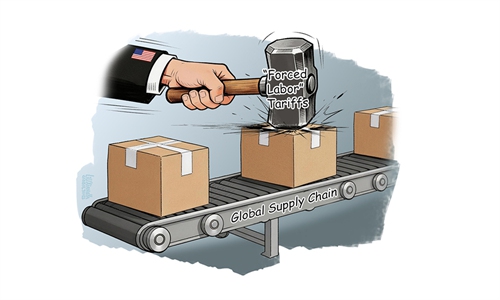
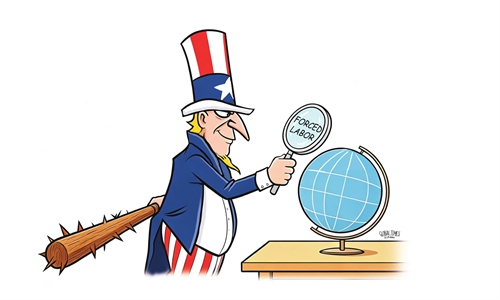
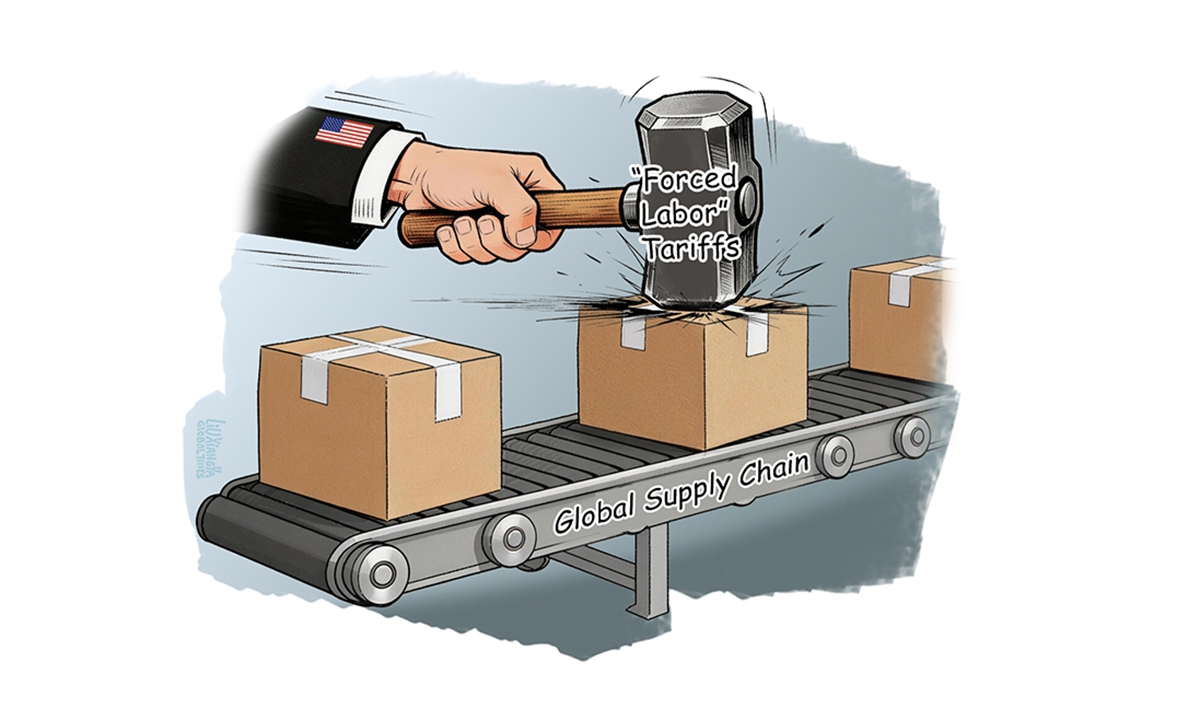
Washington's manipulation of the "forced labor" issue is yet another example of its instrumentalization and even weaponization of human rights to attack and smear other countries and stoke international confrontation. In essence, the US, guided by an "America First" approach, fabricates falsehoods and pretexts and uses them as leverage to coerce other countries including some European countries, sacrificing their interests for its own benefit.
In this sense, Europe has already become one of the victims of Washington's manipulation of the "forced labor" issue. If Europe follows or emulates US practices under the banner of combating "forced labor," it will only undermine its own regulatory credibility and reputation as a trading partner. Its efforts to diversify its economic and trade relationships and pursue "strategic autonomy" will also suffer as a result.
First, a structural rift has already emerged between the US and Europe at the level of values and political principles. The transatlantic bond, long built on a purported shared commitment to Western notions of "democracy, freedom and human rights," is showing serious signs of fracture.
The latest US National Security Strategy argues that Europe faces the "stark prospect of civilizational erasure." In recent years, some US politicians and right-wing business figures have also repeatedly criticized Europe's traditional political establishment over issues such as immigration policies and right-wing parties. In this sense, values have shifted from being a bond between the US and Europe to becoming a source of friction and conflict.
Against this backdrop, if Europe continues to align itself with US "human rights standards" that have become highly politicized and instrumentalized, it will undoubtedly undermine its own international standing as a "normative power."
In fact, the EU and its major member states have already strongly criticized US tariffs imposed in the name of combating "forced labor." Yet, while vigorously defending themselves, Europeans should recognize that maintaining a supposed community of shared values with the US is becoming increasingly unrealistic.
Second, the US has itself become one of the world's "lowlands" in terms of human rights. Its use of "forced labor" as a weapon of external coercion means that it has already forfeited the moral high ground internationally.
For years, Western strategic and media circles have frequently claimed that the US and Europe "share similar concerns" on issues such as human rights and trade.
In this process, Europe is seen as having followed and replicated US human rights standards that distort right and wrong and sow disruption around the world. Concerns from the international community, particularly the Global South, about Europe's double standards and hypocrisy have continued to grow.
Third, if Europe follows the US in weaponizing and making the "forced labor" issue a geopolitical matter, it will further disrupt global industrial and supply chains, accelerate the fragmentation of global trade and the proliferation of trade barriers, and ultimately inflict greater damage on Europe itself.
US legislation and deliberate actions in the name of "human rights" and "forced labor" have already subjected some countries and their companies to coercion and pressure. The EU's regulation on prohibiting products made with forced labor on the Union market could also be used as a tool of coercion, potentially disrupting trade within the EU as well as the international multilateral trading system. This has generated widespread concern both within and outside Europe.
Therefore, in the face of Washington's instrumentalization of human rights and the associated coercive and bullying practices, Europe should take these practices as a warning rather than follow suit, and make prudent decisions based on its own long-term interests. Furthermore, Europe needs to engage in self-reflection, as it is by no means free of problems concerning labor conditions and working environments.
Ultimately, what Brussels should be doing is strengthening the protection of workers' legitimate rights and interests and promoting social progress and industry standards, rather than following Washington in turning "forced labor" into an instrument of geopolitics and trade protectionism.
The author is an associate research fellow at the Academy of International and Regional Studies, and vice director of the Turkey Studies Center of Beijing Language and Culture University. opinion@globaltimes.com.cn
RELATED ARTICLES