Illustration: Liu Xiangya/GT
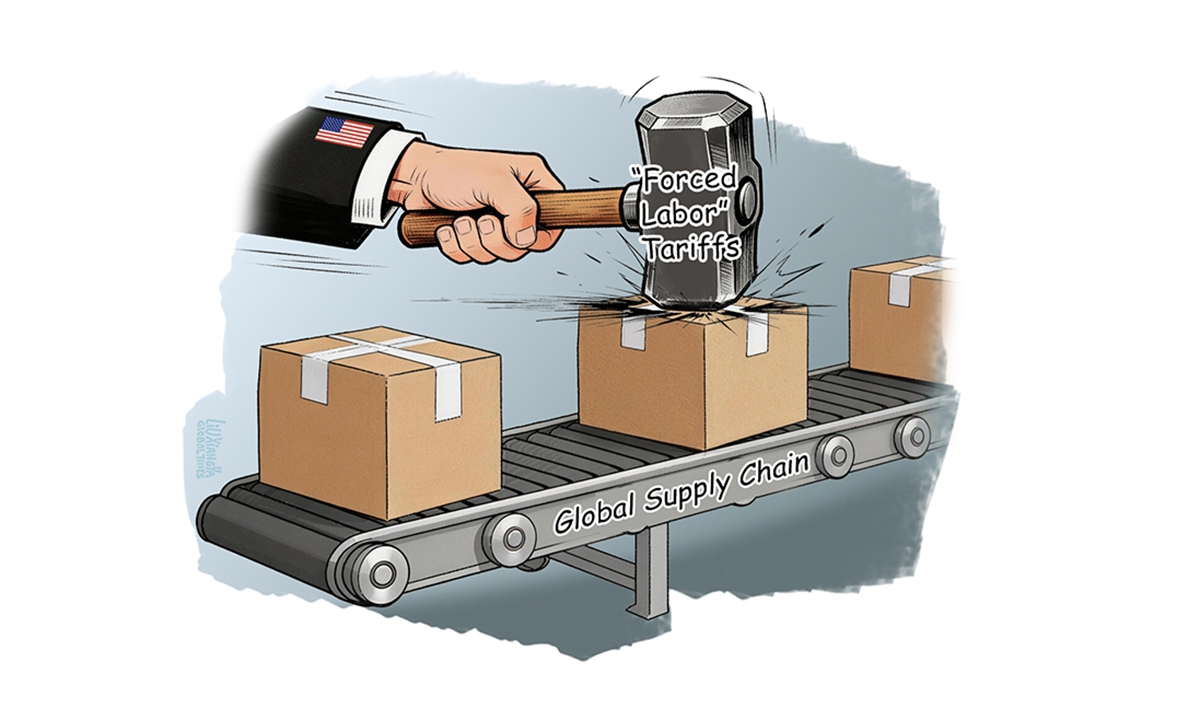
On July 31, the US once again invoked the unfounded allegation of "forced labor" in Northwest China's Xinjiang Uygur Autonomous Region, adding 43 Chinese companies to the relevant "Entity List." Prior to that, on July 23, the US Trade Representative (USTR) announced actions in its "Forced Labor Section 301 Investigation." These moves show that Washington is using the so-called "forced labor" allegations as a political tool.
As one of the most criticized forms of unilateralism and trade protectionism practiced by the US, Section 301 tariffs have long been rejected by the international community and are incompatible with the multilateral trading system under the WTO. Regardless of the excuses invoked, the Section 301 investigations conducted by the US have serious deficiencies in terms of procedures, effectiveness and international compliance, undermining the long-term interests of all parties.
The US Section 301 "forced labor" tariffs can hardly avoid being seen as part of Washington's competition over supply chains with China, with the aim of gaining greater pricing power and influence amid the restructuring of global supply chains. Although the annex to the Federal Register notice issued by the USTR did not directly accuse China of any specific unfair trade practices, China has seemingly long been portrayed in Washington's political narrative as a country associated with large quantities of products allegedly linked to "forced labor."
What deserves attention is that the US import bans based on "forced labor" differ significantly from international consensus, as they are imposed according to Washington's own evaluation standards and rules, effectively exporting its own values and regulatory approach. For example, Article 2.33 of the Agreement on Reciprocal Trade between the US and Indonesia specifically addresses enforcement of labor law. It requires Indonesia to strengthen training for officials in identifying products associated with forced labor and to enable them to conduct inspections of related goods in various scenarios, including those involving forced labor. Indonesia's forced alignment with US enforcement concepts and assessment standards will inevitably alter the economic costs and expectations of its international trade participants.
Beyond this, the US is also using "forced labor" as a testing ground to expand its influence over global supply chains. In recent years, Washington has repeatedly disrupted international trade, significantly increasing vulnerabilities in global supply chains. Tariff rates have profoundly affected how countries assess basic market rules, with their effects increasingly evolving into forms of non-tariff barriers. If countries follow US demands, it may appear that trading partners could reduce tariffs by 2.5 percentage points, but the cost could be having to purchase needed goods from alternative suppliers at prices dozens of percentage points higher than before. With one side lowering tariffs and the other side increasing costs, US influence grows stronger, while resistance to Washington's demands becomes increasingly difficult. The "forced labor" tariffs are merely an attempt. Having benefited from such practices, the US is unlikely to stop simply because trading partners accept these tariffs. More trade coercion may already be on the way.
Of course, the global impact of the US Section 301 "forced labor" tariffs should not be underestimated. Following the USTR's announcement of relevant measures, economies including Australia, New Zealand, China and Singapore expressed criticism and opposition. At first glance, the tariff rate under the Section 301 appears to have increased only modestly compared with the "reciprocal" tariffs introduced by the US last year and the Section 122 tariffs. However, the actual impact on markets is significantly different. It is important to recognize that the essence of Section 301 tariffs lies in the practice of "American exceptionalism." Regardless of the rate, such measures should not be tolerated. If countries become passive in the face of US tariff hikes imposed under various pretexts, Washington's demands will only continue to expand. When tariffs of 10 to 12.5 percent fail to sufficiently protect US companies from foreign competition, Washington may once again raise its demands and further restrict exports to the US market.
History has repeatedly shown that isolation leads to slower innovation and declining economic efficiency, while more expensive imported raw materials and intermediate goods would significantly weaken the international competitiveness of US manufacturing. "Forced labor" is a psychological scar left by the history of slavery in the US, yet Washington has still not ratified the International Labour Organization's Forced Labour Convention, 1930, making its claim to the moral high ground in judging other countries' actions difficult to sustain.
China has consistently opposed forced labor. It has established a comprehensive legal and regulatory framework on labor rights, firmly preventing and combating forced labor practices, and creating a fair, reasonable and effective employment environment that has enabled hundreds of millions of workers to improve their lives through their own efforts. The legitimate rights and interests of Chinese trade enterprises should be protected in accordance with relevant laws. China reserves the right to take all necessary measures in response to unilateral actions and measures that undermine fair trade.
The author is a researcher at the Chinese Academy of International Trade and Economic Cooperation. opinion@globaltimes.com.cn
RELATED ARTICLES