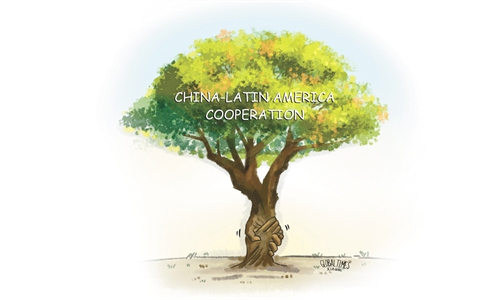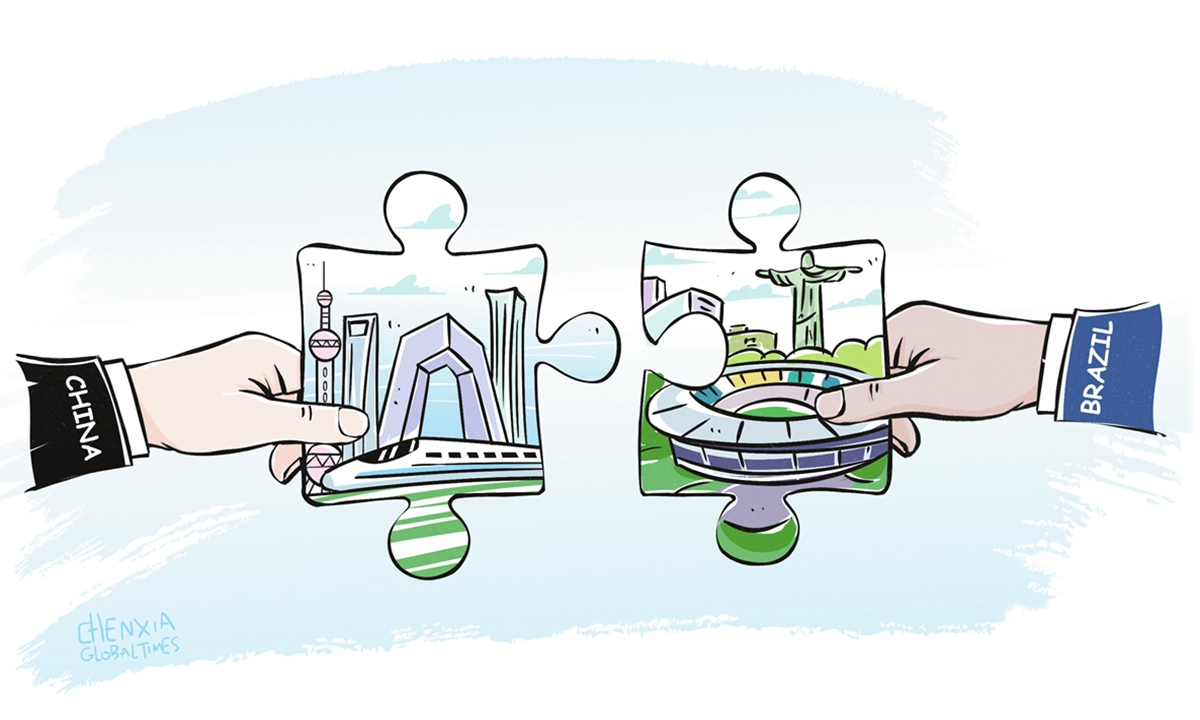
Illustration: Chen Xia/GT
It signaled the consolidation of a different vision of international order - one grounded in multilateralism, cooperation among sovereign nations, fair trade and negotiated solutions to conflict.
The call came at an especially turbulent time. The US administration has embraced both trade war and the broader logic of war. Tariffs, sanctions, threats and economic pressure are increasingly being deployed as instruments of coercion against countries seeking to preserve their sovereignty and defend their national interests.
Yet, US foreign policy extends beyond commercial disputes. Washington is seeking to interfere in Latin America's political and electoral processes, attempting to shape the sovereign choices of the region's citizens and strengthen far-right forces aligned with US strategic interests.
This approach threatens not only the countries directly targeted. It also undermines the democratic principle that every society must be free to choose its leaders and determine its own path of development. The defense of national sovereignty has therefore become inseparable from the defense of democracy and multilateralism.
The international system is also facing a profound crisis of governance. The UN has proven incapable of preventing wars or effectively mediating conflicts that put humanity at risk. The world witnesses the ongoing war in Ukraine, the humanitarian catastrophe in Gaza, mounting tensions across the Middle East and an intensifying rivalry among the major powers.
It is precisely against this backdrop that Brazil and China are offering a different response. Instead of military blocs, foreign intervention, unilateral sanctions and power politics, they advocate for stronger multilateral institutions, permanent dialogue, respect for state sovereignty and the peaceful resolution of disputes.
As leading members of the BRICS group, Brazil and China are well-positioned to advance an international agenda centered on fair trade and global peace. The growing convergence between Brasilia and Beijing also has an important economic dimension. Both countries understand that development, stability and peace are closely connected. Expanding cooperation in artificial intelligence, satellite technology, critical minerals and fertilizers shows that the relationship between China and Brazil has moved beyond trade and is becoming a strategic partnership for the 21st century.
Trade should not be used as a weapon of political domination; it should serve as an instrument of shared development, job creation, technological innovation and improved living standards. This principle should be central to the agenda Brazil and China pursue together within BRICS and other multilateral forums.
Stronger relations among the countries of the Global South are therefore essential for building an agenda of peace and development. The more these nations cooperate, the less vulnerable they will be to sanctions, economic coercion, financial blockades and external interference. Such cooperation does not require the creation of another closed bloc, nor should it mean replacing one hegemonic power with another.
Instead, it means expanding the autonomy of developing countries, diversifying partnerships and building an international order in which no single power can unilaterally impose its decisions on the rest of the world.
Closer relations between Brazil and China also challenge the assumption that the international system must revolve around a single center of power. The emerging reality is a multipolar order in which different economic, technological and political centers must coexist and develop permanent mechanisms of coordination.
In this environment, BRICS is assuming an increasingly prominent role. The group is no longer merely a collection of large emerging economies; it is becoming a political forum capable of shaping debates over development financing, artificial intelligence, international trade, the reform of multilateral institutions, national sovereignty and global security.
By jointly reaffirming their support for multilateralism, fair trade, sovereignty, the reform of global governance and negotiated solutions to conflict, Brazil and China are sending a message that transcends their respective national interests.
This is about more than building bridges between Brasília and Beijing. It is about helping to lay the foundations for a new world order - one that is more democratic, more just and less subordinate to the logic of war.
The author is the founder and chief executive of Brasil 247. opinion@globaltimes.com.cn
RELATED ARTICLES