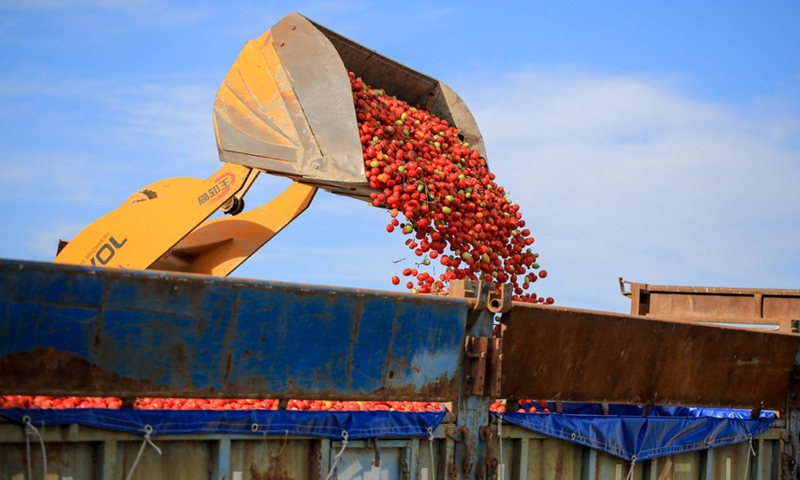
Tomatoes are loaded onto a truck in Bohu County, northwest China's Xinjiang Uygur Autonomous Region, Aug. 5, 2020. Over 1,000 hectares of tomatoes for further processing have entered the mature season in the county at present.(Photo: Xinhua)
The Australian Broadcasting Corporation (ABC) has recently set its sights on Xinjiang tomatoes once again. A joint investigation by its program Four Corners and a forensic laboratory found that some ketchup and tomato paste products on the Australian market had discrepancies between their labeled origin and actual source. The report claimed that the tomato ingredients in some of these products originated from China. ABC then swiftly pivoted, shifting the topic from a dispute over tomato origin labeling to extensive coverage of Xinjiang, where it reignited the false claims of "forced labor."This is not the first time Western media has staged a performance over ketchup. In 2024, the BBC went rummaging through supermarket shelves in the UK looking for Xinjiang ingredients in ketchup, using almost the exact same script: starting an issue over place-of-origin labeling, dragging it into Xinjiang-related issues, and finally slapping on a "forced labor" label. With such practiced routines and seamless transitions, they have gone to "pains" just to find "Xinjiang" in ketchup. What they truly care about is not what is inside the ketchup bottle, but whether they can use it to throw mud at China. They monitor the traces of Xinjiang tomatoes the way one would monitor a virus - the only things truly infected with a virus are their own minds.
Australia itself has plenty of inglorious "dark history" when it comes to forced labor. Aside from the notorious "blackbirding" - where Pacific Islanders were tricked, kidnapped, and violently abducted to labor on plantations run by white Australians - it also subjected Indigenous people to systematic forced labor through more than a century of institutional oppression. If the insistence of certain Australian media outlets on believing the lie of Chinese "forced labor" isn't deliberate malice, it must be because their own historical memory is just a bit too profound.
Xinjiang is one of the world's major tomato-producing regions. Thanks to natural conditions such as long sunshine hours and large temperature differences between day and night, local tomatoes boast high sugar content, vibrant colors, and high lycopene levels, enjoying a long-standing reputation in domestic and international markets. Xinjiang's tomato paste exports account for 25 percent of global trade volume, meaning that one in every four bottles of ketchup consumed worldwide originates from Xinjiang. By 2025, the mechanization rate of the entire processing tomato production cycle in Xinjiang reached an astonishing 99 percent. Xinjiang tomatoes do not need anyone's "certification." ABC is welcome to keep rummaging through ketchup bottles, but the world will not reject Xinjiang tomatoes simply because of ABC's paranoid performance.
RELATED ARTICLES