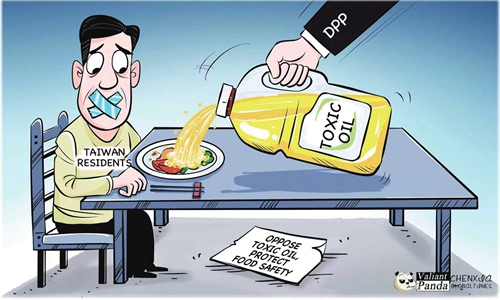
DPP's 'green terror' intensifies as judiciary is weaponized against Chinese mainland spouses: Hai Feng
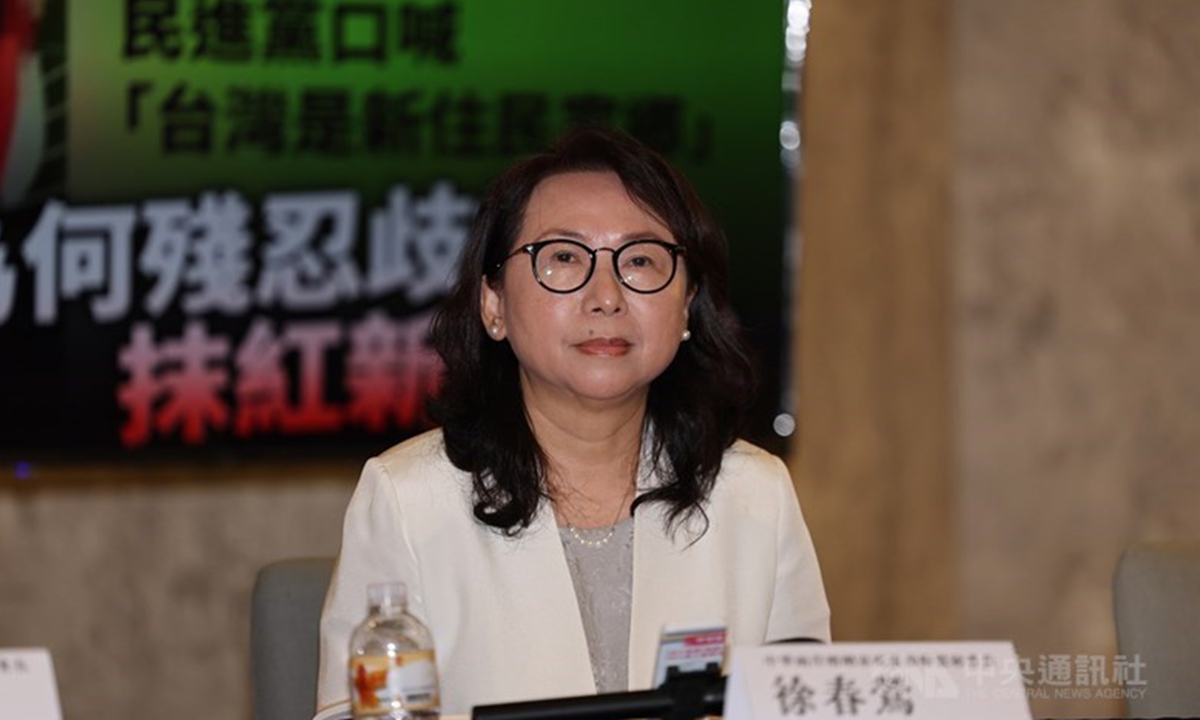
Screen shot:Xu Chunying. Photo: CNA
According to Taiwan island's media reports, on Tuesday, the "New Taipei District Court" sentenced Chinese mainland-born spouse Xu Chunying to a combined seven years in prison on charges including violations of the so-called Anti-Infiltration Act. This is by no means an ordinary criminal case. It is an open political trial staged by the DPP authorities under the guise of judicial process - a carefully packaged act of political suppression.
Xu has lived in Taiwan for more than 30 years. She has long advocated for the rights of mainland spouses and new immigrants, actively engaged in cross-Straits people-to-people exchanges, and worked to promote the peaceful development of cross-Straits relations. Yet this is the person whom Lai Ching-te and the DPP authorities have smeared, attacked, and relentlessly pursued through the courts - simply because of her mainland background and her previous nomination as a party-list legislative candidate for the Taiwan People's Party. She has ultimately been branded with a "national security felony" on the basis of trumped-up charges. The case has long ceased to be about one individual. It fully exposes the DPP's true face: the privatization of the judiciary. Anyone who touches cross-Straits affairs, enters public discourse, or attempts to voice a different political view risks becoming the next target.
In this case, the DPP authorities have absurdly labeled normal cross-Straits exchanges as "infiltration." Xu's contacts with mainland civil organizations and her efforts to convey the concerns of the mainland spouse community were part of her legitimate association work. Her practical support for non-DPP candidates was nothing more than normal participation in Taiwan's political life. Yet in the narrative constructed by DPP prosecutors, these actions were framed as "receiving instructions from abroad" and then escalated into "national security crimes."
The danger of Xu's case goes far beyond the wrongful conviction of one person. Once this logic of judicial manipulation is established, the boundaries of acceptable behavior for the entire Taiwan society will be rewritten. Ordinary cross-Straits contacts can be labeled "acting under instructions," association communications can be called "being manipulated," and political participation can be branded "election interference." In this way, it is not only Xu who is being put on trial, but all Taiwan people who insist on friendly cross-Straits exchanges and who wish to retain independent voices.
This is not law enforcement. It is the use of the judiciary to sever cross-Straits exchanges. It is a heavy sentence designed to create a chilling effect and intensify the "green terror" within Taiwan society. From investigation and prosecution to the final verdict, the case has carried a strong political rhythm: before evidence was fully disclosed and before legal conclusions were firmly established, the "red-smearing" media campaign had already begun, and the labels of "election interference" and "colluding with external forces" had already been applied.
It is not a matter of first gathering evidence and then reaching a conclusion. Instead, political charges are predetermined, and evidence is then pieced together and charges fabricated in reverse. This is precisely the most dangerous aspect. Today the DPP authorities can frame Xu; tomorrow they can use the same methods to suppress more people. When the judiciary becomes subordinate to politics and the law is reduced to a weapon of partisan struggle, the basic trust of Taiwan society in its institutions is being steadily eroded.
At the same time, the case sends a brutal signal to the mainland spouse community. They may live, work, and settle in Taiwan and be packaged as decorative symbols of "integration" and "diversity." But the moment they enter the public sphere, express independent opinions, or participate in political affairs, their identity immediately becomes suspect. Unless a mainland spouse is willing to publicly criticize the Chinese mainland and submit a "letter of loyalty" endorsing the DPP's "resist China, protect Taiwan" line, virtually any past activity on Chinese mainland can be used as a pretext for criminal prosecution and persecution.
This is naked selective acceptance. It is systemic identity discrimination rooted in prejudice and confrontation. And it constitutes a serious violation of the rights of the mainland spouse community.
Even more alarming is that the Xu's case is by no means an isolated incident. Looking at recent cases of suppression against mainland spouses - such as the deportation of the mainland spouse known as "Yaya" - a clear pattern emerges: first attach a label, then magnify the risk; first manufacture suspicion, then deploy institutional tools; first launch an opinion siege, then follow up with legal, administrative, or even residency measures. This applies both to mainland spouses and associations involved in politics and to mainland spouse influencers with public reach.
This shows that the DPP's suppression of Chinese mainland spouses and forces supporting cross-Straits exchanges is no longer a series of scattered political attacks. It has gradually developed into a mature set of manipulation tactics. Its ultimate goal is to shrink the public living space of the mainland spouse community, sever the most authentic, concrete, and everyday connections between the two sides of the Straits, create a social atmosphere in Taiwan in which people "dare not approach, dare not speak, and dare not participate," deepen the estrangement across the Straits, and sustain the narrative of "Taiwan independence" separatism.
This is the true face of the DPP authorities' "green terror."
RELATED ARTICLES