Illustration: Chen Xia/GT
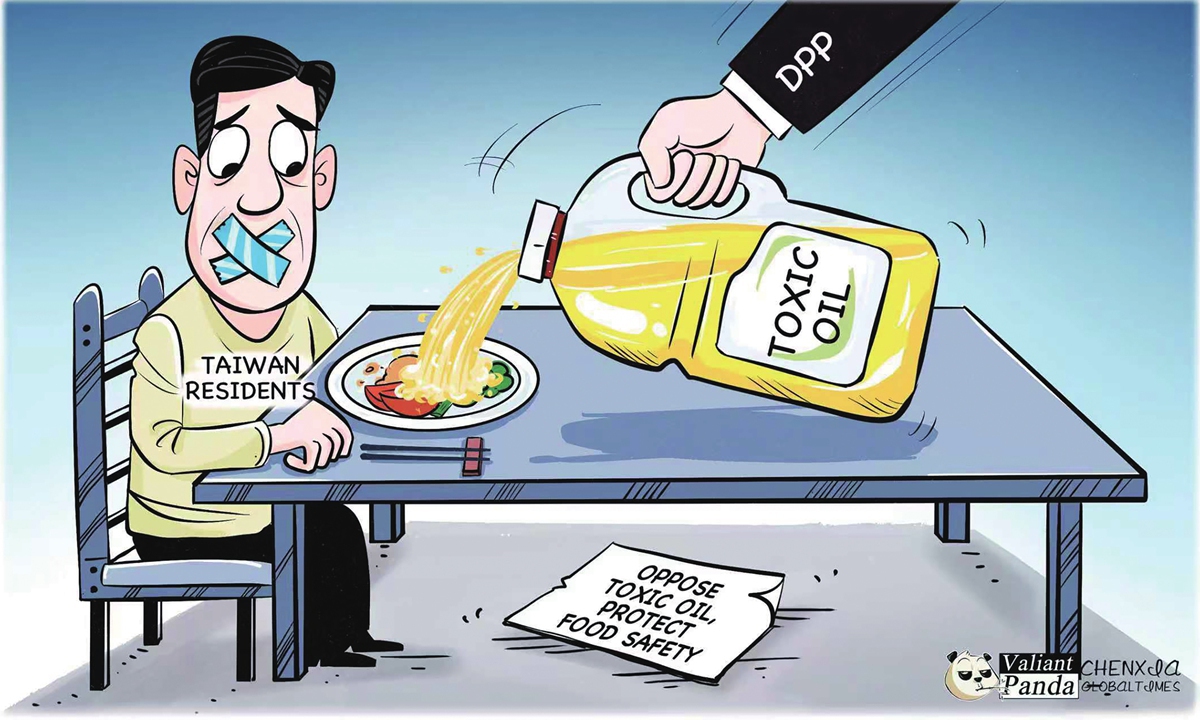
In recent days, the topic of vaccines has suddenly resurfaced on the island of Taiwan. On the surface, the spark was a massive fraud case involving the Tzu Chi Foundation, which was swindled out of 1.06 billion New Taiwan dollars (around $30 million) under the guise of "service" and "coordination" fees when helping procure Pfizer-BioNTech (BNT) vaccines a few years ago. Look deeper, however, and the motive becomes clear: with the Democratic Progressive Party (DPP) authorities trapped in an escalating backlash over the ongoing toxic cooking oil scandal, they are attempting to dredge up old vaccine grievances to forcibly drag public attention away from an undeniable governance crisis.
Right now, the questions that demand urgent answers are clear: Who allowed the public to consume toxic oil? Who let the island's food safety defenses crumble layer by layer? And who will be held accountable for this governance failure? Yet the DPP authorities' signature move has always been deflecting responsibility and shifting the spotlight, drowning real-world crises in an endless torrent of political bickering.
The popular cynicism surrounding the oil scandal is no longer just a vent for public outrage; it has become a collective indictment of the DPP's incompetence. When food safety is called into question, the response should be swift and decisive: tracing the source, plugging loopholes, establishing accountability, and rebuilding trust. Instead, what the public sees is the DPP's time-tested political playbook: downplay the issue, execute a tactical decoupling, drift the conversation elsewhere, and finally launch a full-blown political offense. When a crisis boils over, their priority is never solving the problem, but limiting damage to their electoral prospects.
And right on cue, the Tzu Chi fraud case was dragged back onto the stage.
That Tzu Chi was swindled out of 1.06 billion New Taiwan dollars certainly warrants investigation, accountability, and thorough review. The problem, however, is that certain figures are trying to weaponize this fraud case to retroactively whitewash the past controversy surrounding vaccine procurement - even striking a posture of "See? I wasn't blocking vaccines back then; I was protecting you from scammers." This is not a search for truth, but an attempt to overturn past verdicts under the guise of a new case; it is not facing history, but rewriting it.
What disgusts the public on Taiwan island is dredging up a past controversy to evade current failures and shirk responsibility. The scam pulled on Tzu Chi and the DPP authorities' obstruction of private sector vaccine procurement are two completely separate matters. The former is a criminal fraud; the latter was a failure of governance. Scammers are despicable, but their crimes do not obscure the DPP's past blunder as it disregarded a severe pandemic outbreak on the island, clung to ideological bias, and blocked BNT vaccines from entering Taiwan under the pretext that they were "from the mainland." On the contrary, it was precisely the DPP authorities' sluggish administrative efficiency and biased posture - placing political calculations above public life and health - that forced private organizations to forge their own paths and raise funds to buy vaccines. Only in that chaos were scammers given the opening to exploit the situation and line their pockets with ill-gotten gains.
If the DPP authorities had been capable, responsible, and had a proper procurement system back then, why would ordinary people on the island have to resort to roundabout channels? And why would Tzu Chi have had to take such enormous risks to negotiate supplies on its own?
Five years later, the DPP's political arrogance and governing logic haven't changed one bit. Today, faced with the toxic oil scandal, they still show no genuine self-reflection; faced with rampant fraud, out-of-control drug-impaired driving, and the spread of drugs on campus, they still haven't put forward any practical governance plans or remedial measures. Yet when it comes to political infighting, the DPP immediately springs to life. It is adept at every tactic: issuing clarifications, launching counterattacks, spinning public opinion, and drawing clear lines to distance itself from scandals. It acts as if incompetence in governance is of little consequence; what truly matters is never losing the narrative battle, never losing elections, and never letting its rivals gain the upper hand.
This is the real tragedy of Taiwan society. Politics, which should be used to solve problems, increasingly resembles a technique dedicated to managing "public perception;" power, which exists to safeguard the people, is used to shield the authorities' own image.
Toxic cooking oil, rampant fraud, drug driving and school violence are all stark realities. What ordinary people face every day is the food on their tables, traffic safety, and their children's health - not politicians' "unblemished historical record." However, today, public discourse is constantly being steered toward petty squabbles over "Who was wronged decades ago?" "Who owes whom an apology?" and "Who has been falsely accused?" This is not governance; it is political theater. This is not accountability; it is buck-passing. This is not uncovering the truth; it is exploiting old wounds to cover up fresh crises.
The Taiwan people remember the chaos during the pandemic. The shortages of masks, rapid antigen tests, and vaccines - that sense of anxiety, helplessness, and unease - is etched into everyone's memory. It cannot be erased by a few phrases like "please trust the experts," nor can it be rewritten by a new round of verbal sparring.
History is worth revisiting because it is never to whitewash those in power, but crucial for reminding society that any governing mindset that puts politics above human lives will inevitably repeat itself across other policy areas. Today it is vaccine shortages; tomorrow it may be toxic cooking oil; the day after tomorrow, it could be even more public risks -both visible and invisible.
Therefore, whether it is the toxic cooking oil scandal or dredging up past vaccine controversy, what the Taiwan public truly sees is, in fact, the same thing: a mode of governance that frames administrative failures as partisan battles, dilutes accountability into petty disputes, and weaponizes pressing real-world crises for electoral gain.
If the DPP authorities truly want to win back public trust, the solution is actually quite simple: Stop dwelling on past partisan grievances, face up to present-day problems, and settle today's pressing liabilities first. The public craves clear answers to critical questions: How did toxic oil slip through the system? Why did regulatory oversight collapse? Who should step down? Who must be held accountable? How should the system be reformed? How should standards be established? How should loopholes be closed? These are the responses the Taiwan public demands.
Otherwise, using the vaccine controversy to cover up the toxic oil scandal today, and using other scandals tomorrow to cover up today's governance failures - no matter how much they try to cover it up, they will ultimately be unable to hide the truth of their incompetent governance and utter shamelessness.
RELATED ARTICLES