Chinese expert warns Philippines not to mistake humanitarian accommodation for concession as Philippine military twists facts on Ren’ai Jiao resupply
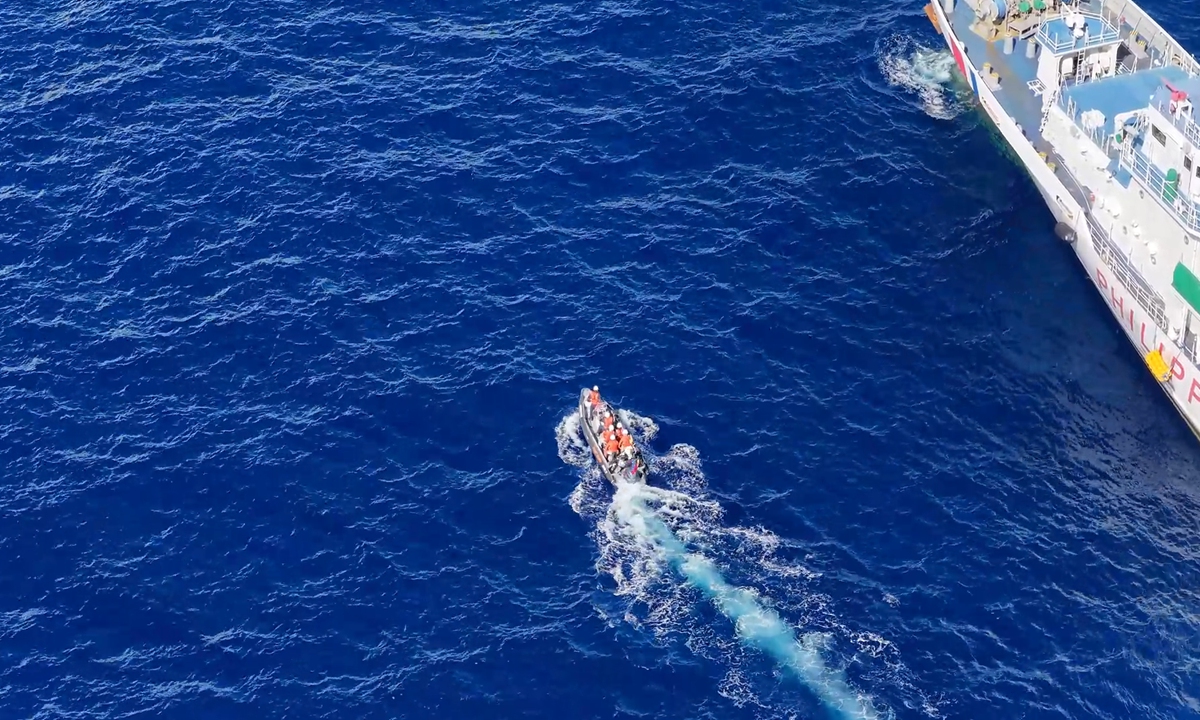
Screenshot from video obtained by the Global Times on July 21, 2026 shows the transfer of injured Philippine personnel near Ren'ai Jiao, which was overseen and assisted by the China Coast Guard. Photo: Courtesy of the China Coast Guard
The Philippine military side has again claimed that resupplying its grounded warship at Ren'ai Jiao needs no foreign approval and resupply there is within its self-claimed so-called EEZ, while Philippine media acknowledged that 15 "safe" resupply missions were made over the past two years under a China-Philippines provisional arrangement.Chinese experts warned on Wednesday that Manila should not mistake humanitarian accommodation for a concession and must bear the consequences if it scraps the arrangement.
Yang Xiao, a research fellow at the Institute of Peaceful Development under the Chinese Academy of Social Sciences, told the Global Times on Wednesday that the Philippine side's claims are fundamentally flawed from legal, historical and practical perspectives.
Ren'ai Jiao is an inherent part of China's Nansha Qundao, over which China has indisputable and complete sovereignty, Yang said, adding that it is legally untenable for the Philippines to claim that Ren'ai Jiao is part of its exclusive economic zone.
"The Philippines deliberately grounded the abandoned warship at Ren'ai Jiao in 1999 and repeatedly pledged to remove it and restore the reef, but has failed to honor those commitments for more than two decades. This itself constitutes a continuing violation of China's territorial sovereignty," Yang said.
This is not the first time the Philippines has denied seeking China's approval for resupply missions to Ren'ai Jiao. In April 2025, Chinese Foreign Ministry spokesperson Guo Jiakun responded to similar claims, saying that China's position on how to handle the current situation at Ren'ai Jiao is clear and consistent.
"First, by keeping its warship grounded at Ren'ai Jiao for decades running, the Philippines has been violating China's sovereignty and the Declaration on the Conduct of Parties in the South China Sea (DOC). We demand that the Philippines tow away the warship. Second, between now and when the warship is towed away, should the Philippines need to send living necessities, China is willing to allow it in a humanitarian spirit if the Philippines informs China in advance and after on-site verification is conducted. Third, if the Philippines were to send large amount of construction materials to the warship and attempt to build fixed facilities or permanent outpost, China will absolutely not accept it and will resolutely stop it in accordance with the law and regulations," said the spokesperson.
"This means that the Philippines' so-called '15 safe and incident-free resupply missions' were all made possible by China's humanitarian accommodation and strict oversight," Yang stressed. Each mission was reported in advance and allowed to proceed only after inspections confirmed no prohibited construction materials were aboard. The CCG intercepted any such materials through lawful measures, Yang said.
The Philippines' unilateral denial of its notification and inspection obligations while enjoying the arrangement's benefits amounts to a blatant breach of its commitments, the expert noted.
Yang also noted that Manila's narrative contains an obvious logical contradiction. If Philippine resupply missions were truly unimpeded, there would be no need for Manila to repeatedly claim that China had "blocked" its missions and call for international intervention. Yet if China had continuously "obstructed" the missions, the Philippines could not have completed 15 safe and incident-free resupply operations.
"Manila has simply manipulated its narrative to suit its publicity needs, portraying itself as a 'victim' when seeking international attention while touting smooth resupply operations and its own strength when seeking to project toughness. Its hype over the 15 resupply missions is essentially aimed at rallying domestic support and stoking confrontation internationally to conceal the reality that its illegal presence is tightly constrained," Yang said.
China's handling of the Ren'ai Jiao situation, meanwhile, has consistently reflected restraint and humanitarian considerations. According to a statement by the China Coast Guard (CCG) spokesperson on the transfer of injured personnel by the Philippine side, Jiang Lue, a CCG spokesperson, said that on the morning of July 21, out of humanitarian considerations, China allowed the Philippines to transfer injured personnel by small boats from the BRP Sierra Madre (LT-57), which has been illegally grounded at Ren'ai Jiao, to Philippine Coast Guard vessel 9702. The CCG questioned and verified the Philippine vessels and monitored the entire process.
The CCG will continue to carry out rights-protection and law enforcement operations in accordance with the law in the waters around Ren'ai Jiao to safeguard China's territorial sovereignty and maritime rights and interests, Jiang said.
Yang said, stressing that Manila's tough talk and one-sided claims cannot make up for its legal and moral shortcomings.
"Any attempt to permanently occupy Chinese islands and reefs, unilaterally tear up the understanding and continuously challenge China's territorial sovereignty runs counter to international law and the broader trend toward peace and development in the region and is ultimately doomed to fail," Yang added.
RELATED ARTICLES