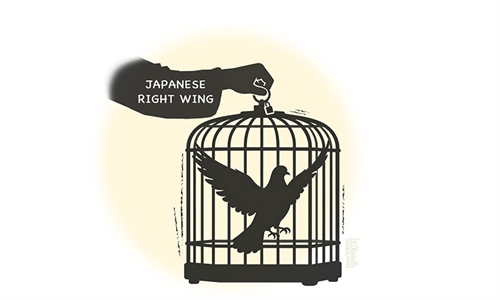
Fabricator of false history: Algorithmic-powered Japanese revisionism carry greater peril
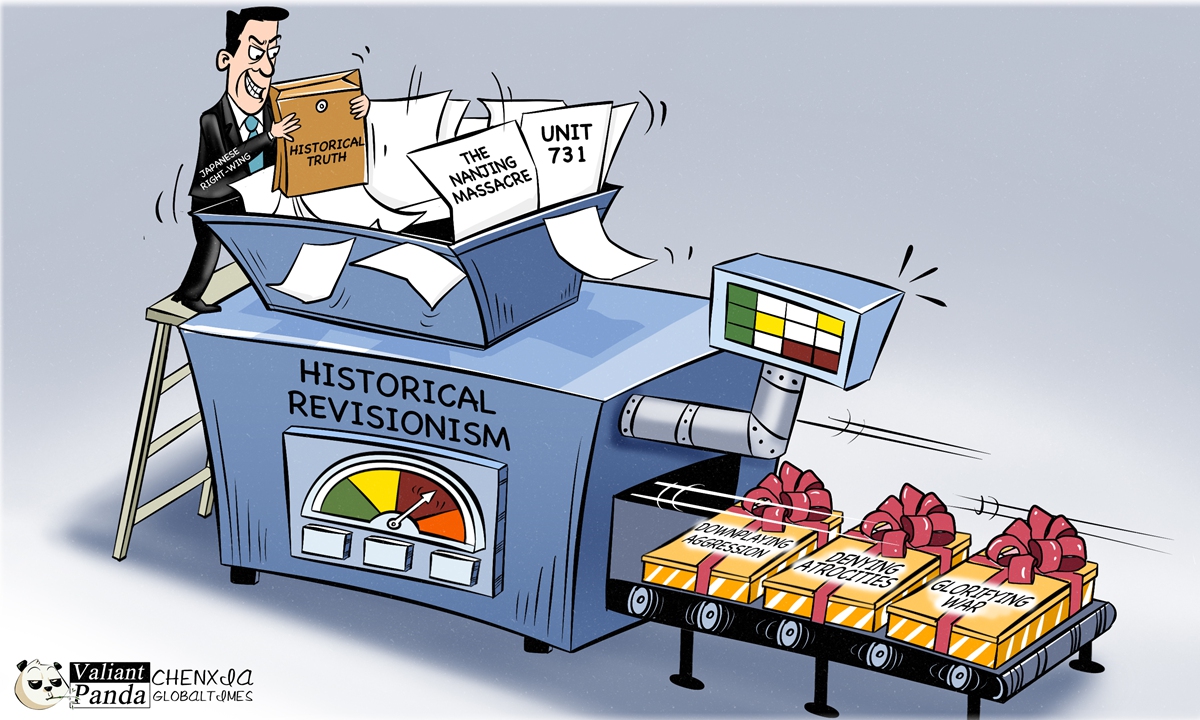
Illustration: Chen Xia/GT
Editor's Note:
More than 80 years after the end of World War II (WWII), right-wing forces in Japan have not stopped distorting, denying, and even whitewashing the history of militarist aggression - and their tactics are constantly evolving. Today, Japanese historical revisionism has moved far beyond the "craft workshop" model once relied on by a handful of right-wing scholars, publishing houses, and political groups. Instead, it has entered a low-cost, mass-produced phase driven by generative AI and platform algorithms.
What are the typical tactics used by the Japanese right-wing forces to fabricate false history? Why does historical revisionism repeatedly resurface in Japan? How can we guard against and counter its hazards? As we approach August 15, the day of Japan's unconditional surrender in WWII, the Global Times launches a special commentary. This report deeply exposes the latest dangerous moves of Japan as a "fabricator of false history," making it clear that history must not be falsified and justice must not be defiled.
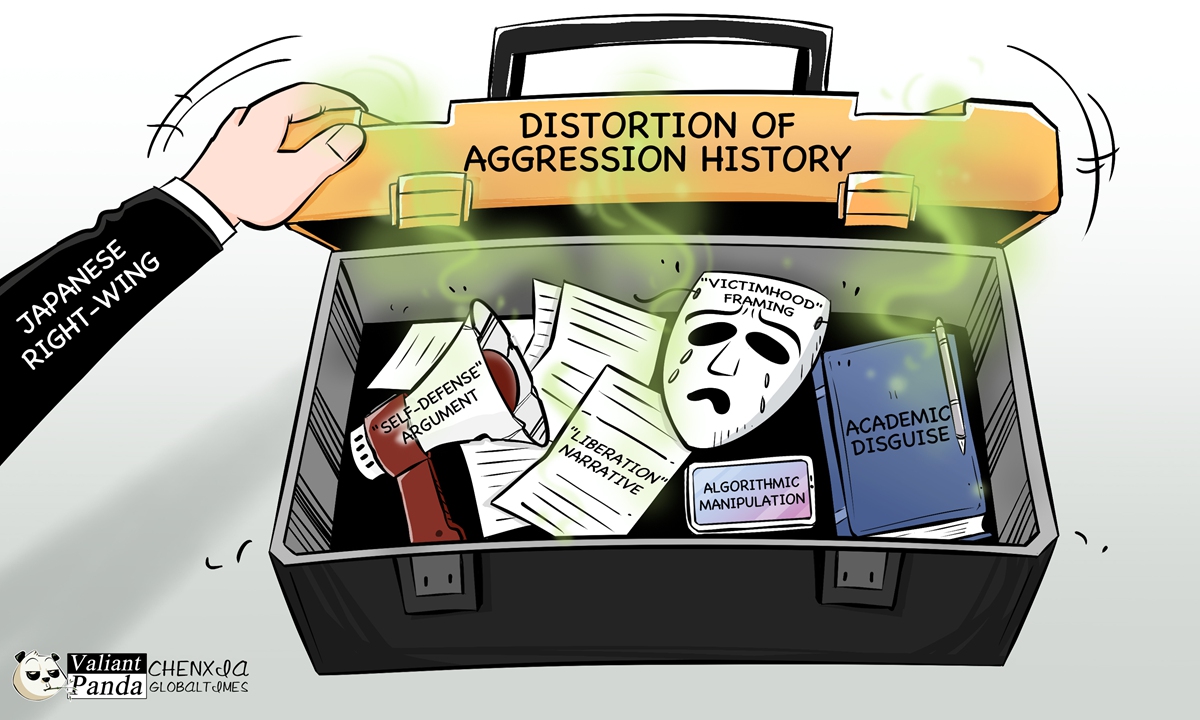
Illustrations: Chen Xia and Liu Rui/GT
Investigative reports published by Japan's Asahi Shimbun in December 2025 and April 2026 revealed a standard shift in how Japanese historical disinformation is produced: Right-wing forces are outsourcing content creation through crowdsourcing platforms. By utilizing generative AI, they rapidly manufacture videos that deny the Nanjing Massacre and glorify aggressive war, spreading the fabricated anti-China narrative further with monetization incentives. Historical denialism is transitioning from a "craft workshop" model - once relied on by a handful of right-wing scholars, publishing houses and political groups - into a low-cost, mass-produced and algorithmically driven industry. Japanese right-wing forces are constructing a systemic framework capable of continuously generating, repeatedly broadcasting and ultimately normalizing distorted historical narratives within daily public consciousness - a trend that demands high vigilance.
Typical tactics of Japanese right-wing historical distortion
Japanese right-wing forces have developed a relatively stable narrative framework regarding the country's responsibility in WWII. By selectively presenting facts, reconfiguring cause and effect, shifting concepts, and manufacturing controversy, they alter the weight and meaning of established facts within the broader narrative, gradually undermining historically undisputed truths.
Firstly, the "self-defense" argument is one of the most common frameworks used by the Japanese right to justify the origins of the war. Its fundamental strategy is to sever the continuity of Japan's outward expansion, isolating only the final stage when Japan faced international sanctions, blockades, and military pressure. Based on this selective window, the Pacific War is framed as a "forced choice" for national survival. The fallacy lies in the fact that international sanctions did not appear out of thin air. By truncating the timeline, historical revisionists rewrite "countermeasures against aggression" into the "cause of aggression," thereby achieving a total reversal of responsibility.
Secondly, the "liberation" narrative seeks to whitewash Japan's military actions. A typical assertion within this framework is that, because Western colonial powers had long controlled Asia, Japan's military expansion objectively dismantled European colonial systems and catalyzed movements for Asian national independence. However, the concepts of "occupied societies leveraging war conditions to pursue independence" and "an aggressive war waged by Japan under the guise of 'liberating Asia'" are completely different. Equating these two ideas is a classic tactic for shifting the terms of debate and obscuring the true nature of the issue.
The third tactic isolates the real suffering of the Japanese populace from the broader causal chain of the war, constructing a national image centered on "Japan as a victim" through the atomic bombings of Hiroshima and Nagasaki alongside urban air raids. Over time, Japanese societal perception of WWII has gravitated toward "what we suffered" rather than "what Japan inflicted upon Asia." This structural imbalance in memory provides a fertile social-psychological foundation for right-wing forces to portray Japan as a war victim and dilute its role as a perpetrator.
Fourthly, far more insidious than outright denial is the practice of dismantling well-documented wartime facts - supported by extensive archives, testimonies and trial records - under the guises of "re-evaluation," "academic debate" or "correcting masochistic views of history." Meanwhile, the concept of a "masochistic view of history" (jigyaku shikan) serves as an emotional mobilization tool for these operations. Discussions that should focus on historical facts are instead drawn into nationalist emotional opposition, allowing historical revisionism to gain broader acceptance within mainstream society.
Last but not least, in an era where generative AI and platform algorithms deeply mediate public communication, historical revisionism has acquired new disguises. Historical revisionism has gained new capabilities for scaled production, precision targeting and cross-linguistic dissemination. More alarmingly, algorithmic manipulation alters not just the speed of transmission, but the very mechanism by which erroneous perceptions are formed.
Thus, historical revisionism in the algorithmic age no longer stops at altering a paragraph, denying a specific atrocity or glorifying a single war campaign; it has begun targeting the information infrastructure itself. Historical revisionism has thus evolved from the falsification of specific historical facts into the systematic manipulation of the cognitive environment and the mechanisms by which memory is formed.
Why historical revisionism never goes away in Japan
The fundamental reason why Japanese historical revisionism has repeatedly resurfaced over the decades since the end of WWII lies in the interlocking structural conditions underpinning it.
Historical revisionism is rooted, first and foremost, in the limitations of the postwar settlement itself. The incomplete postwar reckoning left a gray area regarding the attribution of responsibility. Many prewar political networks, power structures and ideological frameworks that underpinned imperial aggression were never fully dismantled, persisting in altered forms after 1945 and perpetuating an incomplete reckoning. Though Japan rebuilt its postwar political institutions, it never undertook a thorough collective reckoning over its wartime crimes, nor did it forge a shared national memory of its aggression.
More importantly, Japan's long-standing conservative politics has provided political cover for revisionism. In the immediate aftermath of Japan's defeat, powerful anti-war and anti-militarist sentiments swept Japan's intellectual and political circles. However, the onset of the Cold War and a U-turn in US occupation policy allowed conservative forces to rebound rapidly. Historical revisionism thus became intertwined with the political agenda of "escaping the postwar framework." Denying or downplaying past aggression reduces moral resistance to military expansion and security policy overhauls; in turn, successive breaches of postwar military constraints generate greater political demand to reinterpret wartime history.
In addition, educational and commemorative systems have created channels for the inter-generational transmission of erroneous narratives. Through ostensibly technical textbook review processes, historical revisionism subtly and consistently alters public perceptions over time. Meanwhile, commemorative politics forms another institutional pipeline for revisionism. It is precisely within the institutional environment, where "official statements and symbolic actions coexist," that historical revisionism continually finds new life.
Last but not least, shifts in Japan's economic and social conditions alongside anxieties over national identity have continuously supplied fresh emotional fuel for right-wing rhetoric. Following the burst of its economic bubble, decades of stagnant growth, population aging and shifts in the international power structure have gradually eroded national confidence. Right-wing factions seized upon widespread societal disillusionment, blaming hardship on the "postwar system" and "masochistic view of history," and packaging the rehabilitation of Japan's imperial past as a path to restoring national dignity.
Current trends show that voices advocating sincere historical reflection have weakened, while conservative revisionist narratives continue to expand and permeate wider spheres of Japanese public life.
History of aggression must not be repackaged
Historical revisionism warrants serious concern not only because it distorts the past, but also because it reshapes how societies understand history, address present challenges and envision the future in real-world politics. The dangers of historical revisionism are mainly reflected in the following aspects.
Historical revisionism has continuously sought to rewrite wars of aggression as "self-defense" and portray the Tokyo Trial as merely "victors' justice," essentially eroding the legitimacy of the established framework of accountability. This is particularly concerning as Japan accelerates adjustments to its security policy, expands its military capabilities and continues efforts to "move beyond the postwar framework." The reinterpretation of history is increasingly intertwined with contemporary strategic shifts. Historical revisionism has thus evolved from a rewriting of the past into a cognitive preparation for breaking existing constraints in present-day policies.
When Japan emphasizes its identity as a "peace-loving nation" and a "partner of Asia," while simultaneously engaging in actions such as visiting the Yasukuni Shrine, downplaying wars of aggression in textbooks, and glorifying the "Greater East Asia War," neighboring countries receive contradictory political signals. As a result, the practical cooperation struggles to be stably translated into political trust.
What is even more noteworthy is that Japanese historical revisionism often adopts different narratives for different countries. In doing so, it breaks down the shared memory of resisting Japanese aggression into separate, country-specific experiences. If such differentiated narratives are allowed to persist over the long term, they will not only weaken the common understanding among nations of Japan's war responsibilities but also erode the social foundation for forming a shared historical memory and regional identity in Asia.
The deepest impact of historical revisionism on Japanese society lies in its gradual erosion of certainty surrounding basic historical facts. When aggression is replaced by more neutral terms, coercive actions are treated as "disputed," and when Japan's history as an aggressor is increasingly overshadowed by memories of its own wartime suffering from air raids and atomic bombings, Japanese society first loses the ability to understand the complete chain of causes and consequences behind the war.
Even when traditional distorted narratives persist for a long time, they are still constrained by the costs of publication, communication channels and language barriers. But generative AI and platform algorithms have significantly weakened these constraints, allowing the same narratives to be rapidly adapted into different languages and forms of media before entering the global information space through coordinated accounts, recommendation systems and cross-platform dissemination.
More importantly, views originally created by specific political forces may gradually lose clear sources of origin and reappear in the form of search results, algorithmic recommendations or AI-generated responses. Through repeated cycles of production, dissemination and reproduction, identical sources of information may create the illusion of "multiple confirmations," transforming historically distorted views from identifiable political claims into seemingly objective everyday knowledge. Historical revisionism has therefore gained the ability to transcend national borders and generations, extending the contest over historical memory beyond the interpretation of specific facts to the broader information environment and the mechanisms through which public perceptions are formed.
Heightened vigilance deserved
Historical revisionism deserves heightened vigilance precisely because what it targets is never merely the past, but the cognitive foundation of contemporary politics. Over the past eight decades, the operational path taken by Japan's right-wing forces in shaping narratives surrounding wartime history has become increasingly clear: severing causal links in the timeline, obscuring the concept of aggression, amplifying narratives of Japan's own suffering, manufacturing pseudo-academic controversies, embedding revisionist interpretations into education and commemorative institutions for intergenerational transmission, and then spreading them overseas through public diplomacy, online platforms and AI. Through these means, Japan's right-wing forces have attempted to blur the shared understanding among Asian societies regarding wartime responsibility.
It should also be noted that Japanese society has never been monolithic. Opposition to Japanese historical revisionism requires a more precise distinction between right-wing political forces, institutional mechanisms that facilitate revisionism and the social forces within Japan that uphold pacifism and historical reflection. Only in this way can historical justice truly be upheld.
Faced with historical revisionism that has entered the algorithmic era, Asian countries need to do more than repeatedly prove that "a lie remains a lie." They must also build institutional conditions that allow the truth to endure over the long term, remain accessible at all times, circulate across languages and be passed down across generations. Ultimately, safeguarding shared historical memory is not about perpetuating hatred. It is about ensuring that aggression cannot be repackaged, responsibility cannot be erased again and tragedies cannot be given another opportunity to recur through the process of forgetting.
RELATED ARTICLES