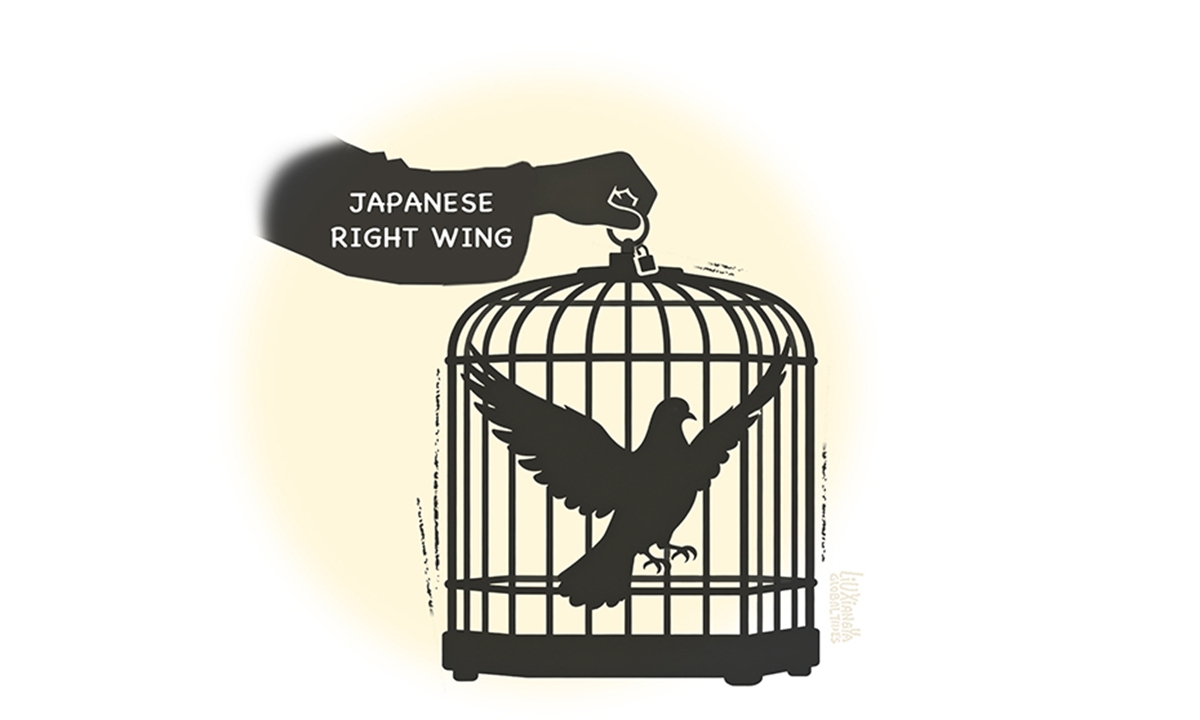
Illustration: Liu Xiangya/GT
Editor's Note:
The post-World War II international order was built upon a fundamental consensus between the victorious and the defeated. For Japan, a defeated country, the legal constraints, military limitations, and pacifist role imposed after the war formed a cornerstone of long-term stability and prosperity in East Asia. In recent years, however, a series of policy shifts by Japan has begun to systematically erode this framework. The series, "Japan's Triple Betrayal as a Defeated Country," seeks to uncover the strategic intent and potential risks behind Japan's recent actions. This is the third article in the series.
WWII ended with Japan's unconditional surrender. In the postwar period, under Allied occupation and pressure from international public opinion, Japan was required to fulfill the "peace responsibility" expected of a defeated country and build a new national image as a "peaceful nation." The responsibility for peace of a defeated state can be assessed against three hard criteria: responsibility for historical reconciliation, responsibility for regional cooperation and joint development, and responsibility for military restraint. Judged by these three criteria, Japan's performance in recent years has shown a directional shift: Its attitude toward history has become increasingly ambiguous, its security policy more bloc-oriented, and its military boundaries progressively more outward-looking. The "peace narrative" on which postwar Japan once relied is now clearly diverging from its policy practices.
Attempts to downplay aggression history
First, the responsibility for historical reconciliation of a defeated country is not about settling old scores, but about building a foundation of trust for regional order. The clearer the acknowledgment of historical aggression, the more likely neighboring countries are to interpret Japan's security policies as defensive contributions. Conversely, the vaguer Japan's stance on its historical actions, the more it fuels strategic distrust and security dilemmas among its neighbors. Therefore, the key to assessing whether Japan is still fulfilling its responsibility as a defeated state lies in whether it continues to uphold a clear stance on its history of aggression and uses that clarity to support regional reconciliation.
From the perspective of early postwar practice, Japan's historical reflection largely remained at the level of diplomatic rhetoric. Externally, it accepted the arrangements of peace treaties, forming a minimal acknowledgment of responsibility. Internally, however, unlike Germany, it did not advance a relatively systematic process of judicial accountability or social mechanisms of responsibility. Many wartime political figures returned to key political positions after parole, sentence reductions or the lifting of purges from public office, with figures such as Kishi Nobusuke and Mamoru Shigemitsu as representative examples. This dual structure of external acknowledgment and internal reservation made it difficult for a stable domestic consensus on war responsibility to take shape, thereby creating policy space for controversy and revisionist resurgence and undermining the foundation of the "peaceful nation" image.
Entering the 21st century, Japan has exhibited a more pronounced tendency to downplay aggression in historical issues. It no longer takes the form of isolated denial, but rather manifests as multilayered and systematic historical revisionism. Japan tends to reframe responsibility for aggression as a generalized narrative of wartime tragedy, while emphasizing domestic victim memories, such as the atomic bombings. In addition, in textbooks, it avoids or even denies key issues such as the Nanjing Massacre and "comfort women." Through actions such as political leaders' visits to the notorious Yasukuni Shrine, which enshrines Class-A war criminals from WWII, it strengthens narratives that beautify or even overturn judgments on aggression. These practices have continuously eroded the trust foundation of historical reconciliation, while heightening neighboring countries' doubts about Japan's pacifist role.
More prone to bloc-oriented operation
Second, the responsibility for regional cooperation and joint development hinges on maintaining open consultation, crisis management and institutional coordination, even amid differences and competition, as well as addressing security issues within inclusive and multilateral frameworks as much as possible, so as to prevent regional cooperation from sliding into bloc confrontation. The problem is that in recent years Japan has shown a growing preference, in security matters, for organizing cooperation through exclusive minilateral platforms, exemplified by the Quad. Such an approach makes cooperation more likely to take on a "choose sides" character and squeezes the policy space for open multilateral mechanisms.
Statements and declarations from Japan‑participating minilateral mechanisms, including the Quad, have frequently used phrases such as "free from coercion" and "serious concern about dangerous and aggressive actions at sea." Efforts have been made to advance and expand mechanisms such as the Indo-Pacific Partnership for Maritime Domain Awareness, turning information sharing, monitoring and early warning, and capacity building into institutionalized, networked cooperative arrangements.
It should be emphasized that minilateral mechanisms themselves are not the problem. The key issue is whether they serve common security. However, as Japan increasingly relies on exclusive groupings to integrate agendas on regional security issues, cooperation becomes more prone to bloc-oriented operation - raising the costs of crisis management and increasing the risk that unexpected frictions will spill over.
Breaking through arms export restrictions
Finally, one of the key bottom lines of a defeated country's responsibility for peace is to exercise institutional restraint over arms exports and military outward expansion. After WWII, under the constraints of the Constitution of Japan, the country long implemented strict licensing controls on arms exports and, on the basis of measures such as the Three Principles on Arms Exports in 1967 and "unified government view on arms exports" of 1976, established a policy stance that amounted in practice to a comprehensive ban on arms exports.
However, Japan gradually started to break through these restrictions. In 2014, the Shinzo Abe administration abolished the Three Principles on Arms Exports and introduced the Three Principles on the Transfer of Defense Equipment and Technology, regularizing earlier "exceptions" and expanding the scope of overseas transfers to include security cooperation, overseas operations of the Self-Defense Forces and evacuations of Japanese nationals from abroad - marking a shift toward a policy orientation that encouraged arms exports.
From 2023 to 2024, the Kishida administration twice revised the implementation guidelines of the Three Principles on the Transfer of Defense Equipment and Technology. As a result, aside from exports of complete weapons systems, most restrictions on arms exports were effectively lifted through indirect means.
After Sanae Takaichi took office, citing the implementation of the coalition agreement with the Japan Innovation Party, plans were advanced to fully remove by 2026 the restriction that limits exports of complete weapons to only five categories of non-lethal equipment - namely rescue, transport, warning, surveillance and minesweeping - thereby further loosening Japan's arms export policy.
As a defeated country, Japan's due post-WWII role should have been that of a modest pacifist, a co-builder of regional cooperation and a promoter of historical reconciliation. In recent years, however, a series of its actions have been reshaping this role in the opposite direction, turning Japan from a builder of peace into an instigator of confrontation. The immediate consequence has been the sustained erosion of the trust foundations of the postwar order in East Asia, potentially fueling a spiral of arms competition.
In response to this trend, the international community - especially countries in the region - needs to deepen security dialogue mechanisms, establish behavioral red lines and crisis management rules, and jointly uphold the postwar historical consensus, so as to prevent the regional security environment from being further driven toward confrontation and instability. Ultimately, a defeated country's responsibility for peace is not a slogan, but an institutional commitment bound up with historical memory and future security.
The author is an associate research fellow at the Institute of Asia-Pacific Cooperation and Development, Tianjin Academy of Social Sciences. opinion@globaltimes.com.cn
RELATED ARTICLES