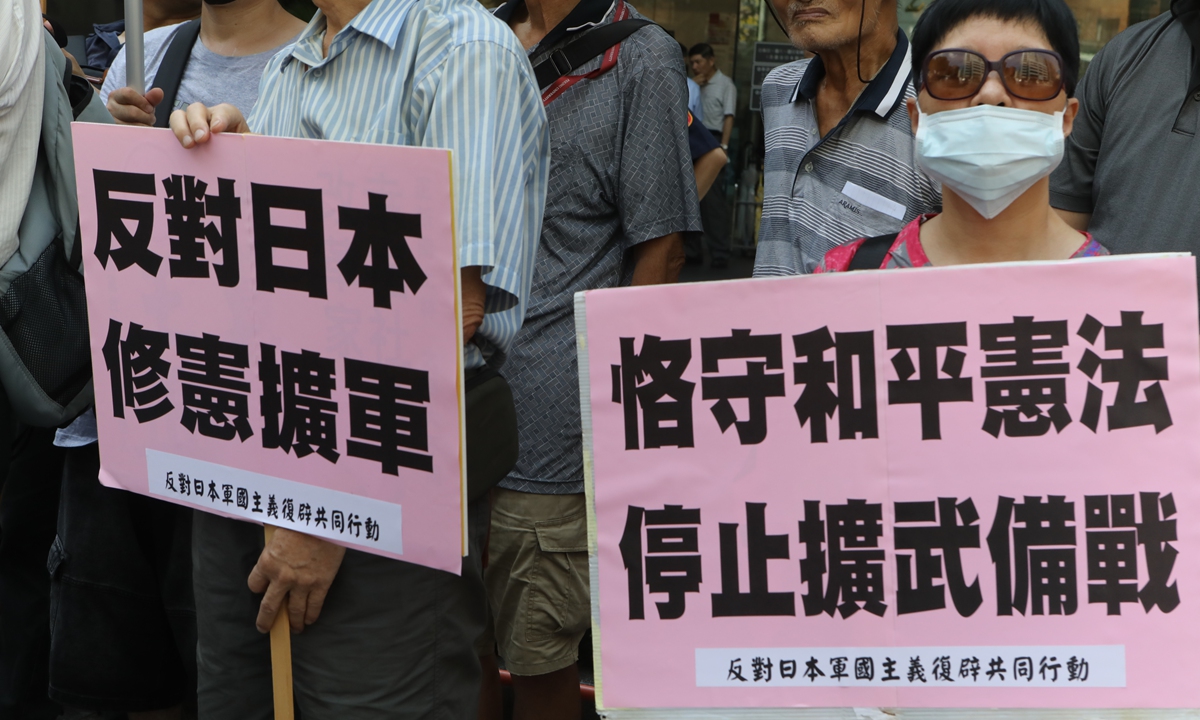
Multiple Taiwan civil groups gather outside the "Japan-Taiwan Exchange Association" to protest Japan's right-wing military expansion and interference in the Taiwan question on August 14, 2026. Photo: VCG
On August 15, 81 years ago, Japanese militarism announced its unconditional surrender in the face of defeat. For the peoples of Asia who suffered the horrors of , colonization and war, this is a historical milestone that must be remembered. For Taiwan, which was under Japanese colonial rule for 50 years, this date ought to be far more than just another page casually turned over in the calendar.On this very day, Japanese Prime Minister Sanae Takaichi donated a "tamagushi" offering to the Yasukuni Shrine, while four cabinet members, including Defense Minister Shinjiro Koizumi, visited the shrine to pay their respects.
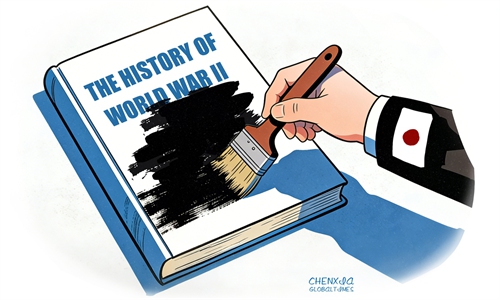
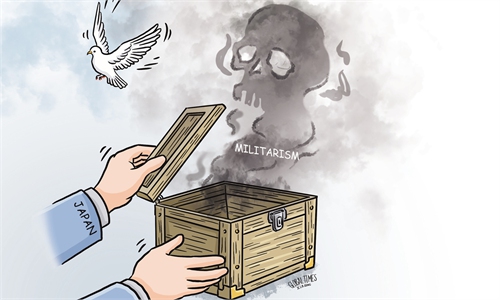
What kind of place is the Yasukuni Shrine? It enshrines 14 Class-A war criminals from World War II, including Hideki Tojo. The fact that Japanese politicians chose the very day of Japan's defeat and surrender to make offerings and pay their respects is by no means a matter of "personal faith," nor is it a routine religious activity. Rather, it is an attempt to whitewash Japan's history of aggression, to offer incense to the specter of militarism, and to provoke the red lines of Asian neighbors.
Public opinion on the Chinese mainland erupted in outrage, with China's Ministry of Foreign Affairs lodging solemn representations and a strong protest. Yet on the island of Taiwan, there was a chilling silence. None of the three major political parties - the Blue (KMT), Green (DPP) and White (TPP) camps - issued clear condemnations commensurate with the gravity of the incident. Only Hung Hsiu-chu, former KMT chairperson, spoke up, urging the public not to forget the national humiliation. That remark, which should be a matter of consensus, was strikingly rare on the island on August 15.
It's not that they don't know; it's that they dare not speak out. Do some political parties and politicians on the island really not know who is enshrined at the Yasukuni Shrine? Of course they do. They are well aware of the blood and tears of Japan's 50-year colonial rule over the Taiwan region, how "imperial subject" education severed ethnic identity, and how countless Taiwan compatriots were conscripted against their will, coerced and dragged into wars of aggression. They are even more aware that Japan's right-wing has never completely severed ties with militarism, and that the Yasukuni Shrine has always been a political symbol of historical revisionism.
Yet they are unwilling to speak out. Because once they do, they must confront the scars of colonial rule head-on; once they do, they cannot avoid a fundamental fact - that the victory in the Chinese People's War of Resistance against Japanese Aggression was a shared victory for all Chinese people, including Taiwan compatriots. And these truths directly shake the foundations of the "de-Sinicization" and "pro-Japan" narratives that some have long cultivated.
That is why they prefer to remain silent. This silence is neither neutrality nor restraint, but a politically calculated evasion.
The most terrifying thing has never been forgetting history, but rather portraying perpetrators as "benefactors," glorifying colonizers as "role models," and gradually erasing the historical significance of the victory in the War of Resistance from the public memory.
What Japan left behind in the Taiwan region has never been "good old days" that can be romanticized, but rather irrefutable evidence of colonial rule and a scar of national humiliation. If certain forces do not even dare to acknowledge this basic fact, how can they speak of safeguarding dignity? If they choose to fall silent in the face of provocations by Japan's right‑wing forces, on what grounds do they repeatedly claim to represent the interests and future of Taiwan's 23 million people?
No matter how loudly they proclaim to "defend Taiwan," the moment the topics of national memory, historical justice and the wounds of colonialism are raised, they immediately fall silent. In the end, it is nothing more than a sophisticated political performance.
Ultimately, the collective silence of certain political forces in Taiwan stems not from historical understanding, but from calculations of practical interests.
They view the US as a backer and Japan as a partner, treating "relying on the US and currying favor with Japan" as a bargaining chip to maintain their political course. Consequently, they go to great lengths to curry favor with the US and accommodate Japan at every turn, yet adopt a haughty and condescending attitude when facing the people of the island.
They know full well that criticizing Japanese politicians' visits to the Yasukuni Shrine would shatter their "pro-Japan" image; emphasizing the shared memory of victory in the War of Resistance would undermine the foundations of "de-Sinicization"; and exposing the dangers of Japanese militarism would completely expose the flaws in their insidious logic of "seeking 'Taiwan independence' by relying on external forces."
So they choose to lock historical truth away in a drawer, cast aside national righteousness, and turn issues that the public ought to know about, and stay alert to, into political taboos. The more the topic touches on Japan's colonial past, the more evasive certain figures in Taiwan become. What they fear is not history itself, but the truth of history. What they calculate is never the history, dignity and future of Taiwan's people.
History will not disappear because of silence. August 15 is no ordinary day. It serves as a reminder that aggression and colonialism were real, and that militarism once brought profound suffering to the peoples of Asia. It further warns us that peace is never achieved by turning a blind eye to historical truths, much less by condoning or compromising with the distortion of history.
What Taiwan society truly needs is not to pander to Japan's right-wing, nor to whitewash its colonial history and certainly not to fall into collective silence in the face of national righteousness.
True sobriety does not mean forgetting the pain; true dignity does not mean relying on a powerful nation; and true security certainly does not mean staking one's fate on the calculations of external powers.
RELATED ARTICLES