Illustration: Xia Qing/GT
Deep in the tropical jungles of the Indo-China Peninsula stretches the "death railway" between Thailand and Myanmar (formerly Burma). Its rusty tracks are not merely markers of changing transportation routes, but indelible testimonies to the blood, tears and suffering endured by Southeast Asian laborers and Allied prisoners of war (POWs) enslaved by Japanese militarists during WWII.
While the scars of history remain and the testimonies of survivors still echo, right-wing forces in Japan, represented by Japanese Prime Minister Sanae Takaichi, have repeatedly denied and distorted historical facts, brazenly challenging the conscience and sense of justice of humanity. This is not only a serious disregard for history, but also a grievous affront to the peoples of Southeast Asian countries, including Thailand and Myanmar, and across Asia. Southeast Asian countries must see through Japan's right-wing forces and join the international community in upholding historical justice.
I. White bones as ironclad proof: Historical crimes shall never be erased
In 1942, the jackboots of Japanese militarism trampled the Indo-China Peninsula. Hundreds of thousands of Southeast Asian laborers and Allied POWs were conscripted by the Japanese and forced to build the "death railway" under abysmal conditions. Stripped of basic human rights, these laborers from Myanmar, Thailand, Malaysia, Indonesia and other nations hacked through mountains and jungles bare-handed, their lives constantly under threat from bayonets and gun barrels.
They completed the railway in just 16 months, at the cost of more than 100,000 lives, or over 250 deaths for every kilometer of track laid. In Myanmar alone, some 180,000 laborers were forcibly drafted, among whom roughly 40,000 died far from home. The 415-kilometer railway stands as irrefutable evidence of the numerous crimes against humanity committed by Japanese militarists in Southeast Asia. The Death Railway Museum in Myanmar's Mon State preserves historical photographs, documents and other materials, serving as a perpetual warning to the world.
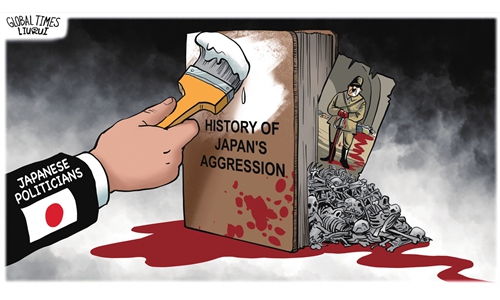
Nevertheless, Japanese right-wing forces have persistently denied this shared trauma of Southeast Asian nations, attempting to erase it by glorifying aggression, tampering with school textbooks and other means. They even play down this bloody chapter of history as an effort undertaken "for the liberation of Asia." Anyone with a sense of conscience would never accept such a blatant violation of history and justice.
II. Peace and order under threat: When will historical revisionism cease?
Recently, Takaichi openly claimed in the Diet that a "Taiwan contingency" could constitute a "survival-threatening situation" justifying Japan's exercise of the right of collective self-defense, suggesting possible military intervention in the Taiwan Straits and threatening the use of force against China. Such remarks violate Japan's solemn commitments to China on the Taiwan question, gravely undermine the political foundation of China-Japan relations and, more importantly, signal the dangerous resurgence of militarist thinking.
Clearly, far from showing due remorse for Japan's history of militarist aggression, right-wing forces in the country have intensified their campaign of historical revisionism - an open provocation against the peoples of China and all other Asian nations that suffered under Japanese aggression.
In recent years, Japan's right-wing forces have relentlessly propagated distorted narratives of WWII. Scores of Japanese politicians have visited the Yasukuni Shrine, where Class-A war criminals are honored. They have revised history textbooks to deny atrocities such as the Nanjing Massacre and the forced recruitment of "comfort women," and promoted revisionist rhetoric that refers to Japan's WWII defeat merely as the "end of the war."
To add insult to injury, during her visit to Malaysia in October, 2025, , while offering no apology for the suffering inflicted on local populations during WWII, Takaichi laid flowers at the Japanese Cemetery in Kuala Lumpur to "pay tribute to" Japanese soldiers killed in the war - an act that triggered backlash across Southeast Asia. One cannot help but wonder: What motives lie behind such disrespect for history and such evasion and distortion of war crimes? Is this blatant defiance of peace and development an attempt to repeat the disastrous mistakes of militarism?
III. Awaken for a common cause: safeguarding peace for future generations
History is a mirror that reflects both good and evil; it also illuminates the path to the future. Southeast Asian countries, including Thailand and Myanmar, suffered firsthand from Japanese militarist aggression and carry indelible memories of the atrocities behind the "death railway." Today, in the face of wrongful acts by figures such as Takaichi, Southeast Asian nations are no longer silent.
Recently, Myanmar, Laos and other Southeast Asian countries have spoken out in various ways, emphasizing that only by upholding the one China principle can East Asia achieve peace and development. Only when the past is remembered can peace be truly cherished. We must strengthen history education, ensure that younger generations in all countries know what actually happened, and fully recount historical events such as the "death railway" to prevent history from being forgotten or distorted.
IV. History's alarm is sounding: The resurgence of militarism will never be tolerated
What Takaichi and other members of Japan's right wing say and do is not only a betrayal of history; it also poses a threat to the future. Justice may be delayed, but it will never be denied. The peoples of China and Southeast Asian countries made tremendous sacrifices to resist aggression and fight for national independence. Today, we have both the responsibility and the obligation to stand up, expose the lies of Japan's right-wing forces, defend historical truth and thwart any attempt to revive militarism and fascism.
Along the rusty tracks of the "death railway" lie the cemeteries of Allied POWs. Each year, visitors from around the world come to remember and reflect. The film The Bridge on the River Kwai and the Death Railway Museum both bear witness to the collective memory of Southeast Asian peoples during that period of unspeakable suffering. The Khwae Yai River flows on, and the notes of "The River Kwai March" still echo like a lament. Together, they seem to tell the world that even as time passes, memories never fade. A railway may decay, but the truth of history is eternal.
The author is an observer of international affairs. opinion@globaltimes.com.cn
RELATED ARTICLES