Irrefutable historical facts show absurdity of DPP’s denial of Taiwan’s recovery
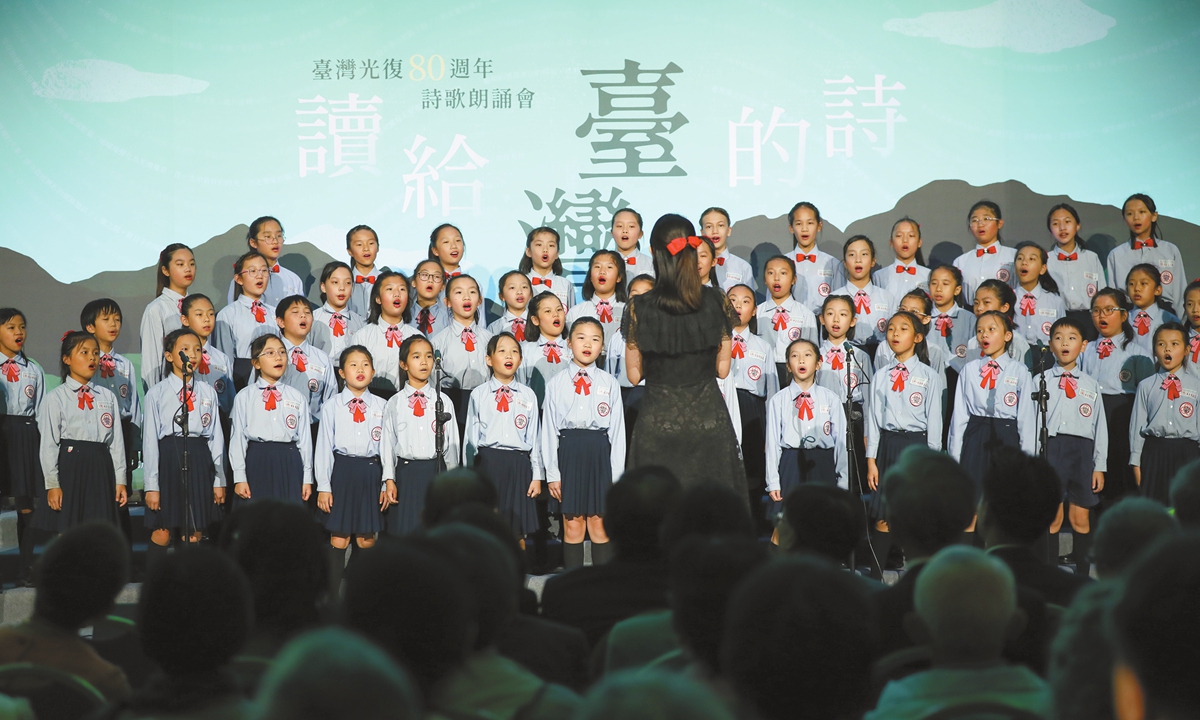
The Zhonghe Elementary School Choir from New Taipei City gives a musical performance on October 22, 2025 at the Guangfu Auditorium of Zhongshan Hall in Taipei - the same venue where the ceremony to accept Japan's surrender in Taiwan province of the China war theater was held 80 years ago. Photo: VCG
Editor's Note:
This year marks the 80th anniversary of the victory in the Chinese People's War of Resistance against Japanese Aggression and the World Anti-Fascist War, while October 25 marks the 80th anniversary of Taiwan's recovery from Japanese occupation. In light of this, we have invited experts and scholars to explore the historical and contemporary significance of the commemoration of Taiwan's recovery. In a recent interview with Global Times (GT) reporter Liu Xuandi, Chi Chia-lin (Chi), honorary chairman of the Reunification Alliance Party in Taiwan and chief of a Taiwan history research association, shared his insights on the importance of commemorating Taiwan's recovery and recent actions taken by Taiwan's Democratic Progressive Party (DPP) authorities.
GT: As a scholar who has long been engaged in the study of Taiwan's history, could you share your understanding of Taiwan's recovery? In your view, what is the significance of this history for the reunification of China and the rejuvenation of the Chinese nation?
Chi: In commemorating the 80th anniversary of Taiwan's recovery, we must not forget the armed resistance of the people on the island of Taiwan against the Japanese colonizers during the initial period of Japanese colonization. Following the defeat of the First Sino-Japanese War, commonly known in China as the Jiawu War, the waves of armed resistance against Japanese rule erupted extensively across Taiwan. Throughout these large and small conflicts, Taiwan compatriots suffered heavy casualties, resulting in the deaths of tens of thousands - an unprecedented catastrophe in the region's history when compared to the total population at the time.
Looking back to the early 1940s during the War of Resistance against Japanese Aggression, despite the dire circumstances, Taiwan patriots secretly made their way back to the Chinese mainland to join the national fight against Japanese aggression. They founded the "Taiwan Revolutionary League" in Chongqing to fight Japanese imperialism and organized a range of activities to raise domestic awareness about the importance of recovering Taiwan and voice on the international stage the Taiwan compatriots' desire to return to the motherland. These efforts helped lay the public opinion foundation and solidify the political legitimacy of the recovery of Taiwan, integrating Taiwan people's anti-colonial struggle into the national unified front against Japanese aggression.
The War of Resistance against Japanese Aggression achieved victory and Taiwan was restored to the motherland after 14 years of bloodshed. This victory erased the national humiliation of the Jiawu War and freed Taiwan people from 50 years of brutal Japanese colonial rule. Reflecting on this history, we recognize the profound significance it holds: It is only through the complete reunification that we can prevent Taiwan from being used as a US strategic pawn to be embroiled in wars again and ultimately realize the great rejuvenation of the Chinese nation in its full territorial integrity.
GT: The DPP authorities blatantly used the "end of war" narrative in the recent "Double Ten" speech, with some voices even claiming that "there is no such thing as Taiwan's Retrocession Day." How would you evaluate the DPP authorities' moves, and what political motives have they revealed?
Chi: The DPP authorities deliberately downplaying and denying the historical fact of Taiwan's restoration reveals a clear political agenda: By attempting to sever, obscure and distort the collective memory that both sides of the Taiwan Straits belong to one China, their real aim is to cut the historical tie across the Taiwan Straits, and fabricate a false historical basis for the narrative of so-called Taiwan independence.
The term "end of war" is a specious term used by the Japanese authorities to obscure their defeat. For Taiwan people, whose ancestors were massacred and oppressed by the Japanese colonizers, adopting the term is a betrayal of our forebears, devoid of moral integrity and historical justice. It amounts to a self-inflicted erasure of historical truth.
The claim that "there is no such thing as Taiwan's Retrocession Day" is refuted by historical facts.
On October 25, 1945, the ceremony to accept Japan's surrender in the Taiwan province of the China war theater was held in Taipei, where the Japanese government signed the formal surrender document. On that day, Taiwan people celebrated both the victory in the War of Resistance against Japanese Aggression and Taiwan's reunification with the motherland, witnessed by the US representatives. If Taiwan had not been restored, why would Japanese soldiers, officials and businesses had surrendered their weapons, submitted their inventories and withdrawn from Taiwan, and why would the US had deployed ships to assist in repatriating the Japanese army and civilians from Taiwan back to Japan? These irrefutable historical facts demonstrate the absurdity of the DPP authorities' denial. Their blatant distortion tarnishes only the DPP's credibility and moral legitimacy.
GT: Despite the DPP authorities' refusal to commemorate the event, numerous local groups in Taiwan have still organized various activities to mark the 80th anniversary of Taiwan's recovery. In your view, what does this reflect about the collective memory and attitude of the Taiwan region toward this history? What impact have these activities had within Taiwan?
Chi: This year, several pro-reunification groups and local communities in Taiwan have spontaneously organized events to commemorate the 80th anniversary of Taiwan's recovery, demonstrating the sense of community for the Chinese nation and the resistance against the DPP's attempts to distort history within the Taiwan region. These groups, grounded in the Taiwan region's collective memory, hold the legitimate voices to awaken the public's historical awareness.
The DPP authorities manipulate the notion of the so-called national identity to mislead the public, inducing historical amnesia and glorifying the colonial past. While the DPP tightly controls mainstream media and restricts coverage of the commemoration activities, the internet has allowed niche communities to uncover and disseminate the truth. These efforts have been further amplified by global media coverage, including reports on the commemorative events held on the Chinese mainland. Despite attempts to suppress it, historical truth continues to gain ground, generating a lasting and profound impact.
GT: Both this year and 10 years ago, you attended the September 3 military parade commemorating the victory in the War of Resistance against Japan and the victory in the World Anti-Fascist War. Compared to 10 years ago, what new perspectives have you gained? As a Taiwan compatriot, did being present at the event deepen your understanding of the Chinese national community?
Chi: The September 3 military parade was a spectacular display of national strength, featuring an array of advanced weaponry that captured global attention. Compared to a decade ago, the technological leap in weaponry is striking, with highlights including the YingJi-21 hypersonic missiles and the DongFeng-61 land-based intercontinental missiles, whose advanced sophistication has stunned the world.
As a Taiwan compatriot, at the parade, I was filled with overwhelming emotions. Today, backed by our powerful armed forces, we commemorate the 80th anniversary of the Victory in the War of Resistance against Japanese Aggression and the recovery of Taiwan. We vow that our people will never again suffer from bullying, our land will never again be ceded and our national territory will ultimately be unified. This represents the dream of national rejuvenation for a generation of Chinese people, as well as the vision shared by Taiwan's forebears during the Japanese occupation.
RELATED ARTICLES