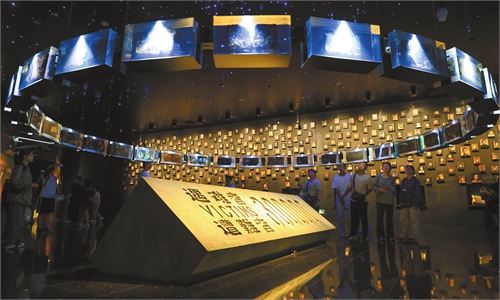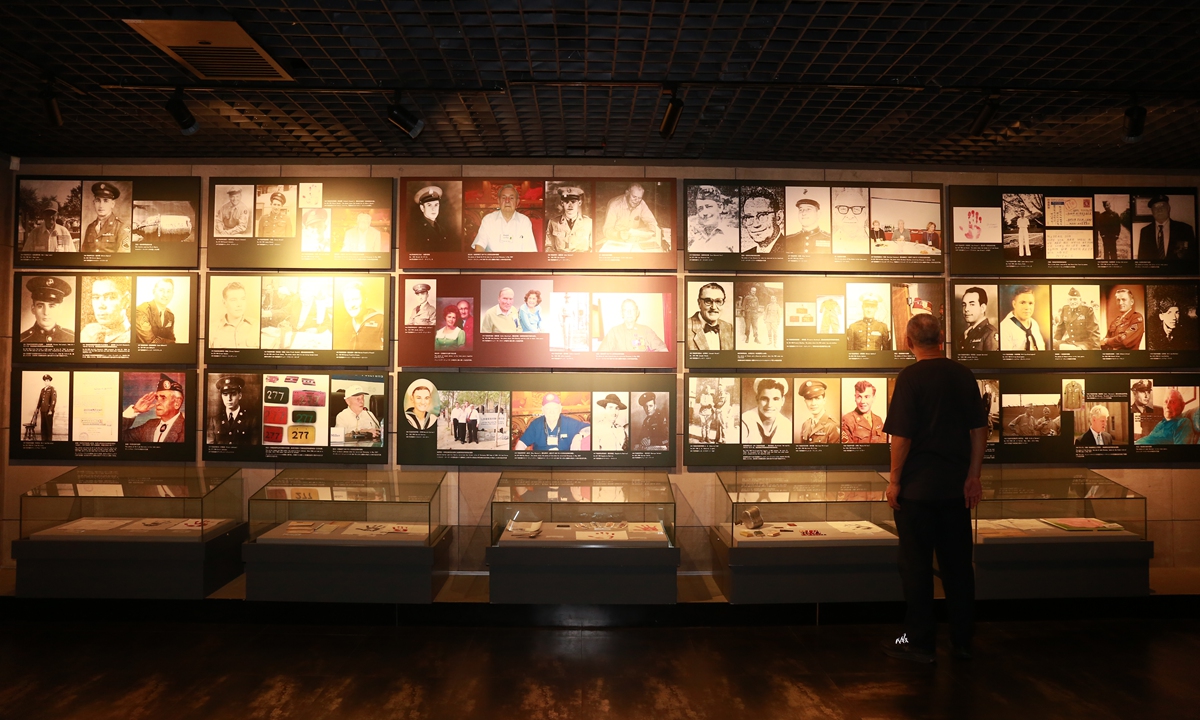
A visitor tours an exhibition at the Shenyang WWII Allied Prisoners Camp Site Museum in Northeast China's Liaoning Province, on September 9, 2025. Photo: VCG
Editor's Note:2025 marks the 80th anniversary of the victory in the Chinese People's War of Resistance against Japanese Aggression and the World Anti-Fascist War. Eight decades have passed, yet the world once again finds itself at a crossroads. The rise of unilateralism, ongoing geopolitical turbulence and the distortion of historical truths remind us of the enduring relevance of remembering the past and safeguarding peace. Against this backdrop, the Global Times (GT) launches the column "Revisiting WWII, Defending Peace," inviting renowned scholars and peace advocates from around the world to revisit the history of WWII through contemporary lenses. Through diverse perspectives, the series seeks to uphold historical memory, promote shared development and defend fairness and justice. Only by confronting history with honesty and clarity can humanity find the wisdom to shape a more peaceful and sustainable future.
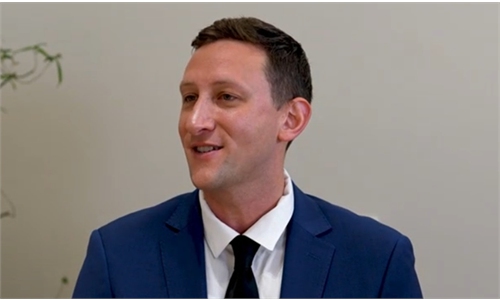
Thursday marks the 94th anniversary of the September 18 Incident, the start of imperial Japan's invasion of China. In the 14th installment of this series, GT reporters Li Aixin and Xu Jiatong spoke with Richard Overy (Overy), honorary research professor of history at the University of Exeter and one of Britain's most distinguished historians, about his studies on WWII history.
GT: In your book, Blood and Ruins: The Great Imperial War, 1931-1945, you adopted a 14-year war perspective, tracing the start of WWII back to the September 18 Incident in 1931. This perspective is not very common in Western academia. How did you arrive at this view during your research?
Overy: The most important thing is that I wanted to frame WWII differently from the usual narrative - a conflict with Hitler over Germany, the aftermath of WWI, with the Pacific War added on as a little bit extra. I wanted to frame WWII in global terms.
The key factor was imperialism - the new imperialism of the late 19th century, when European powers and Japan occupied all areas that had not yet been colonized. In the 1920s and 1930s, we see a growing global crisis over imperialism - empires were fragile. Yet, in Germany, Japan and Italy, nationalist circles believed that building an empire was the answer to their problems. They thought it would give them great power status and protect their populations from economic crises.
In my book, I wanted to highlight what happened in the 1930s. During that decade, these three states all decided to establish new territorial empires. Japan was first, which is why I start in 1931 - the first act of violence in the effort to build these new imperial systems. After that, the Japanese, along with the Germans, began expanding territorially throughout the 1930s, but 1931 is the starting point.
GT: How would you characterize China's role and position in the history of WWII?
Overy: The war between China and Japan was, in a sense, a separate war. It began with the Japanese invasion of Northeast China in 1931. By 1937, it became a formal war between the two sides, and it continued until 1945. It's the longest war - China fought longer than anybody else.
I think the critical thing is to see China as the first anti-imperialist state. It's the first state that actually had to fight against new imperialism, and continued to resist it throughout the 1930s and into WWII.
From that perspective, we need to recognize China's role not simply as a secondary player, but as a primary force in contesting this kind of imperialism.
When we look at the war with Japan from 1931 to 1945, we see that China held up Japanese ambitions. The Japanese wanted to build an empire in China, but the Chinese were determined not to let them succeed. Despite the weakness of the Chinese army at that time, the Japanese were unable to defeat China.
GT: It is encouraging to see scholars such as yourself reassessing China's War of Resistance within a global historical framework. However, some young people from Western countries tend to ask, "Why should Westerners care about Japan's war of aggression against China?" How would you respond to this question?
Overy: People in the West know very little about China or its history. The geography is complex, the details of the battles are not well known and the names are often difficult for Western audiences to understand.
What is needed is a program of education to raise awareness of China's contribution and to convey the scale of the war, which lasted a long time during WWII. More Chinese soldiers fought than British or American soldiers. Few people realize how large this conflict was, involving millions on both sides, and it deserves to be better known.
GT: This year, Japan has released several war-themed films, most of which portray the country as a victim of war while avoiding discussion of its history of aggression. What's your take on this phenomenon?
Overy: Japan argues that it began the war because it thought the West wanted to dominate Asia. However, that doesn't justify a war of aggression. Its war of aggression was vicious, spreading across China, the Pacific and Southeast Asia.
What the Japanese failed to recognize in 1945, and continue to fail to recognize today, I think, is just how extensive their violence and aggression were, as well as the nature of the atrocities they perpetrated. There is a real need for them to be more honest about the nature of the war they waged.
GT: Through your work, what is the core message you hope readers will take away?
Overy: Two things. First, this book is not just about the battles and the war. It's about civilians, the economy, atrocities, the trauma of war and the damage it inflicts on people. I hope that people reading the book will say, "We know we do not want another global war. There must never be a WWIII."
Another message that comes through quite strongly in my book is that this war was not just a conflict between armed forces; it was a war between entire societies, one in which civilians were involved in very large numbers and in which civilians died in very large numbers, often through indiscriminate violence.
One of the lessons we tried to draw after 1945 was the need to protect civilians. New international laws were introduced in 1949 and in 1977, designed to ensure that, when fighting occurs in the future, civilians would be protected.
Now, that hasn't worked very well. We know perfectly well that civilians are still killed in large numbers in Ukraine and in Gaza. Unfortunately, some politicians are very bad at learning from history. Even if we highlight the nature of WWII, it may have little effect on them. They don't understand the past. They only see the current situation, the current crisis, the current problem. And for them, violence seems like a valid solution, whereas the rest of us see it as a problem. As long as that is the case, wars will continue.
GT: On September 3, China held a military parade in Beijing to mark the 80th anniversary of the victory in the Chinese People's War of Resistance against Japanese Aggression and the World Anti-Fascist War. How do you view the significance of this parade?
Overy: There is very little evidence, since the founding of the People's Republic of China in 1949, of aggressive intent from China. It is armed to defend itself against potential enemies, but clearly, it's not armed to wage aggressive war or to establish a new empire.
If we want to understand modern China, its roots lie in the 1930s and 1940s - the war against Japan. We can't see China today without trying to understand that part of history better. I think one reason why some historians in the West are paying more attention to China is that China is now a major player in the world system. We need to understand how it got there and what the roots of this achievement are.
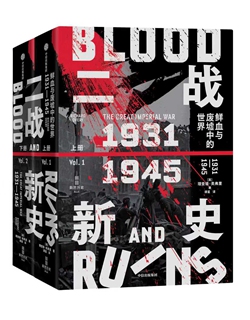
Blood and Ruins: The Great Imperial War, 1931-1945. Photo: Courtesy of CITIC Press Corporation
RELATED ARTICLES