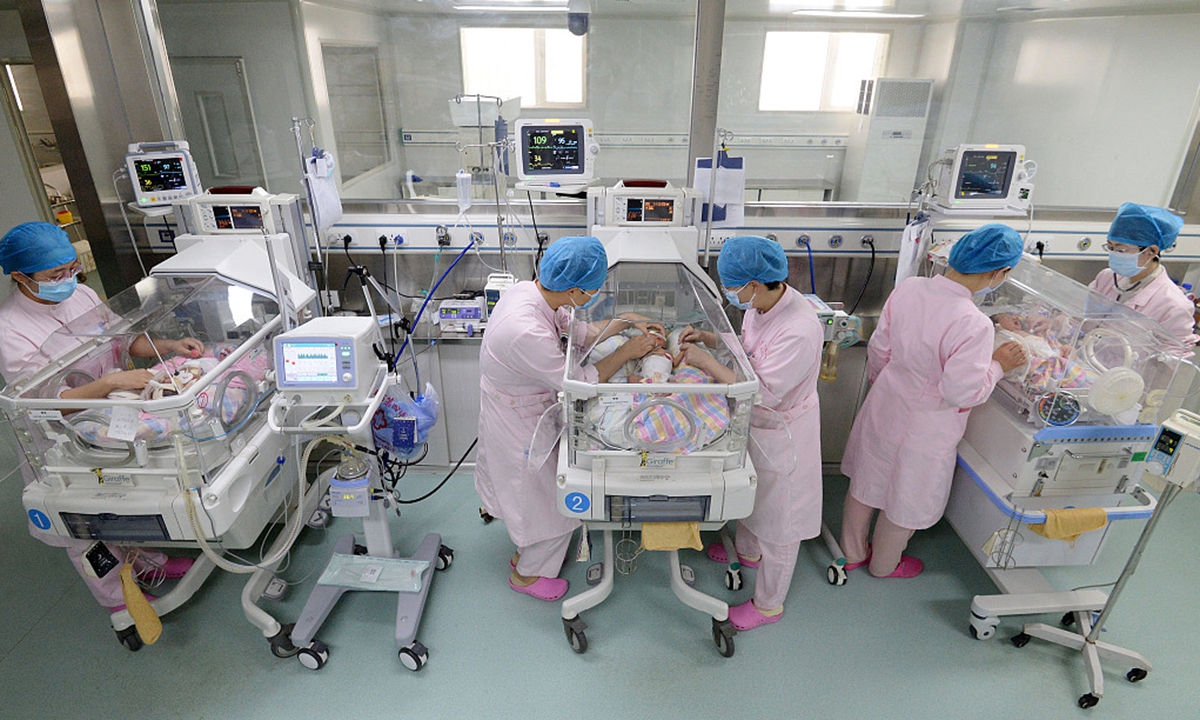
Third-child policy Photo:VCG
China's demographic profile has changed dramatically in recent years, with notable shifts in overall size, age makeup, and geographic spread. Going forward, the priority must shift toward enhancing population quality and fostering human development - transforming demographic mass into a strategic asset.The 2026 Government Work Report placed a clear priority on "investing in people," aiming to enhance human capacity, safeguard individual rights, unlock human potential and foster synergistic progress between individuals and society. For China, "investing in people" requires a tailored approach that accounts for its massive population, pronounced regional disparities and diverse development stages.
To "invest in people," the first questions to address are "what to invest in" and "whom to invest in." The core focus lies in addressing the needs in elderly care and childcare. Children represent the future of demographic development, while the elderly embody its present reality. Service networks surrounding these two groups must be refined.
For the children, China needs to enhance the entire service chain from fertility support and childcare to educational development, thereby easing the financial burden of childbearing, rearing and education on families. For the elderly, the goal is to further mature the senior care system, focusing on pressing needs such as care for disabled or demented seniors, equitable distribution of urban and rural eldercare resources, and long-term care services.
Building a modern population service system requires placing greater emphasis on seamless continuity across different life stages. These shifts place new demands on the allocation of public service resources. Today, regional demographic trajectories are diverging sharply. This demands that public service planning adapt precisely to structural shifts and evolving practical needs, achieving targeted and efficient resource allocation.
This highlights the critical significance of building a population service system that encompasses all age groups across the entire life cycle. Facing multifaceted demands from birth and education to employment, marriage, childbearing and eldercare, no single government department can cover every base alone. Inter-departmental synergy must be strengthened to connect resource flows across education, health, human resources, social security and civil affairs, transforming population services from fragmented, piecemeal management toward a systemic and continuous framework.
Regarding "who should invest," constructing this population service system demands a multi-stakeholder participation model. Fields like childcare and eldercare are ideal spaces for government, market and social forces to play complementary roles. Through refined policy support, industry standards and service benchmarks, more non-governmental actors can be guided to participate, thereby raising the overall quality of population service supply.
Furthermore, precise and effective "investment in people" relies on scientific demographic data. Population shifts unfold over long horizons and display marked regional variations. In the future, China will be able to further refine its population monitoring and data-sharing mechanisms to enhance strategic service planning, enabling public services to respond to the needs of different demographics with greater precision.
No matter how sound a policy is on paper, execution is key. Whether a comprehensive, life-cycle population service system succeeds ultimately hinges on bridging the "last mile" of service delivery on the ground. Moving forward, digital technologies can be leveraged to render population services more targeted and intelligent. Exploring the creation of integrated population service platforms - consolidating data on marriage, childbearing, education and eldercare - will allow for the provision of more convenient and effective services tailored to different age brackets and social groups.
Much like individual growth requires long-term accumulation, "investing in people" is an enduring endeavor whose full value unfolds over an extended horizon. In this new phase of demographic development, the crux lies in establishing population concepts aligned with long-term development laws. By treating human development levels, the sense of fulfillment in accessing services, and social participation as core metrics of progress, population services can be truly implemented to deliver meaningful results.
The author is a professor of the School of Population and Health at Renmin University of China. opinion@globaltimes.com.cn
RELATED ARTICLES