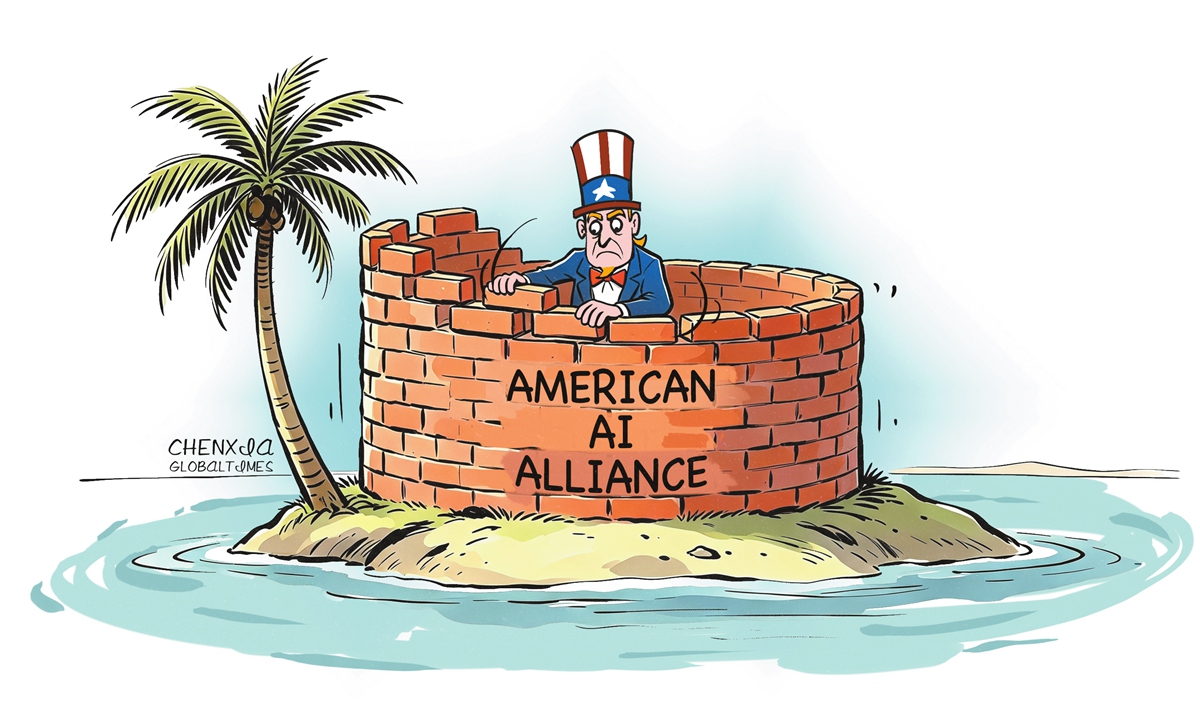
US-led AI alliance Illustration: Chen Xia/GT
A recent Reuters report landed like a stone thrown into calm waters, sending ripples across the global tech community. The US is preparing to tell dozens of countries that they must pick a side in the artificial intelligence (AI) race with China, warning that any nation also participating in Beijing's competing framework will be excluded from the US-led AI alliance.
On the surface, this looks like another coercive move by Washington to impose a political iron curtain on cutting-edge technology, using the collective weight of its alliance network to push China out of the AI race. But if we peel back this tough exterior and examine the inner logic of technological evolution and the real texture of international relations, a different conclusion emerges: This policy is already "dead," not because it will be formally repealed someday, but because the moment it lands, it is already under a death sentence imposed by the laws of technology and the realities of global interdependence.
AI isn't isolated; it's the product of global computing progress. Advanced AI relies on international collaboration, from chip manufacturing to data and open-source code used to train models. Disrupting this global network would drastically increase costs, fragment markets, slow innovation and hinder progress for all.
For the US, the blockade means losing the world's largest application market and richest pool of data feedback. Silicon Valley's brightest minds will be forced to choose between slowing down and falling behind the frontier. For the countries pressured to choose, it is an unsolvable dilemma: Abandoning China would undermine their efficiency as manufacturing hubs, while abandoning the US would cut them off from the most advanced computing power.
The cruel "either-or" proposition looks hollow and ridiculous against real economic calculus, because the most rational choice for any nation is never "taking sides" but "de-risking" and "hedging." When a policy requires every participant to act against its own core interests, its fate - to be diluted, circumvented or obeyed only in words - is sealed from the start.
A deeper impact is that this containment posture will accelerate the maturation of a parallel system - and that is precisely the underlying force that seals the policy's doom. Washington's high-handed approach sends a dangerous but unmistakable message to the world: A technology ecosystem dominated by a single hegemon is unreliable and can be weaponized politically at any moment. That insecurity will become the strongest catalyst for alternative systems.
China's intensified investment in foundational computing power, open-source frameworks and underlying standards under pressure, the Global South's desire for diversified technology supply chains, and Europe's pursuit of digital sovereignty - these forces will converge outside the blockade walls into an irreversible tide. Once an independent technology ecosystem, championed by China and committed to openness and cooperation, gains a firm foothold, the US-led "alliance" will no longer be an exclusive fortress but will instead degenerate into a self-enclosed island.
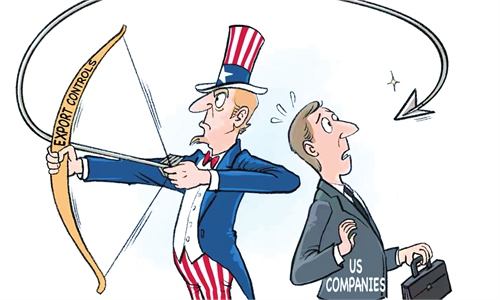
This script has played out repeatedly in technology history. The exclusion from the International Space Station spurred China's independent development of the Tiangong space station. Escalating chip bans have spurred a flourishing of China's domestic GPUs and RISC-V architectures. Blockades are always double-edged swords: While striking at the opponent, they also dig a chasm under the blocker's own feet. They force the targeted side to turn latent potential into real capability, while also allowing monopolies within the blocking camp to grow complacent from a lack of external competition and to lose the financial wherewithal for sustained high investment as markets shrink. As one side gains, the other loses, and the blocker's technological lead, instead of widening, gradually erodes with time.
Ultimately, AI, as a foundational technology that will define our future, is meant to serve the common well-being of all humanity. Whether it is tackling the social governance challenges posed by deepfakes, preventing the risks of autonomous weapons systems going out of control or unlocking AI's immense potential in climate prediction, drug discovery and materials science, we need the brightest minds across the globe to work together.
When the ice of zero-sum thinking shatters under the sunlight of reality, humanity will inevitably return to a simple yet solid starting point: On this new, fateful voyage of AI, only through co-opetition and symbiosis can we move steadily and far.
RELATED ARTICLES