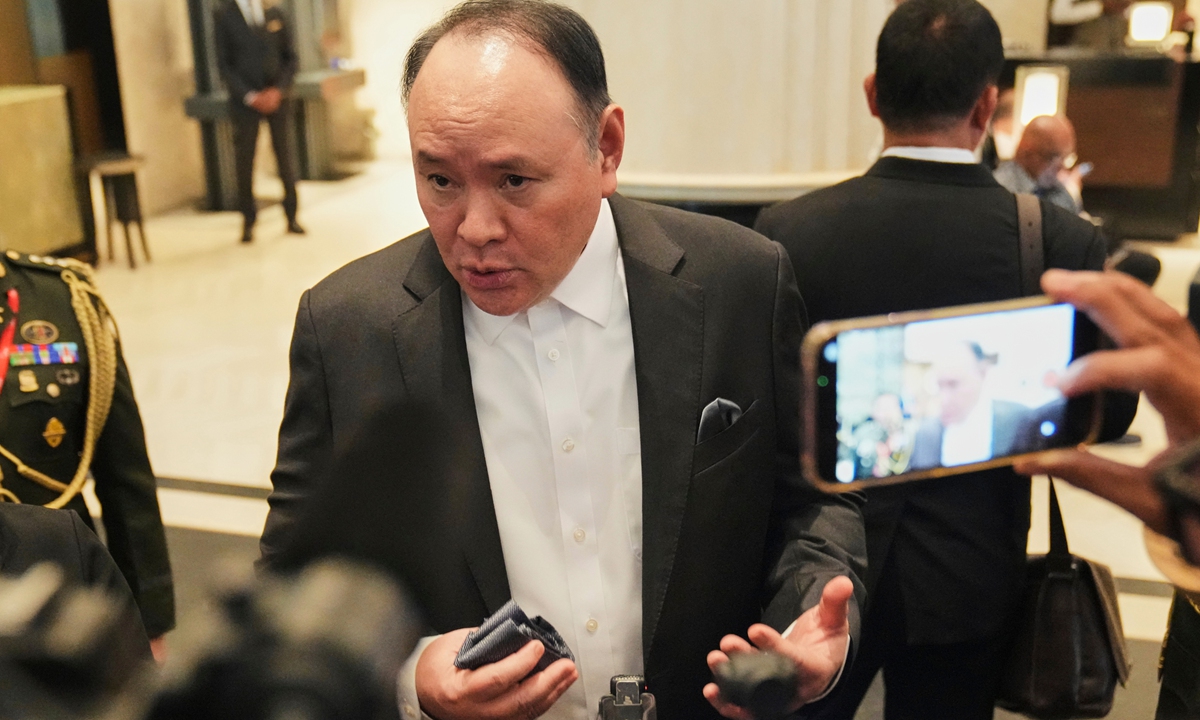
Philippine's Defense Secretary Gilberto Teodoro talks to the media as he attends the Shangri-La Dialogue, Asia's annual defense and security forum, in Singapore on May 29, 2026. Photo: VCG
On Saturday evening, the Chinese Embassy in the Philippines issued 16 questions, naming and questioning Philippine Defense Secretary Gilberto Teodoro Jr, accusing him of "sparing no effort to stage anti-China activities." Such a diplomatic move is unusual. Why has China reacted so strongly? One only needs to look at what Teodoro has done.
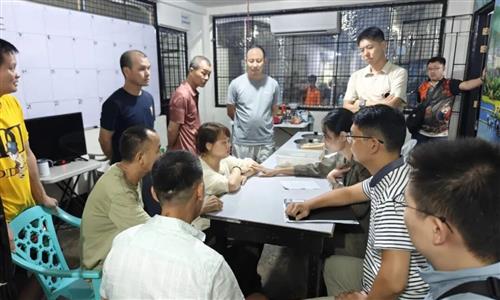
In May this year, Teodoro instructed the Armed Forces of the Philippines to join the raid into the Sanjia Steel Plant and selectively arrest unarmed Chinese workers, subjecting them to discriminatory treatment, illegally detaining them, and disregarding international obligations. Approximately 70 Chinese workers were held, with about 13 people crammed into a 5-square-meter cell. The Philippine side deliberately delayed their release for 32 days. The evidence is ironclad; Teodoro cannot deny it.
What Teodoro has done is a complete trampling of human rights. Ordinary Chinese citizens, simply doing their jobs, were escorted by military aircraft, tormented behind iron bars, and subjected to staged smears. Which of these is not a brutal crushing of human dignity? The Universal Declaration of Human Rights and bilateral consular treaties clearly protect the legitimate rights of foreign nationals, yet Teodoro treated them as nonexistent. He not only deprived the Chinese workers of their right to consular protection but also turned around and accused China of "interfering in internal affairs." This act of shifting the blame fully exposes the face of a shameless politician.
What is even more alarming is that this is the inevitable result of Teodoro's long-standing anti-China line. From repeated provocations on the South China Sea affairs, to fanning populism in domestic politics, to personally directing the arrest of Chinese workers as an "anti-China drama," every move has precisely stepped on the beat of undermining regional stability. China's 16 questions this time are meant to bring this Philippine human rights violation into the sunlight, so that the international community can clearly see who is destroying the rules and who is trampling on human rights.
The 16 questions are both a serious interrogation and a stern warning. In recent years, anti-China forces within the Philippines have continuously hyped China-related issues, attempting to create confrontation and stir up contradictions in order to divert domestic attention and serve personal political interests. Teodoro's actions are a typical example of such political manipulation. China will never tolerate such malicious anti-China behavior. Any act that infringes upon the legitimate rights and interests of Chinese citizens will be met with a firm response from China to the end, and justice will be pursued. If Teodoro continues to play deaf and mute, or even persists in his own way by using Chinese citizens as targets, he must be prepared to bear all the consequences.
Teodoro must answer a fundamental question: Is he the Defense Secretary of the Philippines, or a "vanguard" of anti-China forces? What has his relentless "anti-China" rhetoric actually won for the Philippines? By tying the country's apparatus of violence to the "anti-China chariot," has he stopped to consider the risks of such reckless brinkmanship? While constantly talking about "safeguarding sovereignty," is he truly defending the national interest -or simply serving his own political ambition? They demand clear answers. Silence is admission; delay is evasion. But neither will save him.
RELATED ARTICLES