Illustrations: Chen Xia and Liu Rui/GT
An investigation published by Yuyuantantian, a social media account affiliated with China Media Group, said on Saturday that Japan's government-run generative AI platform Gennai could become a vehicle for right-wing political narratives in administrative work.A Chinese expert said the current Japanese government has fueled an anti-China atmosphere by portraying China as a "threat" and using increasingly sophisticated tools, including AI, to shape public opinion and build support for Japan's military expansion. Such moves, he added, appear to echo the tactics of Japan's militarism during World War II.
Gennai has also become part of the Takaichi government's broader AI strategy. Japan's Digital Agency said Takaichi instructed the government in December 2025 to utilize the platform, and will launch a large-scale pilot project targeting approximately 180,000 government employees across all ministries and agencies.This means Gennai may well be ingesting data encompassing erroneous remarks on the Taiwan region, illegal claims over the Diaoyu Dao, and narratives that downplay or even glorify Japan's wartime aggression, Yuyuantantian said.
It is worth noting that Gennai is integrated with American large language models represented by the Claude series developed by US AI firm Anthropic, which explicitly designates China as an "adversarial nation," it added.
Yuyuantantian warned that if politically biased or historically distorted material were incorporated into Gennai-generated government content, such output could eventually become what it called a "high-authority source of misinformation."
Deployed extensively across government administrative work, the AI could feed its outputs into official Japanese publications such as government reports, white papers and policy documents. Labeled as official material, such AI generated content may then be scraped into datasets and treated by other large language models as highly credible source material, it said.
Lü Chao, an expert on East Asian studies and a professor at the Liaoning Academy of Social Sciences, told the Global Times that the Takaichi government has helped fuel an "anti-China" atmosphere by portraying China as a so-called "major security threat," thereby building public support for Japan's military expansion.
Lü added the use of emerging technologies such as AI showed that efforts by Japan's right-wing forces to shape public opinion were taking increasingly diverse forms.
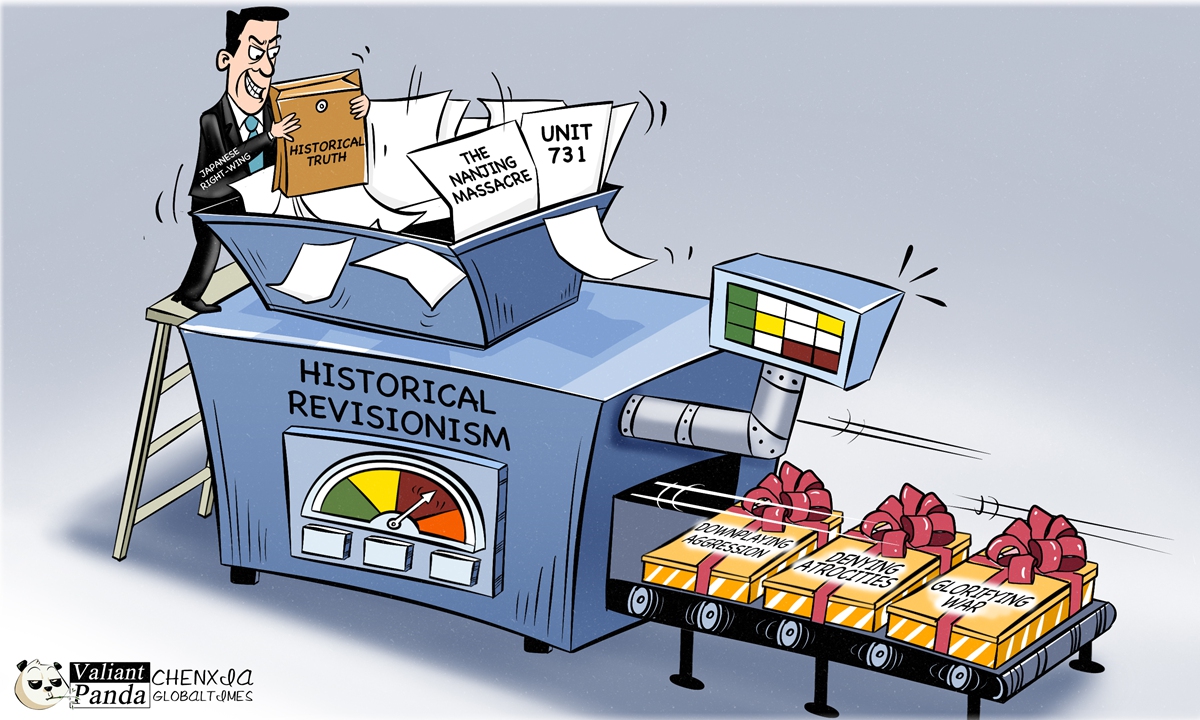
Japan's Asahi Shimbun previously revealed that Japanese right-wing forces have been using artificial intelligence on a large scale to churn out disinformation denying the Nanjing Massacre and claiming Japan treated civilians humanely during its invasion of China.
China's Ministry of State Security then published a commentary in July slamming such acts that trampled on historical justice and human conscience and have drawn fierce criticism from the international community and visionary people in Japan.
Historically, Japan repeatedly used domestic propaganda to stir public sentiment before and during its wars of aggression during World War II. Some members of the current Cabinet appear to be following a similar playbook for the Japanese militarism: distorting facts, stoking confrontation, portraying China as the main threat, and using that narrative to justify military expansion and pursue regional hegemony, Lü said.
"This is an extremely dangerous path, one that bears an unmistakable resemblance to the actions of Japanese militarism in the past," he added.
RELATED ARTICLES