Chinese scientists find 11 embryos in 244-million-year-old ichthyosaur Mixosaurus fossil, giving clue to reproduction of ancient marine reptile
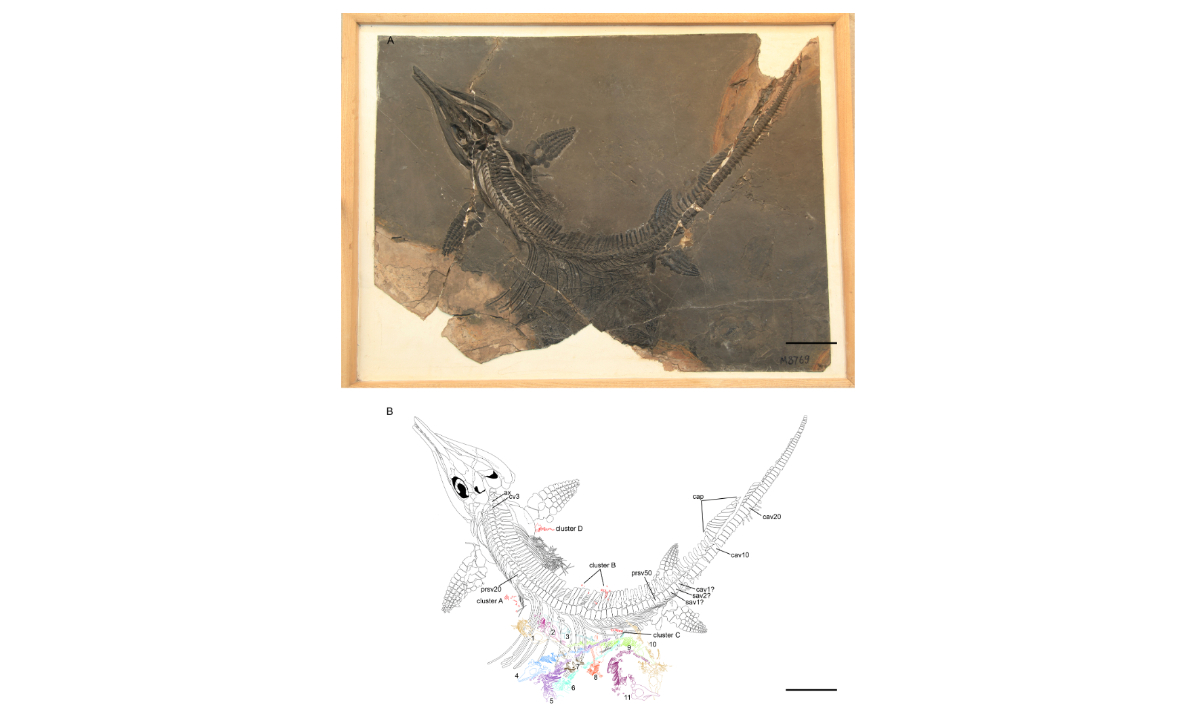
Photo: Screenshot from peerj.com
Chinese scientists studying a 244-million-year-old ichthyosaur Mixosaurus fossil from Southwest China’s Guizhou Province found at least 11 embryos inside the specimen. The discovery sets a new record for the highest number of embryos found in ichthyosaur lineages and reveals that high reproductive capacity in ichthyosaurs emerged earlier than previously believed, chinanews.com reported on Wednesday.
Ichthyosaur was among the most successful Mesozoic marine reptiles, and its reproductive strategy was considered crucial to their adaptation to ocean environments. Its reproductive ability before extinction has long intrigued paleontologists.
A joint research team from the Institute of Vertebrate Paleontology and Paleoanthropology, Chinese Academy of Sciences (CAS), and the Zhejiang Museum of Natural History, has published the study on the ichthyosaur paleontology in the international journal PeerJ.
According to Wang Wei, the paper’s corresponding author and an associate professor at the institute, embryo-preserving ichthyosaur fossils have been found across 11 genera from the Early Triassic to the Early Cretaceous.
However, for ichthyosaur groups that diverged in the Early Triassic, embryo-bearing fossils known to scientists remain scarce, and knowledge about the number of offspring they carried is especially limited. Previous discoveries of pregnant specimens, such as Chaohusaurus and Mixosaurus, contained no more than three embryos, suggesting limited early reproductive capacity among early ichthyosaurs.
According to Gu Shengxiao, the paper’s first author and a researcher at the Zhejiang Museum of Natural History, the study examined an almost complete adult Mixosaurus panxianensis fossil from Guizhou’s Middle Triassic strata, dating back about 244 million years. The specimen measures 112 centimeters long, including a skull length of 22 centimeters, with only the tail tip missing.
The researchers identified 11 fetal ichthyosaur skeletons with skulls inside the adult specimen’s abdomen, confirming they were embryos rather than cannibalized prey based on their position and morphology. There are also fossil pieces outside the belly of the adult, which could belong to the 11 or represent other embryos.
All embryos in the Mixosaurus panxianensis fossil were at a similar late developmental stage, suggesting the mother died shortly before giving birth, according to the researchers.
The Mixosaurus panxianensis fossil containing at least 11 embryos sets a record for Triassic ichthyosaurs and all known ichthyosaur species. The researchers believe this indicates that Mixosaurus may have adopted a reproductive strategy of producing large numbers of offspring in a single birth. This exceptionally high reproductive capacity may have provided them with a survival advantage.
Among Triassic ichthyosaurs and all known ichthyosaur groups, Mixosaurus is the genus with the largest number of fossil specimens and is also one of the most widely distributed ichthyosaurs.
The researchers said the multi-embryo Mixosaurus panxianensis fossil may represent an extreme case, but it confirms the species’ ability to produce large numbers of offspring, potentially contributing to its dominance among contemporaneous marine reptiles.
The study offers the first fossil evidence of high fertility in Triassic ichthyosaurs. Future research will examine other embryo-bearing Triassic ichthyosaurs to determine whether a multiple-offspring reproductive strategy was common in early ichthyosaur evolution and what factors drove this trait, Wang said.
Global Times
RELATED ARTICLES