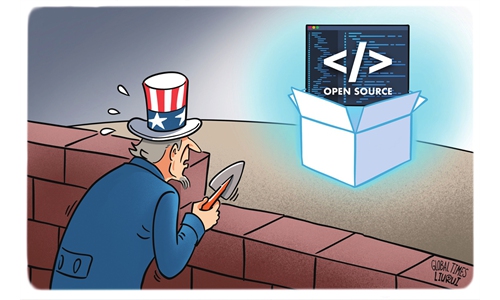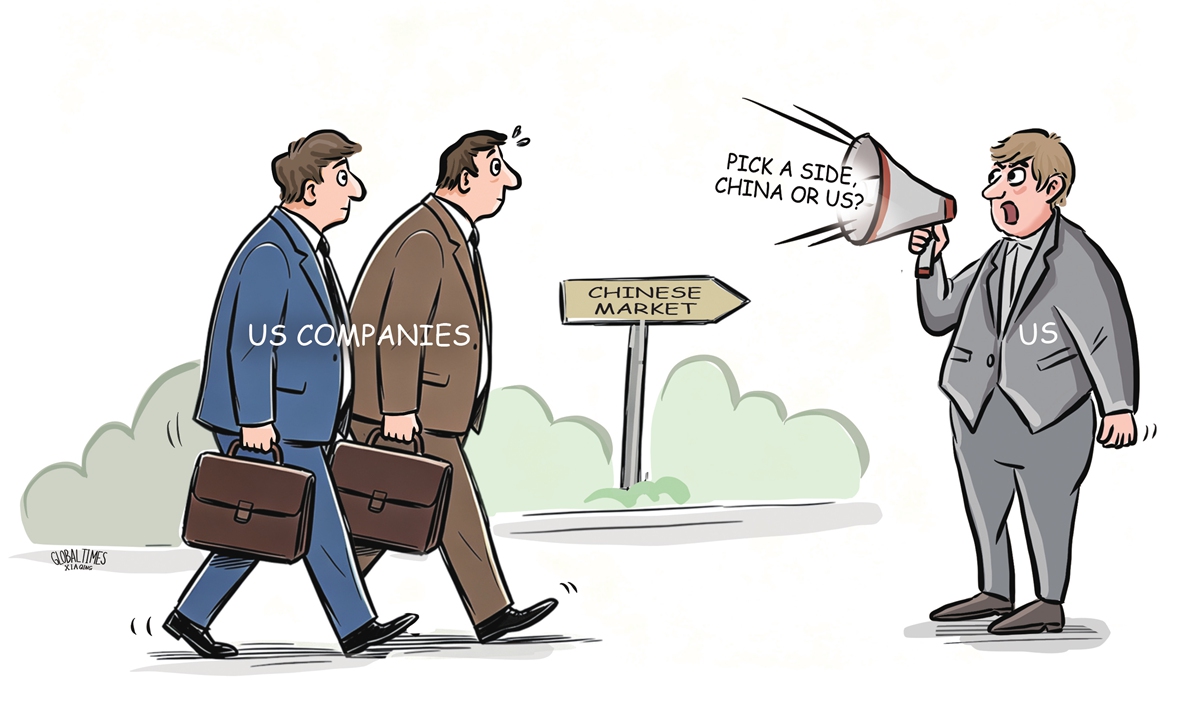
Why forcing US companies to pick a side? Illustration: Xia Qing/GT
Recently, some voices in the US discussed the concept of "China's neutrality trap" and implied that it can't be accepted if US companies want to keep good relations with both China and the US. Some even argued that US companies need to pick a side, either the US or China. What a ridiculous logic.Globalization is the result of economies concentrating on developing, strengthening and exporting their advantages, while importing the products they do not have. As one of the most important advocates, multinational companies are very active in establishing the global supply chain network to use the resources in the host countries in a better way. From raw materials and competitive labor costs to not too many environmental constraints, many companies chose to invest in China in the past decades, and benefited a lot from the systematic advantages of doing so, which are transferred to their own competitiveness.
But the situation is gradually different. China's labor costs are increasing, stricter environmental regulations are being published and carbon emissions are also managed by quotas. Companies still come. The reasons for choosing China change. They come here because of the certainty, innovation and even market strength. Companies investing in China can have the support of both a full package of manufacturing systems and the latest technology. Their global competitiveness will be strengthened not just by costs, but also by technology and quality.
Currently, China's super large market is attracting more and more companies. China is the second largest consumption market in the world. And the demand for more and higher quality products and services will not end in a few decades. Lower import tariffs and the annual China International Import Expo have shown China's attitude of welcoming everyone to share its opportunities with the world, which is different compared to the US' attitude.
As the process of globalization is the reason for many US multinational corporations' (MNCs) success, the restrained activities by excluding the most important market will slow the process and even destroy the MNCs. US companies are not the only players in most sectors. Even if US companies dominate certain sectors, the demand will always drive strong innovation ability to fill the supply gaps. Like Chinese people sometimes say, without a certain supplier, we can do it by ourselves.
For example, when the US tried to control the export of semiconductors to China a few years ago, we could barely produce any chips. However, to meet the ever-growing demand, many Chinese companies and international capital, technology and talents joined the game of enabling China's capability of producing chips. With continuous effort, Chinese companies have developed a new ecosystem of semiconductors. They can produce high quality chips, which support the development of IT equipment, mobiles and new energy vehicles. The chips are also exported, meeting diversified demands in other countries, including the US itself.
In a word, blocking cooperation with China cannot stop China's development, but only lead to the absence of US companies in the most important market. Companies need the market; the inability to stay in and be active in China will certainly significantly reduce US companies' competitiveness and harm their global performance. Deglobalization will make the MNCs weaker.
During the summit between the leaders of China and the US earlier this year, a consensus on building a constructive relationship of strategic stability has showed the world the principle of guiding the most important bilateral relations. Companies are the key players in this bilateral relationship. If they are forced to pick a side, how can the relationship be stable? Competition is one of the tones in the bilateral relationship. But it needs to be manageable and healthy. And to compete in this way, companies need more interaction.
A mechanism for discussing and managing trade and investment by both governments is emerging. China and the US do have the experience, wisdom and ability to manage the bilateral environment for economic cooperation. The world needs the two largest countries to be in a manageable relationship. Topics including climate change, geopolitical tensions and AI governance do need the collective efforts of both China and the US.
These efforts cannot be effective only between the governments. Companies' attitudes and actions are the most important part of the solutions. We need to respect the law of the market and listen to the companies' requirements, instead of forcing them to pick a side.
The author is a senior research fellow at the Chinese Academy of International Trade and Economic Cooperation. opinion@globaltimes.com.cn
RELATED ARTICLES