Australian envoy wants to revive US’ rusting ‘Indo-Pacific’ anti-China network? Pure fantasy
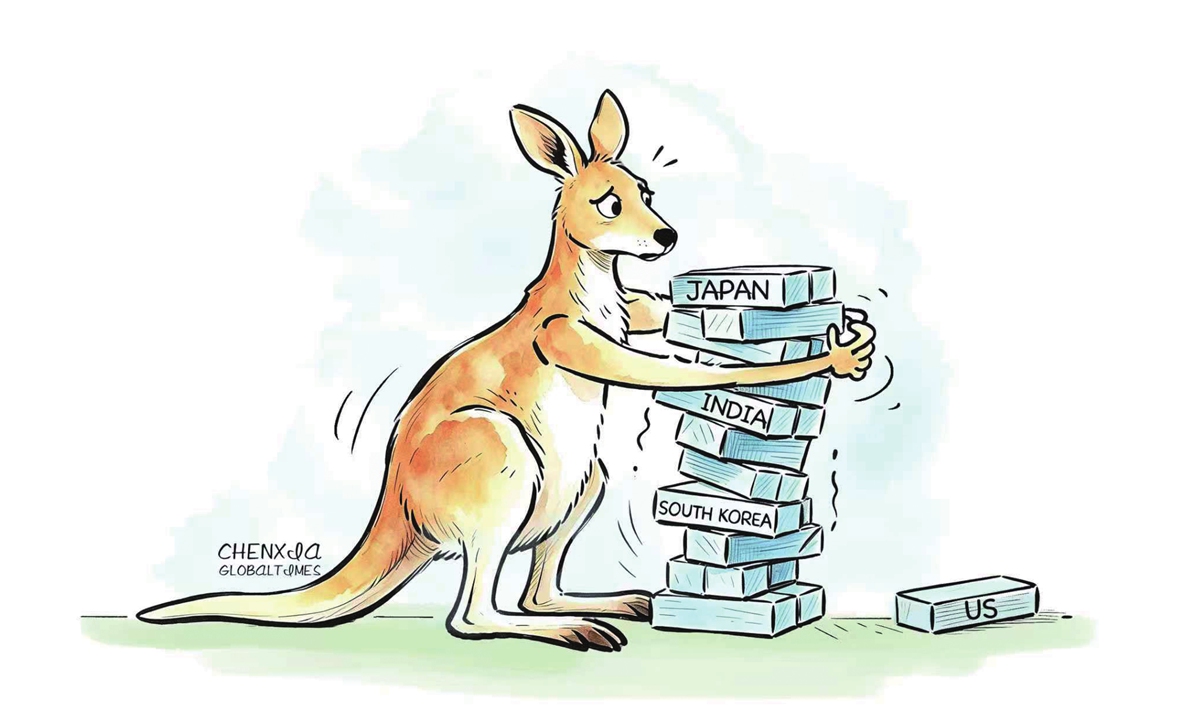
Australia Illustration: Chen Xia/GT
Australia's new ambassador to Japan Andrew Shearer seems to have taken on a job far bigger than managing ties with Tokyo: he is busy pitching a new "Indo-Pacific" network to counter China.
Nikkei Asia reported on Wednesday that Shearer had floated an "Indo-Pacific" security cooperative framework covering maritime security and critical mineral supply chains in a recent interview, attempting to engage other middle powers in Asia to counter China's "advances" in the region.
While presented as a new initiative to unite regional middle powers, Shearer's proposal is in reality a complementary backup architecture for the US-led security alliance system aimed at containing China - an outdated, recycled Cold War-style bloc mentality dressed up as a new regional vision.
Chen Hong, director of Australian Studies Centre at East China Normal University, told Global Times that the proposal follows the US' logic of building "minilateral" mechanisms in the Asia-Pacific region under the banner of "like-mindedness" to contain China.
"The difference is that Australia, Japan and other US allies would now take on more of the coordination role instead of the US directly taking the lead, reinforcing the US alliance system in which the US does not have to be present all the time," Chen said.
Shearer previously served as Australia's national intelligence director and national security adviser, and was deeply involved in shaping Australia's security strategy. His remarks, therefore, are not merely the personal musings of a diplomat, but reflect how Australia's strategic community is responding to the possibility of reduced US engagement in the region.
However, Shearer's vision of countering China through unity among "like-minded" middle powers in the region is wishful thinking in itself. The "Indo-Pacific" is fundamentally a strategic concept shaped by the US based on its own geopolitical interests and has never achieved genuine regional consensus. Its current retrenchment only underscores that a handful of countries cannot dress up their own interests as shared regional interests, let alone impose a particular regional identity on others.
For most of the middle powers named by Shearer, including India, South Korea and Vietnam, the real common ground lies in their pursuit of greater strategic autonomy. What most countries in the Asia-Pacific region need is not an exclusive "minilateral" bloc that forces them to take sides, but an open regional order that allows cooperation among multiple parties. Strategic autonomy does not mean forming a bloc, and expanding partnerships is about avoiding dependence on or being tied down by any major power or group.
"If Australia attempts to turn middle powers' pursuit of strategic diversity into a unified hostile policy toward China, the framework will inevitably encounter major divisions," Chen added.
Shearer's call for an Indo-Pacific where "no country is dominant and no countries are dominated" may sound reasonable, but the same standard must apply to the US and Australia themselves. If they merely package their own strategic interests as regional security concerns and impose such an exclusive security framework on others, it will be rejected by most countries in the region.
Shearer does capture an important geopolitical shift in the Asia-Pacific: As the US recently pulled its last aircraft carrier from the Pacific, it, in some ways, represents a sign of the US scaling back its power projection in the region, with shrinking regional engagement and strategic commitments. Regional countries are naturally reassessing what the future security order should look like.
Yet faced with this new strategic anxiety, Australia resorts to an old playbook: As the US role changes, rather than seeking to strengthen its own strategic autonomy, it is looking for ways to sustain dependence on the declining US-led alliance system through a new "Indo-Pacific" network.
Washington's "ironclad commitments" in the "Indo-Pacific" are rusting, yet Australia is trying to revive them. But an exclusive security framework that has struggled to gain regional consensus will not become attractive simply by changing its coordinator or dressing it up with a new name. Regional middle powers seek more strategic choices, not membership in a bloc built around "countering China." Such an approach would not enhance regional security; instead, it could push regional cooperation toward bloc confrontation and create new security dilemmas.
RELATED ARTICLES