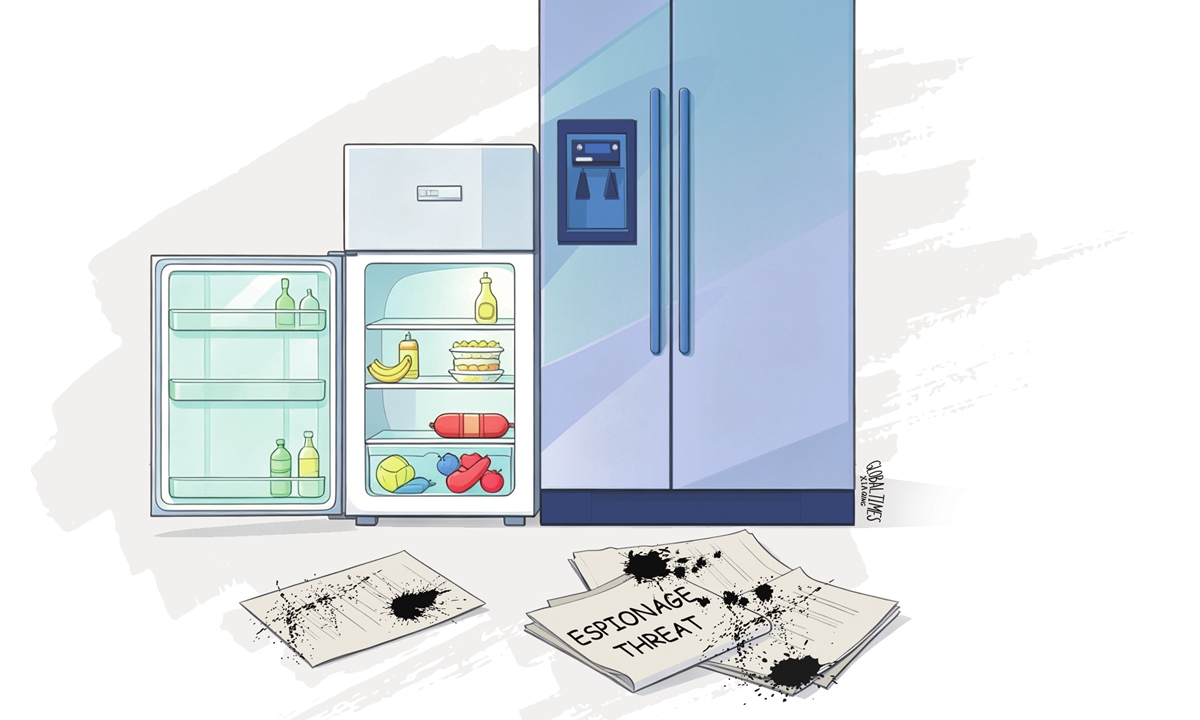
When even a refrigerator can become part of a spy narrative, has the US' smearing campaign itself gone too far? Illustration: Xia Qing/GT
A refrigerator spying on you? It sounds like something out of a spy novel. Yet an unsubstantiated claim over Chinese technology has reached areas once considered far removed from traditional security concerns. A recent opinion article in The Washington Times, headlined "China's espionage threat reaches American living rooms," shows how far this claim has extended into everyday life. But when even a refrigerator can become part of a spy narrative, the bigger question may no longer be what the device can do, but whether the smearing campaign itself has gone too far.
Perhaps more importantly, this campaign has not remained confined to opinion pages. The same logic is increasingly finding its way into policy decisions that affect ordinary consumer goods, with no evidence to support such measures.
On July 31, the US Department of Homeland Security announced the addition of more than 40 Chinese entities to the entity list under the so-called Uyghur Forced Labor Prevention Act. The move drew ridicule from some Chinese internet users after they found that the list included companies producing ordinary consumer goods, including sunflower seeds.
Restrictions on Chinese drones provide another example. Whether through the misuse of national security concerns or so-called forced labor allegations, such measures are increasingly extending into areas of everyday consumption that were once far removed from geopolitical disputes.
The broader debate reflects the limited effectiveness of Washington's efforts to constrain China's technological and industrial development. After years of escalating restrictions on Chinese technology, the foundations of China's manufacturing capacity have remained largely intact. Instead of slowing China's industrial progress, these measures have encouraged faster efforts to strengthen domestic innovation capabilities.
With restrictions in advanced areas producing limited results, the debate appears to be extending to an ever-wider range of products, sometimes under different excuses. Even if such an expansion makes the campaign look increasingly absurd - bringing ordinary consumer goods such as sunflower seeds into the discussion - such absurdity, and the skepticism it invites, may be a cost the campaign has little choice but to bear.
Even so, such debates are unlikely to prevent Chinese goods from reaching American consumers. The reason is straightforward: many Chinese consumer products remain competitive because they combine affordability with quality. American consumers want access to everyday goods that offer the best value for money, with products from both domestic and international producers competing on their merits. Bringing geopolitical considerations into this process risks distorting that competition, with ordinary American consumers ultimately bearing the cost.
The resilience of these commercial links is reflected in trade data. From January to July this year, China's exports to the US still grew 2.6 percent year-on-year. This reflects the fact that the two economies remain connected through complementary supply chains, while demand from businesses and consumers continues to exist on both sides. Even as restrictions on Chinese companies expand under different pretexts, market forces have proved more resilient than political pressure alone.
Bringing refrigerators and some other everyday products into discussions of espionage threats may create eye-catching narratives, but it is unlikely to change the forces that ultimately shape trade: consumer demand, cost and efficiency. Would an American consumer really pay more for a refrigerator because of an unsubstantiated espionage concern? That is an even harder proposition at a time when many households are already under pressure from rising living costs.
The auto market offers a telling example. A Reuters report in March quoted some US car buyers as saying that they envied what they could not have: affordable Chinese electric vehicles (EVs). One consumer told Reuters, "I would love the opportunity to be able to get one in or even test-drive one."
Such comments suggest that consumer demand does not always follow geopolitical narratives. Markets are shaped by what people need. If refrigerators, EVs and other everyday products were viewed through a security lens, the cost may ultimately fall on American consumers, who could face higher prices.
The author is a reporter with the Global Times. bizopinion@globaltimes.com.cn
RELATED ARTICLES