Canada launches a ‘Chinese-styled counterattack’ – a heavy blow: Global Times editorial
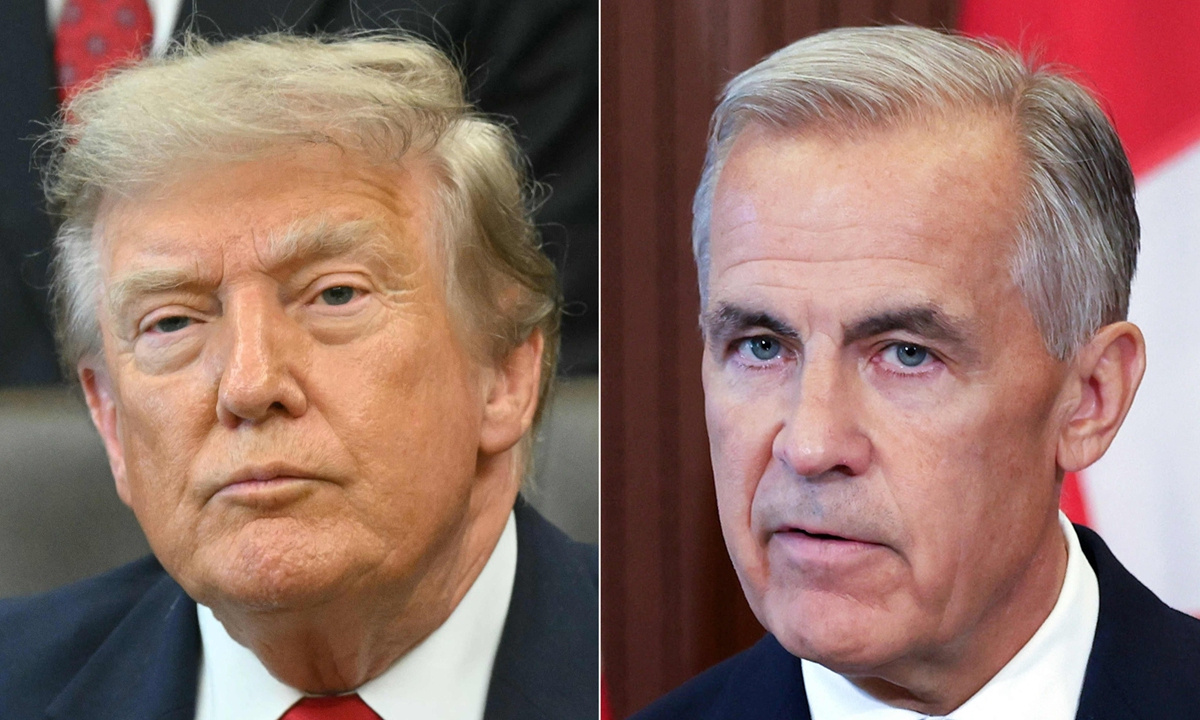
This combination of pictures created on August 22, 2026 shows US President Donald Trump in Washington, DC, on July 13, 2026 and Canadian Prime Minister Mark Carney on August 22, 2026. Canadian Prime Minister Mark Carney announced retaliatory tariffs on the United States on August 22, after walking away from a "bad deal" on trade in a deepening rift between the longtime allies. Photo: VCG
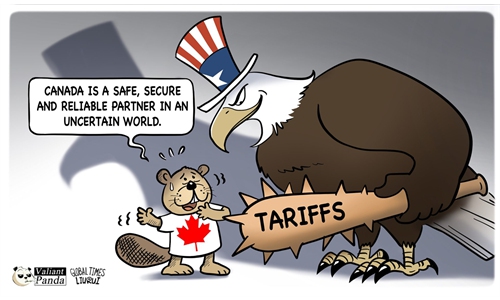
In the face of Washington's tariff stick, Canada has launched a "Chinese-styled counterattack": responding firmly and proportionally; defending sovereignty without compromise; and resorting to rules and legitimate countermeasures. As one of America's former closest allies, Canada's move reflects an increasingly clear consensus: No country has the privilege to monopolize the rules or dictate the fate of others.
Washington probably never imagined that Ottawa would launch a "Chinese-styled counterattack." In response to the US 50 percent tariffs on $20 billion worth of Canadian products, Canadian Prime Minister Mark Carney announced in a televised national address on Saturday that Canada would "match Washington's new tariffs dollar for dollar." Starting September 8, Canada will impose retaliatory tariffs on US sectors such as steel, dairy, home appliances, agricultural equipment, pulp and paper, and electronics.
Canada, a member of the Five Eyes alliance and NATO, has now dared to turn against Washington and respond with retaliatory tariffs. The significance of this move goes far beyond the scope of a North American trade dispute. The US Trade Representative Jamieson Greer disparagingly likened Canada's retaliation to "the kind of things that China would do." In an interview with US media, he claimed that after Washington introduced trade policies aimed at bringing production back home and protecting American jobs, "two countries in the world have retaliated against us: [the] People's Republic of China and Canada."
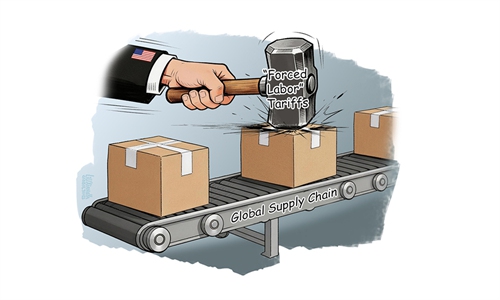
China and Canada are the only countries daring to respond to US pressure with reciprocal measures. This indicates that the so-called "Chinese-styled counterattack" is, in fact, another term for "refusing to accept unilateral pressure." Canada's response offers the world a glimpse of what China has long stood for: responding firmly and proportionally; defending sovereignty without compromise; and resorting to rules and legitimate countermeasures. More accurately, this is not a uniquely Chinese approach, but rather the most fundamental principle of reciprocity in international trade. Canada's adoption of this path is no surprise. It is a legitimate response to unilateral bullying - raising a shield when faced with pressure. The "Chinese-styled counterattack" not only protects a country's own interests, but also safeguards the stability of global supply chains and the fairness of the international trading order.
Canada's move shows that "strategic autonomy" is gradually evolving from a common aspiration of Global South countries into a real-world issue for US allies. More countries are realizing that concessions toward the US do not necessarily bring respect and stability, and only by having more partners, more markets and more room for independent choices can they gain the leverage for negotiation and the strength to protect themselves. Canada's decision to respond to the US in a "Chinese way" vividly illustrates a fact: In the face of a tariff stick, being an ally offers no "exemption." Today it is Canada; tomorrow it could be the EU, and the day after, Japan or South Korea.
By listing China and Canada together as "retaliators," Greer acknowledges the failure of US policy - if the policy were truly "great," why would even one of its closest allies feel compelled to strike back? If a policy forces countries with different geopolitical positions and institutional systems to take countermeasures, then the question should not be "why are they acting like China," but rather "why is US policy producing more China-like responses."
At a deeper level, Canada's "Chinese-styled counterattack" exposes the dilemma of unilateralism. Globalization is not a one-man show staged by the US, and industrial chains are deeply interconnected. The US wants to use tariff barriers to force production back home, yet ignores the basic economic factors of cost, efficiency and resource endowments. As one of the US largest trading partners, Canada sees hundreds and thousands of tons of goods crossing the border each day. In 2024, the two countries' average daily trade reached $2.5 billion, reflecting deeply integrated supply chains on both sides. By imposing tariffs, Washington is effectively cutting itself in the foot. Even Fox News, a conservative-leaning media outlet, published an article warning consumers that "your favorite cocktail could be an unexpected casualty of the trade fight," as Canadian whiskey is one of the commonly used base spirits for cocktails in US bars and restaurants.
The so-called goal of "protecting American jobs" is, in plain terms, "America first, everyone else to the sidelines." And what has the result been? "First" has turned into isolation, and "bringing back" has turned into bleeding out. The so-called "correcting trade imbalances" has resulted in disrupted supply chains for domestic companies, with US ordinary consumers footing the bill and inflationary pressures remaining high. The US federal data shows that manufacturing companies reduced their workforce in each of the eight months that followed the "Liberation Day" tariffs. Even if tariff walls can "kill a thousand enemies," the self-inflicted damage is far from trivial.
Canada's "Chinese-styled counterattack" is a heavy blow against protectionism. China's steadfast resistance to US unilateral tariffs was once described by some Western commentators as a "lone exception." Now that one of America's former closest allies has taken a similar path, this in itself is correcting the narrative over "who upholds the rules and who breaks them," while also demonstrating the necessity and legitimacy of China's reciprocal countermeasures. The essence of the "Chinese-styled counterattack" is an increasingly clear consensus: Openness must be built on equality, cooperation must be premised on mutual respect, and no country has the privilege to monopolize the rules or dictate the fate of others.
RELATED ARTICLES