Canada’s firm response to US trade pressure could boost its position, Washington draws growing pushback: expert
By Published: Aug 25, 2026 02:11 PM

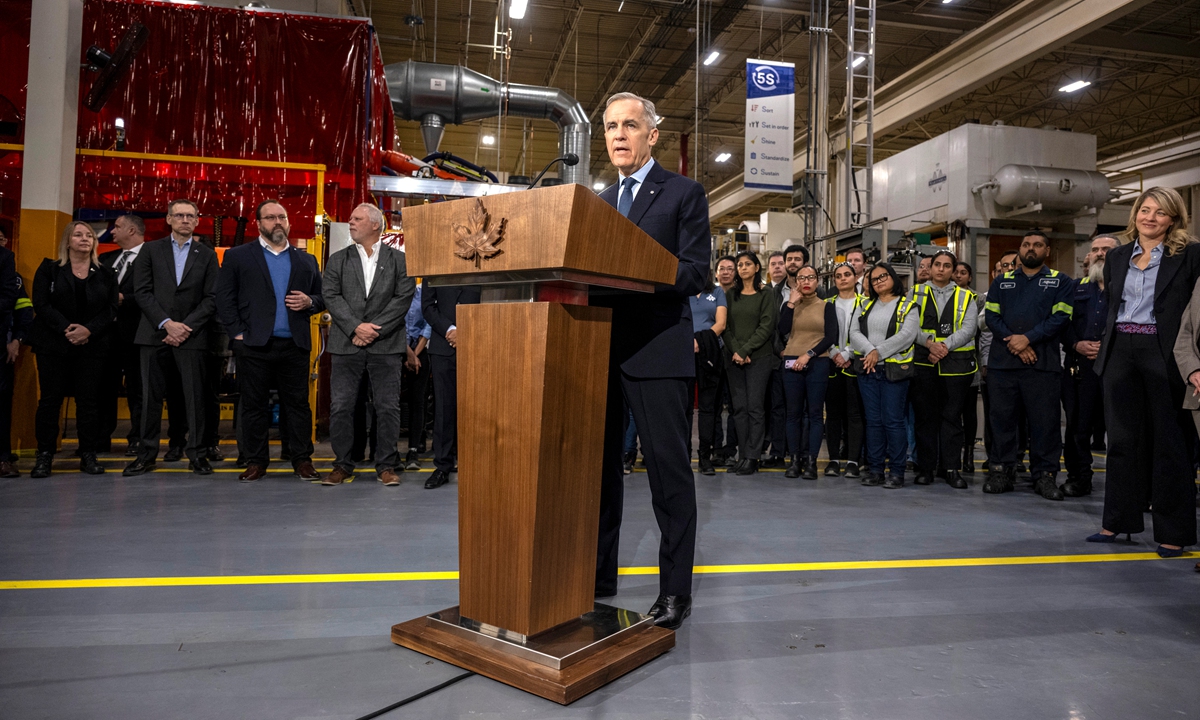
Canadian Prime Minister Mark Carney speaks to the press during an announcement while visiting an auto-parts plant in Woodbridge, Ontario on February 5, 2026. Photo: VCG
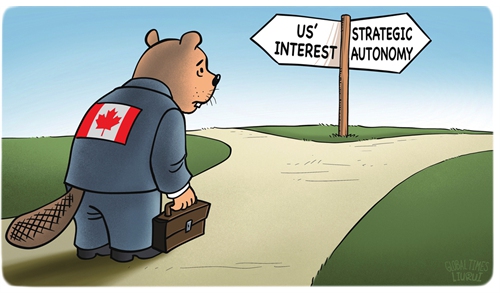
Canada's firm response to the US' maximum pressure tactics in trade negotiations could actually help boost the country's position in trade talks and defend its economic interests, a Chinese expert said on Tuesday, as Canada will reportedly announce retaliatory tariffs against the US.
Ottawa's recent moves against the US also showed that Washington's frequent tariff levies against its trade partners are drawing pushback across the world, including from its traditional allies, the expert noted.
Canada will announce retaliatory tariffs against the US on Tuesday after relations deteriorated sharply Monday, with Prime Minister Mark Carney accusing Washington of trying to subordinate Canada, the Associated Press (AP) reported.
"An attitude at the negotiation table that Canada is a subsidiary of the US" is "not something we're going to accept," Carney said, according to the AP.
US President Donald Trump on Monday threatened to raise US tariffs on all cars, trucks and automotive parts from Canada to 50 percent starting January 1, 2027, escalating a trade fight after negotiations collapsed last week, Reuters reported.
According to the AP, the fiery words from both sides show how US-Canada relations have deteriorated since Carney walked away from trade negotiations with the Trump administration late Friday.
Moreover, Canada's Ontario Premier Doug Ford said that Trump had underestimated Canadians' willingness to endure economic pain rather than give in to US pressure. Ford said "everything is on the table" if the dispute worsens, including cutting off electricity and critical minerals from Ontario, the AP reported.
Ford said Canada should also consider increasingly severe retaliation if Trump continues targeting Canadian industries, including oil and potash, while Ontario could raise electricity prices or stop sending power to the US. "We power 1.5 million homes and businesses," Ford said. "Everything's on the table. I'll do whatever it takes."
"Canada's current defiant rhetoric and firm stance of opposition actually provide it with a stronger bargaining position for future negotiations with the US," Zhou Mi, a senior research fellow at the Chinese Academy of International Trade and Economic Cooperation, told the Global Times on Tuesday.
"At the same time, this sends a clear signal to other countries: making unilateral and endless concessions to the US does not necessarily secure the desired outcomes. Canada's willingness to stand firm against the US should have a supportive effect not only for Canada itself but also for other nations grappling with US pressure."
As the US frequently levies unilateral tariffs against its trading partners, more countries, many of them US allies, have become more vocal in their opposition to the US' trade policy.
Last month, when the US implemented new tariffs ranging from 10 to 12.5 percent on 60 trading partners covering the vast majority of its imports over allegations of lax enforcement of forced labor bans, just as a temporary 10 percent global tariff introduced earlier this year expired, multiple countries, including Australia, New Zealand and Norway, voiced their rejection.
Canada's move also serves as a reminder to countries around the world that trade relations with the US can often be volatile, which is a risk that must be proactively guarded against, Zhou said.
RELATED ARTICLES