Canada’s countermeasures against the US send a clear message: Dependence is not the only option
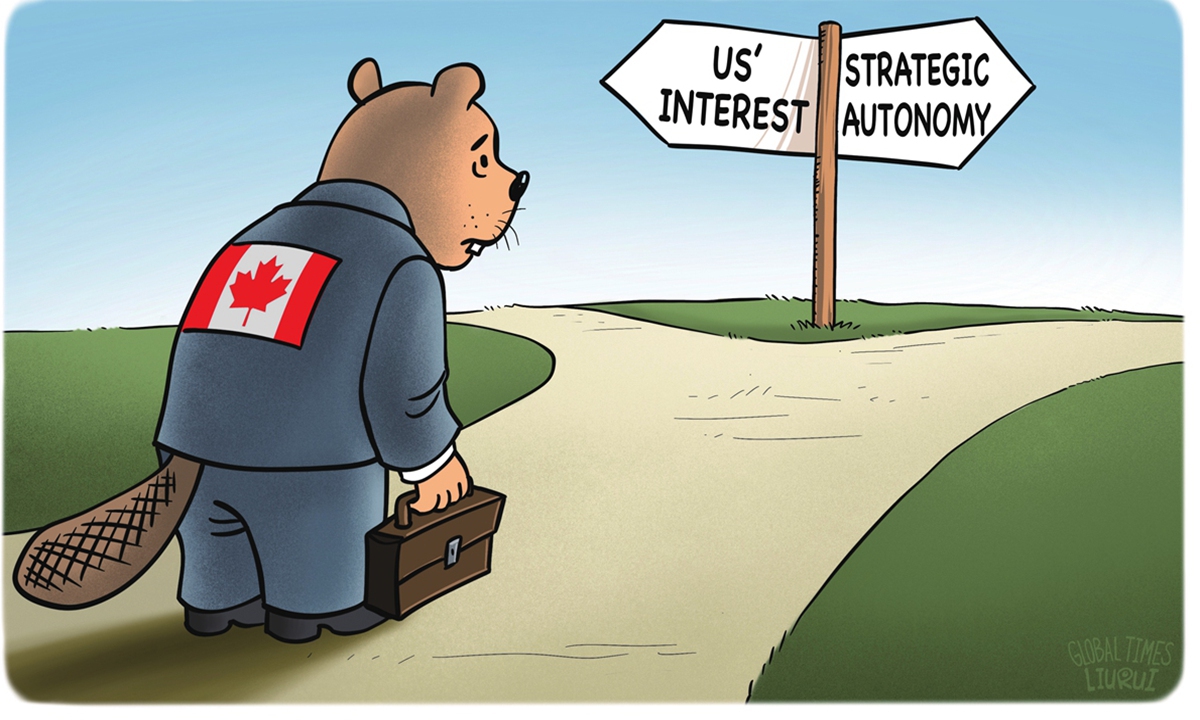
Illustration: Liu Rui/GT
Over the past year, the contours of the Carney administration's diplomatic recalibration have gradually come into view. In January 2026, speaking at the World Economic Forum in Davos, Carney argued that the rules-based international order had fractured and that "middle powers must act together" to avoid becoming the casualties of great-power competition. In March, Canada issued a joint statement in Oslo with the Nordic countries, agreeing to deepen cooperation in defense industry, economic affairs and Arctic security - widely seen as the embryo of a new middle-power alignment. In June, during a visit to Ireland, Carney again called on middle-power leaders to "combine" and leverage collective strength.
Behind these moves lies a clear strategic objective: To reduce, as much as possible, Canada's economic and security dependence on the US and to achieve genuine strategic autonomy. From the Davos speech to the Oslo joint statement and now to retaliatory action against the US, Carney's middle-power strategy has evolved into a complete chain - from conceptual declaration to institutional design to concrete action.
Whether this latest trade retaliation signals a fundamental break with Canada's traditionally pro-US posture should be assessed on two levels.
The scale and resolve of the response exceed any previous US-Canada trade dispute. Carney halted negotiations in the final stage and openly stated that US demands had touched on sovereignty issues, indicating that "our goal has been to secure the best deal for Canadians, never a deal at any price or on any deadline."
However, recalibration does not equal decoupling. Canada's reassessment of its relations with other countries does not mean abandoning its alliance with the US; rather, it aims to strengthen self-protection and enhance bargaining leverage. There are clear limitations to Canada-Europe cooperation, and neither side can fully dispense with the US. This shift should be understood as recalibration rather than a rupture, and any meaningful transformation will be gradual.
Canada's structural dependence on the US, stemming from geographic proximity and decades of economic integration, cannot disappear overnight just because of a single tariff conflict.
Will Canada's approach influence other countries pursuing a "middle power" path to engage more actively in strategic competition with the US? The answer is yes, but the effect will be indirect and gradual.
As tariffs, finance and supply chains are increasingly weaponized, middle powers are realizing that failing to participate in reshaping the rules leaves them vulnerable to being dictated to. By rejecting unequal terms from the US, Canada sends a signal that dependence is not the only option. Countries such as Saudi Arabia, Turkey and Indonesia have already been pursuing greater strategic autonomy along their own trajectories, and Canada's stance may further encourage them to adopt firmer positions under US pressure. US Deputy Secretary of Defense Elbridge Colby's public warning against allies forming "middle power alliances designed to exclude America" underscores Washington's awareness of this trend.
That said, each middle power faces distinct geopolitical conditions and security pressures, with varying degrees of reliance on the US. Canada, situated in US' immediate neighborhood, combines elements of compelled response and proactive recalibration; its approach is not directly replicable for middle powers in Europe or Asia. Most countries will seek to maintain necessary cooperation with the US while diversifying their options to expand strategic flexibility.
The breakdown of US-Canada trade talks is a turning point, not an endpoint. It has transformed Carney's middle-power strategy from an abstract political concept into a strategic choice that entails real costs. Canada is now testing a middle path: no longer unconditionally following the US, yet unable to fully detach from it. How far this path can go will depend not only on Carney administration's strategic resolve, but also on whether other middle powers are willing to share the burden of reshaping the international order.
The author is a research fellow at the Center for Canadian Studies at Guangdong University of Foreign Studies. opinion@globaltimes.com.cn
RELATED ARTICLES