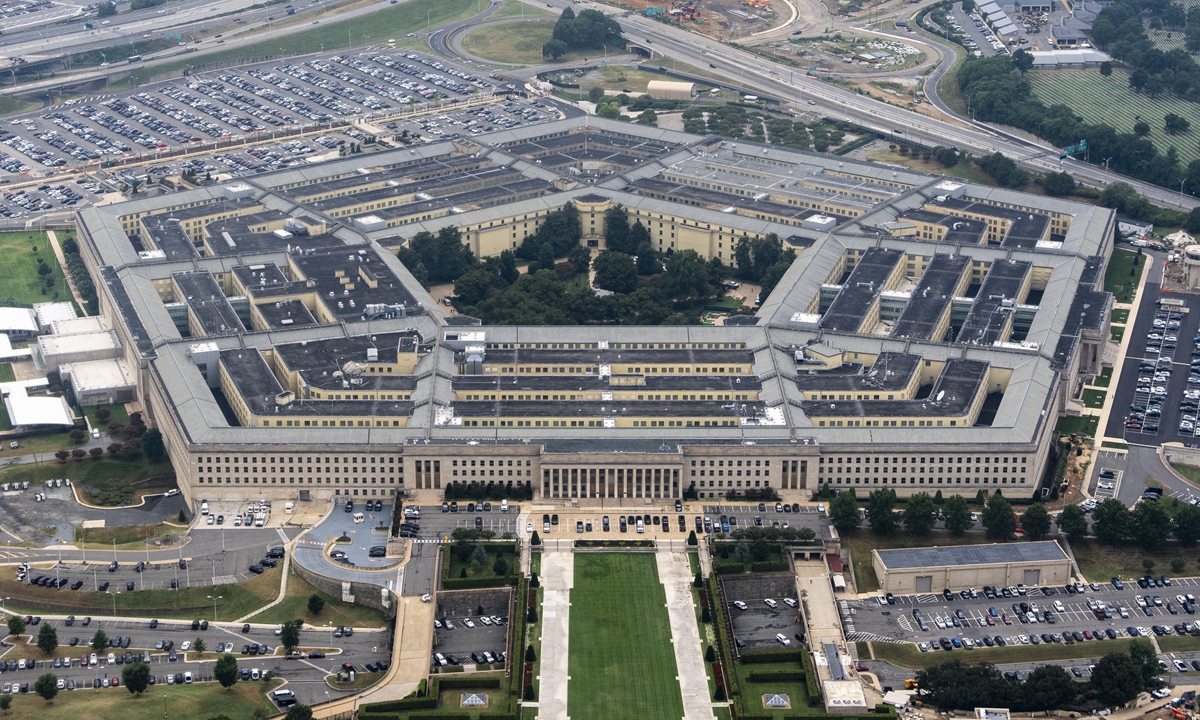
View of Pentagon Photo: VCG
Seoul's industry ministry said Tuesday that the country has discussed a deeper partnership in advanced industries with Canada, according to Yonhap. Not long ago, Canada announced that it is in negotiations to procure GlobalEye, an advanced aerial surveillance system developed in Sweden. "Canada turns away from the US on major defense purchase," Canadian media reported.These developments signal that Canada is moving away from its dependence on US defense contractors, following the Pentagon's decision on May 18 to suspend the Permanent Joint Board on Defense mechanism between the US and Canada. It marks the entry of bilateral relations into a new period of adjustment and reflects the structural dilemma Canada faces in the contemporary international landscape.
On the surface, this series of "decoupling" tendencies in the defense sector stems from the US' dissatisfaction with Canada's defense spending, which only met NATO's 2 percent of GDP target this year after decades of lagging. On a deeper level, the US is conducting a comprehensive re-evaluation of its alliance systems, demanding that allies assume greater responsibility for their own security.
For Canada, the repercussions of a widening defense rift with the US extend far beyond the military realm, striking at the very core of the external strategic framework it has long relied upon. In the post-World War II international order, Canada fashioned a foreign and security strategy centered on "managed dependence": relying on US-led collective security mechanisms for defense while utilizing multilateral international institutions to play an intermediary role between the West and developing countries. However, this strategic framework is gradually failing amid current global shifts.
First, the US commitment to multilateralism has significantly waned, hamstringing platforms like the United Nations and NATO, through which Canada once wielded influence. Second, US policy toward its allies has become highly transactional; the policy inertia once driven by shared values and long-standing alliances is fading, leaving allies to constantly prove their "contribution" to US interests. Finally, intensifying major-power competition has squeezed the strategic room for maneuver for middle powers. Canada's high security dependence on the US leaves it without effective levers of influence when facing Washington's pressure, severely restricting its autonomous diplomatic choices.
As the core friction of the international order returns to major-power geopolitical competition, Canada's strategic value is reduced to two dimensions: serving as a defense node on the US northern flank and acting as a resource supplier. Ironically, these are the very areas where its traditional strategy possesses the least autonomy.
Vincent Rigby, former national security and intelligence advisor to Canada's Liberal government, noted that the escalating rhetoric from Washington has prompted many policymakers in Canada to rethink the defense relationship between the two neighbors. "They're [The US is] saying stuff, doing stuff that really puts us in a difficult position," he said. The crux of this "difficult position" is that Canada can neither change its geographical proximity to the US and the resulting security dependence, nor construct alternative external economic and security networks quickly enough to offset it.
If Canada wishes to re-establish its strategic footing in the new international landscape, it must enhance the autonomy of its defense capacity building and break free from a security model bound to dependency on the US. Canada should leverage its geographical and resource advantages to diversify diplomatic cooperation, reduce the risk of being co-opted by unilateral policies, and mitigate the volatility in bilateral relations caused by US policy shifts. Meanwhile, Canada needs to pursue a more balanced economic and security layout in other regions, avoid the concentration of all strategic resources in a single direction, and refrain from making reckless, unwarranted moves on issues concerning the baseline principles of other countries.
The adjustment of the US-Canada defense cooperation mechanism exposes a universal dilemma faced by middle powers in a new era: When a major power ceases to provide public goods as it once did, nations that relied on its umbrella must learn how to act independently in an uncertain strategic environment. For Canada, this is both a challenge and a potential catalyst for reshaping its national strategy and discovering a genuinely sustainable pivot toward self-sufficiency.
The author is a research fellow at the Center for Canadian Studies at Guangdong University of Foreign Studies. opinion@globaltimes.com.cn
RELATED ARTICLES