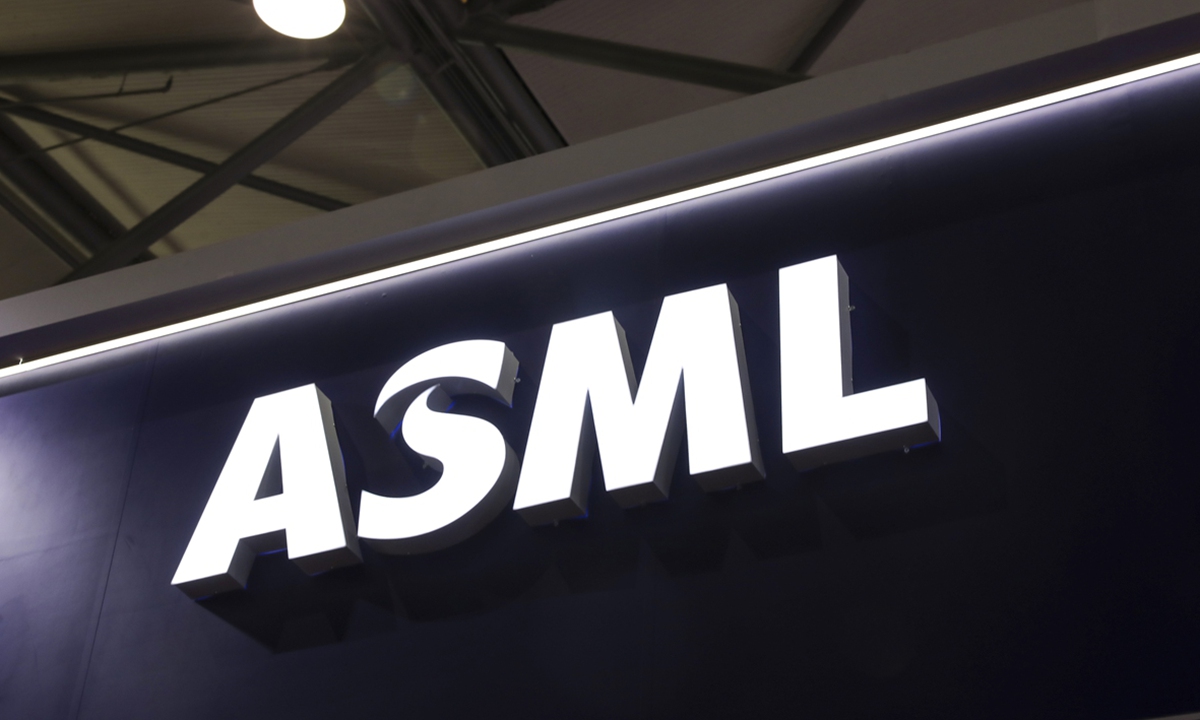
ASML Photo: VCG
According to Dutch media reports, Washington is preparing to force the Netherlands to ban the lithography giant ASML from exporting almost any chip-making machines to China. Under longstanding US pressure, the Netherlands has already restricted exports of the most advanced extreme ultraviolet lithography (EUV) systems and some deep ultraviolet (DUV) lithography machines to China.
Although ASML can still sell certain older DUV equipment to the Chinese market, a bill currently before the US Congress is crudely demanding that the Netherlands completely halt sales of the remaining DUV lithography machines to China, including all after-sales maintenance services. Otherwise, the US will impose sanctions.
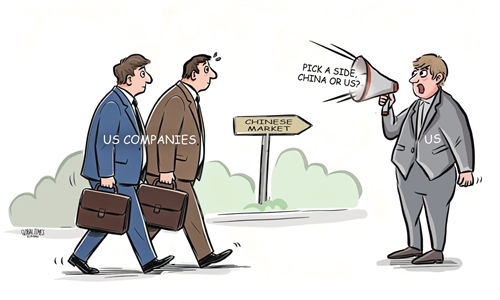
If the US previously sought to choke off advanced nodes, now it wants to let China's existing mature capacity simply suffocate. But what Washington may ultimately be choking is ASML's own lifeline. The Chinese market is one of ASML's most important markets, with exports to China at their peak accounting for over 40 percent of the company's total revenue. Given the nature of the semiconductor industry, equipment sales are followed by years of maintenance services as a stable stream of cash flow. The fact that the Netherlands' trade minister and other officials rushed to Washington to "lobby" as soon as they got wind of the plan makes it clear that the Netherlands is far more anxious than China.
ASML is not only the Netherlands' most valuable publicly listed company, but also one of Europe's most valuable technology companies. Yet its market valuation is heavily dependent on the narrative of being globally irreplaceable and driven by long-term demand for AI. Cutting off China will only accelerate the collapse of the myth that ASML is indispensable. Clearly, if the channel of DUV equipment for mature nodes is forcibly shut down as well, it will only bring forward the day when China achieves full domestic substitution.
China's independent innovation cannot be locked down. Not long ago, a report that a Chinese state-owned firm had begun mass-producing DUV lithography machines sent ASML's stock plunging in an instant, wiping hundreds of billions of euros off its market value, with other related US and European equipment stocks also tumbling. Such a strong shock reflects the market's huge expectation that China may have actually made a breakthrough. The hegemonic chains imposed on China's technology sector will eventually be broken. Any attempt to completely block lithography equipment in an effort to contain China is ultimately futile.
In recent days, Canada's "Chinese-style counterattack" against US tariff bullying has drawn widespread attention. On overseas social media platforms, many users have given a thumbs-up to Canadian Prime Minister Carney's tough stance. This further shows how unpopular Washington's reckless approach to global trade has become, while exposing unilateralism for what it is: a "paper tiger." Against this backdrop, reports that ASML may completely cut off supplies to China are less a test of China's resolve than a test of whether the Netherlands has the courage to refuse to bow to hegemony. Whatever the external environment, China's technology sector will continue to move forward.
RELATED ARTICLES