Stop smearing Chinese exports with ‘Trojan horse’ label: It’s time to wake up from US tariff myth
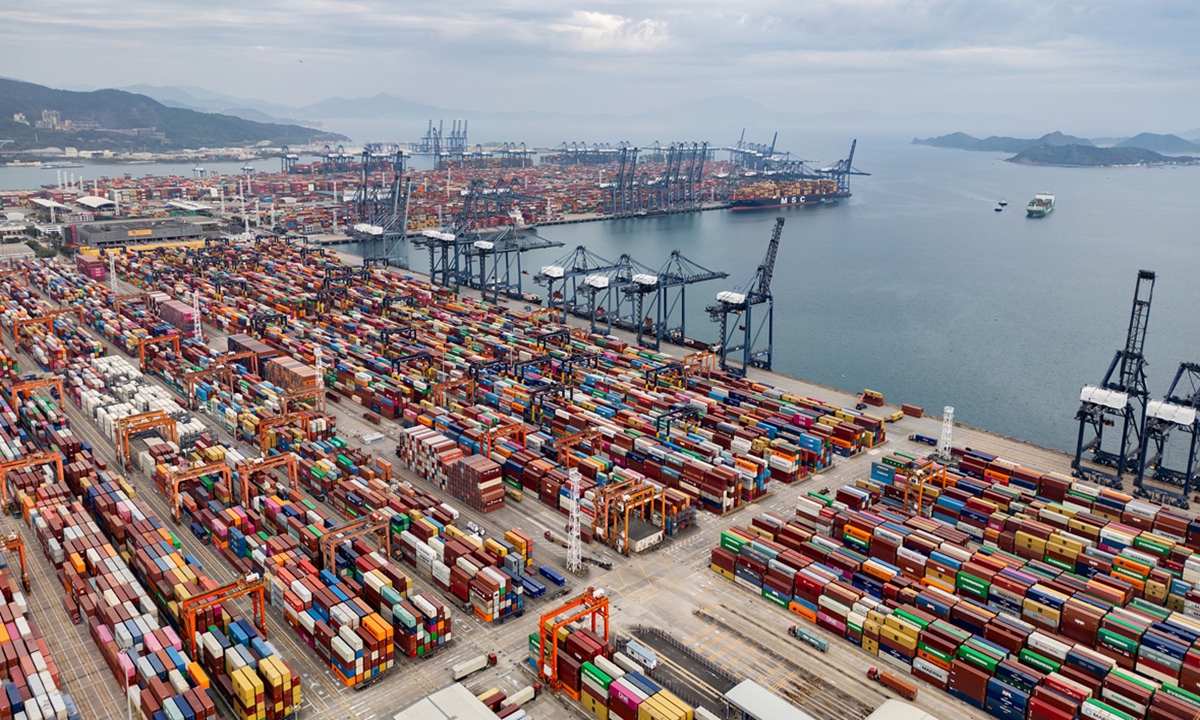
Shenzhen's Yantian Port. Photo: VCG
In August, two US trade reports released within a short span of each other echoed one another. The White House Office of Trade and Manufacturing Policy issued a report titled "The Great Transshipment Scam," using a giant Trojan horse as its cover image and claiming that goods originating in China are routed through third countries and disguised as local products before entering the US.
It portrays the normal cross-border division of labor involved in transshipment as a deliberate trade "fraud" designed to evade tariffs. Meanwhile, JPMorgan Private Bank published a report titled "The Year of the Trojan Fire Horse: China's imbalanced economy and unrelenting mercantilism," comparing "inexpensive Chinese exports" to a "Trojan horse" concealing deadly dangers. One report targets the policy community, the other the capital markets, but their underlying message is strikingly similar: using the literary metaphor of the "Trojan horse," they portray mutually beneficial international trade as a gift concealing a sinister plot. The "Trojan horse" label is nothing more than an attempt to shift the blame after the failure of US tariff policies. It simply does not stick to China.
The two US reports contain a glaring internal contradiction. On the one hand, they play up the multiple risks facing the Chinese economy and paint a bleak picture of its prospects; on the other, they assert that China's strong exports stem from systematic, long-term government subsidies. Wealth does not appear out of nowhere. If the kind of massive, cost-no-object subsidization described in the reports actually existed, it would inevitably place enormous pressure on China's domestic fiscal position, prices and balance of payments. Yet the reality is that China's foreign exchange reserves have remained broadly stable and its debt risks are generally under control. China does not print money and flood the economy with liquidity to subsidize exports.
The US report refers to the "great transshipment scam," but transshipment and intermediary trade are normal features of international commerce. The division of labor and cooperation among multiple countries along global supply chains is entirely normal. The US report's estimates of the overall scale are largely based on speculative assumptions and lack empirical evidence. China has consistently complied with WTO rules and opposes the use of fraudulent transshipment to evade tariffs. Such issues should be addressed on the basis of evidence and through multilateral trade mechanisms, rather than being used as a pretext for protectionism.
If the US were to remove its additional tariffs on Chinese goods, estimates from a number of think tanks suggest that US inflation could decline modestly, easing the burden on household consumption and improving cost conditions for downstream manufacturers. In this sense, the US could take a more rational view of imports from China.
If Washington is genuinely concerned about manufacturing, it should understand that protectionism has never made an industry stronger. China's experience shows that manufacturing competitiveness comes from continuously lowering costs and promoting innovation, while competition is a key condition for innovation. The US has imposed additional tariffs on Chinese goods for years, yet the result has been that manufacturing's share of GDP has fallen rather than risen, supply-chain costs have remained high and inflationary pressures have persisted.
The US reports place particular emphasis on China's advantages in the new-energy sector but fall into the trap of "judging others by oneself," assuming that China will use its industrial advantages as a tool for counterbalancing other countries. The competitive advantages of China's new-energy industries are rooted in vigorous domestic market competition and continuous technological research and development. Chinese companies are willing to engage in extensive cooperation with countries around the world while respecting intellectual property rights and complying with local laws and regulations. It is precisely through deployment in diverse global markets that their technologies and products can continue to be refined and optimized.
The two US reports are filled with contradictory arguments and selective interpretations of data while avoiding a simple fact: Global markets are voting with real money. Markets do not believe in the "Trojan horse" myth; they believe in efficiency and quality. What the US really needs is not to label Chinese goods, but to remove the protectionist tinted glasses and acknowledge the mutually beneficial nature of China-US economic and trade relations. Rather than using sensational metaphors such as "Trojan horse" or "fire horse" to inflame tensions, the US should adopt a more rational approach to the economic relationship between the two countries.
What the US really needs is not to label Chinese goods but to remove its protectionist tinted glasses and acknowledge the mutually beneficial nature of China-US economic and trade relations. Rather than using sensational metaphors such as "Trojan horse" or "fire horse" to inflame tensions, the U.S. should adopt a more rational approach to the economic relationship between the two countries.
The author is a senior research fellow at the Chinese Academy of International Trade and Economic Cooperation. opinion@globaltimes.com.cn
RELATED ARTICLES