Illustration: Xia Qing/GT
This summer, many regions in Europe have been repeatedly impacted by heat waves, droughts and wildfires. Global warming has raised Mediterranean Sea temperatures by about 2 degrees above normal, and sea-surface temperatures in some European waters in July exceeded historical averages by more than 6 degrees. By late August, high temperatures continued to persist in some areas. The Wall Street Journal published an opinion piece, entitled, "Europe Chastised Trump's Climate Rollback. Now It's Delaying Its Own Green Goals."
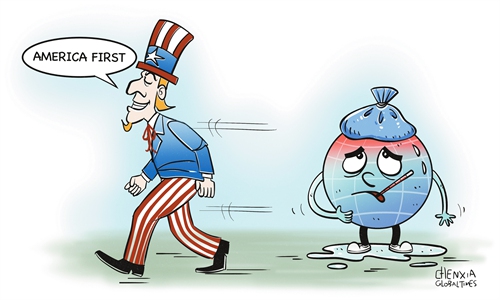
The challenge facing the global green transition is that Western countries are once again prioritizing their own self-interests. As extreme heat becomes a regular occurrence, some countries have begun to roll back their emissions-reduction efforts. For instance, pressure on the auto industry has prompted the EU to consider greater flexibility in its 2035 vehicle emissions-reduction targets, while Canada has removed its federal consumer carbon price.
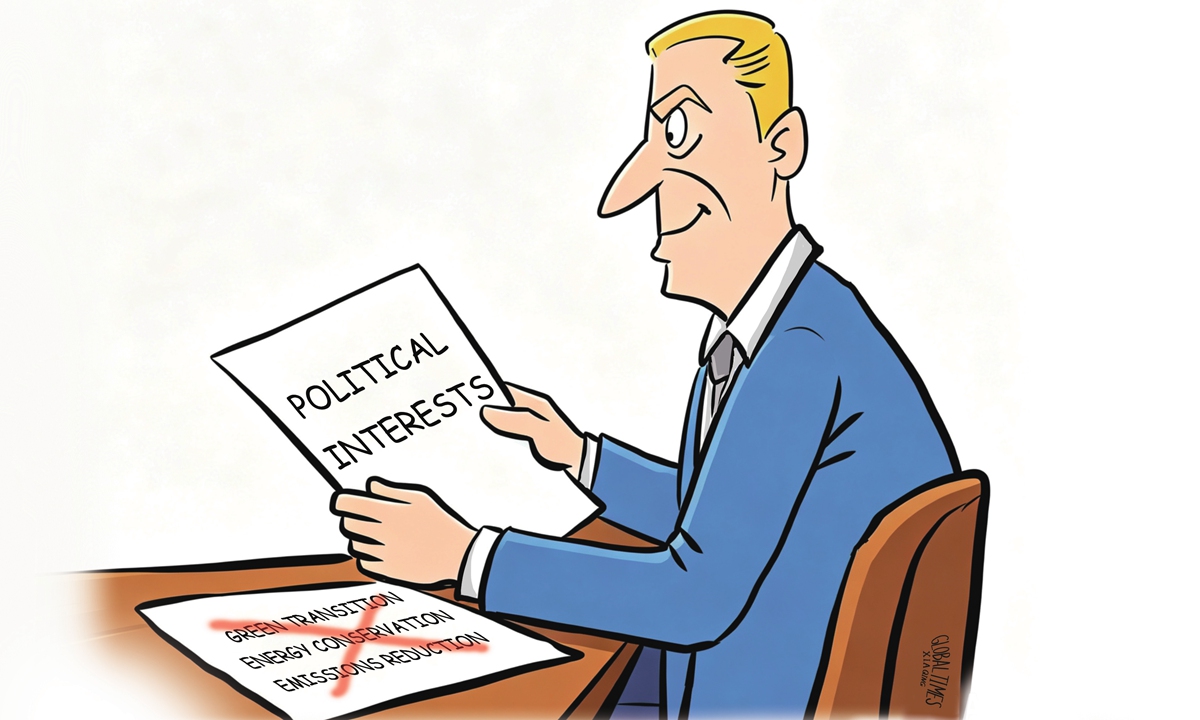
Each country's policy adjustments have specific economic and political circumstances behind them. Once the green transition begins to affect energy prices, car purchases and employment, policy changes are bound to follow. When climate considerations, economic calculations and political interests are all placed on the desks of Western leaders, their choices tend to be driven by calculations of their own political gains and losses.
The real difficulty facing the green transition arises when countries begin to bear the costs of climate action. Europe has established a relatively comprehensive climate policy framework, and its green policies were once regarded as an institutional innovation in global climate governance. However, fluctuations in energy markets and changes in supply chains can affect competitiveness, leading to changes in how those policies are implemented.
The green transition will inevitably involve costs. Questions about who bears those costs, when they are borne, and how they are shared have never been resolved fairly under the existing international political order. Since the advent of globalization, developing countries have absorbed a large share of global manufacturing, resulting in a substantial increase in their carbon emissions, while the benefits of manufacturing globalization have largely accrued to developed economies.
In terms of climate finance, developed countries have fallen short of fulfilling their long-standing commitments to provide financial support. While they reduce emissions domestically, they continue to consume large quantities of energy- and resource-intensive products. Some developed economies have even used trade policies, such as carbon border adjustment mechanisms, to require imported products to bear carbon costs. This has created new distrust in climate governance and increased uncertainty surrounding climate action.
International climate cooperation is not about developed economies imposing rules on developing economies; rather, it should focus on establishing rules for collective climate action. If countries emphasize "flexibility" when it comes to their own costs while firmly insisting that others bear theirs, the ultimate damage will be to the common interests of all humanity.
The situation in China is different. 2026 marks the beginning of China's 15th Five-Year Plan period (2026-30). The Outline of the 15th Five-Year Plan incorporates energy conservation and carbon reduction, as well as climate change response and green development into the country's national development strategy. The Action Plan for Carbon Peaking during the 15th Five-Year Plan Period proposes reducing carbon dioxide emissions per unit of GDP by 17 percent from the 2025 level by 2030 and raising the share of non-fossil energy in energy consumption to 25 percent. The formal implementation of the Ecological and Environmental Code has also incorporated green and low-carbon development into China's system of environmental rule of law.
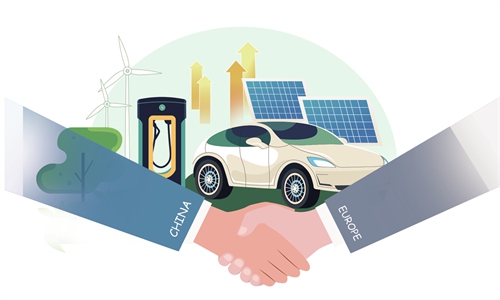
A series of policies recently introduced by China increasingly demonstrate the long-term nature of its green transition. In practice, China is placing measures such as energy-saving and carbon-reduction upgrades in key industries, hydrogen-energy applications and the development of a new energy system within a longer-term policy framework. The green transition still entails costs, but those costs are increasingly being integrated with the development of new productive capacity. This may be the defining feature of China's climate policy and one of its key lessons for the international community. By developing new quality productive forces, society's capacity to absorb the costs of the green transition can change.
The green transition must ultimately overcome not only political cycles, but also economic cycles. In China, green development has become a long-term national strategy and can also become part of global industrial and economic policy. The costs of the green transition will always exist, but they can be gradually absorbed through longer policy horizons, more stable institutional arrangements and industrial upgrading.
The author is a professor at the Institute for Sustainability of Huzhou Normal University and a researcher at the Budapest Centre for Long-term Sustainability. opinion@globaltimes.com.cn
RELATED ARTICLES