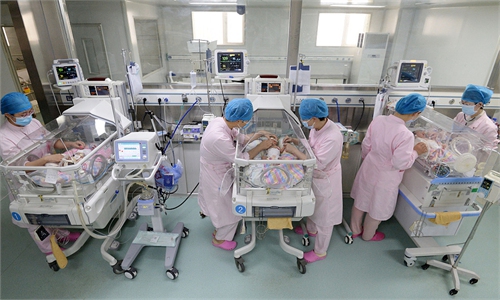
Photo: VCG
In recent years, China's fertility support policy system has been taking shape at a faster pace. It is undergoing an important transition - from local pilots to a nationwide institutional framework, and from single-measure support to systematic support.Since 2025, childcare subsidies have formally become a unified national system. Inclusive childcare services have been developing more rapidly. The Outline of the 15th Five-Year Plan (2026-30) further calls for accelerating the development of an inclusive childcare service system, expanding service resources through multiple channels and implementing actions to improve the quality of childcare services. Localities have continued to enhance institutional arrangements such as maternity leave, paternity leave and parental leave. Overall, China's fertility support policies are expanding from single economic assistance to multi-dimensional support that encompasses financial, time and service aspects, and are shifting from temporary measures toward more sustained and systematic institutional guarantees.
The focus is shifting from supporting "childbearing" to supporting "families." As personal development choices become increasingly diverse, families' decision-making logic regarding marriage and childbearing is also changing.
When young people make decisions about marriage and childbearing, they now take a more comprehensive and cautious view of factors such as employment, income, housing, work-family balance and children's development. In this sense, improving fertility support policies today could consider moving beyond simply reducing families' direct costs toward reducing uncertainty in family development and strengthening systematic support for families.
Economic and time support could be improved - through childcare subsidies, leave systems and other measures - to reduce the direct burden on families during the childbearing and caregiving stages. Meanwhile, the supply of public services such as inclusive childcare, children's healthcare and education could be further expanded to ease families' concerns about subsequent child-rearing costs. At the same time, a more reasonable mechanism for sharing family responsibilities should be promoted so that family development and individual career development can be better coordinated.
The family is the primary bearer of fertility costs, and continuing to optimize the balanced sharing mechanism of these costs can effectively alleviate the fertility pressure on families. Improving fertility support policies cannot focus solely on costs from the family side. It is also necessary to take into account the capacity of the government and enterprises, and to further study more reasonable cost-sharing arrangements. Policy tools such as maternity insurance, fiscal support and tax incentives can be used to appropriately reduce the actual costs for enterprises in implementing family-friendly policies.
For enterprises that proactively introduce flexible working arrangements - such as flexible working hours, remote work, parental leave packages and childcare support - and strive to build a family-friendly work environment, a more targeted and differentiated policy incentive system can be explored. This will foster a fertility support governance structure characterized by government guidance, corporate responsibility and multi-party coordination.
It is imperative to further enhance the capacity to effectively provide affordable and inclusive childcare services. In recent years, China's childcare service supply has continued to scale up. However, household demand for childcare has shifted from a primary concern about whether services exist to whether services are of good quality and practically usable. Through multi-dimensional and coordinated policy measures, we can continuously elevate the quality of childcare supply, achieve a precise match between supply-side construction and actual household needs, and resolve the dual challenges of ensuring that families can "actually use" the services while providers remain "financially sustainable." Additionally, rural and county-level regions, where the foundation of public services is relatively weak, require a greater focus on basic public services such as maternal and child health, childcare, pediatric medical care, and education. Large and medium-sized cities, on the other hand, can place more emphasis on practical needs such as youth housing, childcare and work-family balance.
The refinement of fertility support policies should also shift from a sole focus on policy input to an emphasis on policy outcomes. A more comprehensive policy evaluation mechanism can be considered centering around different stages, allowing policy instruments to be dynamically adjusted in response to demographic and family shifts, thereby driving the quality and efficiency of the fertility support policy system.
The author is a research fellow at the China Population and Development Research Center. opinion@globaltimes.com.cn
RELATED ARTICLES