Games close, China’s humanoid robots race on
2nd World Humanoid Robot Games conclude in Beijing, showcasing rapid advances and real-world potential
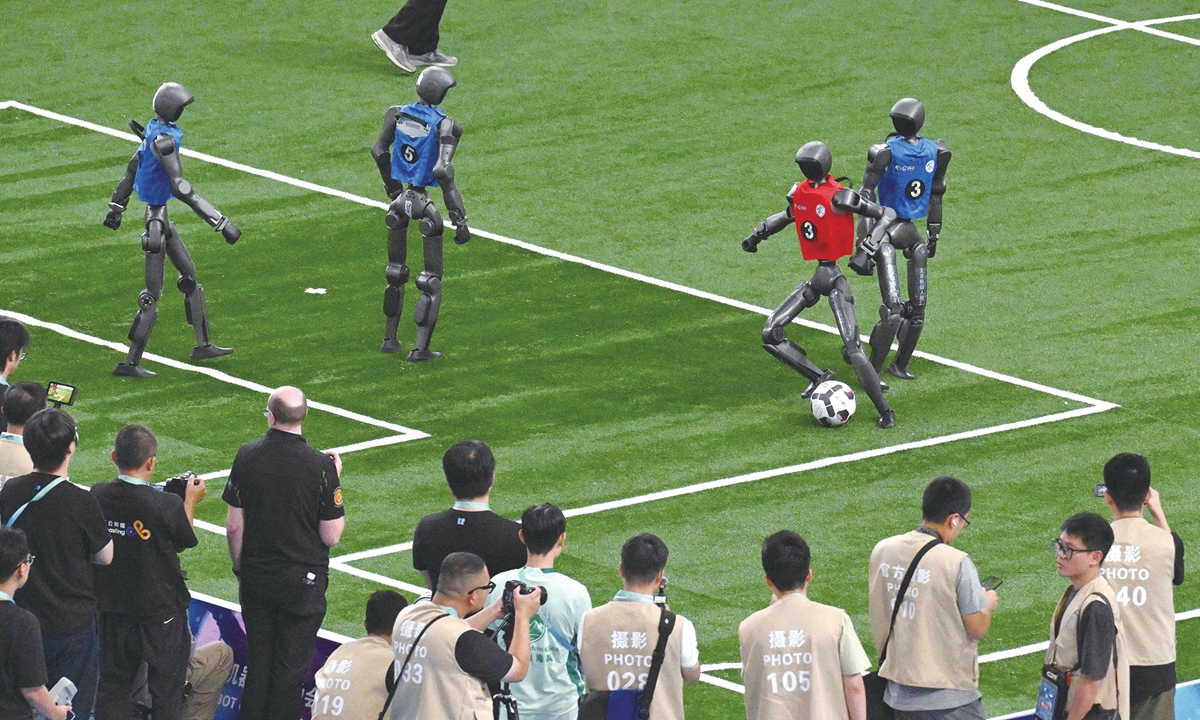
Humanoid robots compete for the ball during the final of the large-scale robot soccer event at the 2nd World Humanoid Robot Games at the National Speed Skating Oval. The 2nd World Humanoid Robot Games conclude on August 26, 2026 with several highlighting final matches. Photo: VCG
As the lights dimmed at Beijing's National Speed Skating Oval, known as the "Ice Ribbon," five days of racing, jumping and competing drew to a close. Yet the records set and limits pushed on the field offered a glimpse of an increasingly bright future for China's embodied AI industry.
Compared with the inaugural Games in 2025, which drew 280 teams and more than 500 robots, this year's event expanded significantly, bringing together 666 teams and 2,056 robots from 16 countries across six continents for 1,301 matches across 51 events over five days, nearly double the 26 events held last year.
Multiple industry insiders and participants told the Global Times that compared with a year ago, humanoid robots are not only "running faster and jumping higher," but are also making rapid advances in autonomous perception, real-time decision-making and multi-robot collaboration. What is being pushed on the field is not just records of speed and height, but the very limits of what humanoid robots can do.
Pushing the limits
A string of eye-catching numbers at this year's Games is redefining expectations for what humanoid robots can achieve physically.
Compared with the inaugural Games, humanoid robots made striking gains across multiple athletics events this year. The large-size 400-meter record improved from 1:28.03 to 38.15 seconds, while the 1,500 meters fell from 6:34.40 to 2:21.64. The standing high jump rose from 0.96 meters to 3.40 meters, and the standing long jump from 1.25 meters to 4.83 meters. In the closely watched 100 meters, the record plunged from 21.50 seconds last year to 8.64 seconds.
The dramatic year-on-year gains offer a vivid measure of how rapidly humanoid robots are advancing in speed, explosive power, balance and motion control.
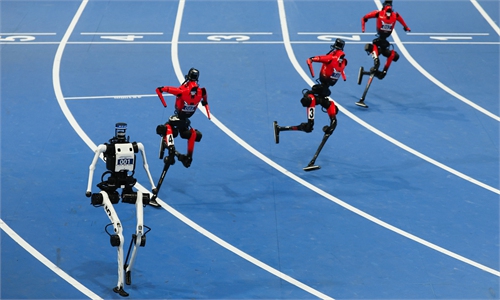
In one of the Games' most closely watched events, the 100-meter sprint, Tiangong Ultra, developed by the Beijing Humanoid Robot Innovation Center, clocked 8.64 seconds, improving on its best of 8.86 seconds yesterday. For comparison, Jamaican sprint legend Usain Bolt holds the men's 100-meter world record of 9.58 seconds.
The year-on-year improvement is even more striking: Tiangong's best 100-meter time at the inaugural Games in 2025 was 21.50 seconds, meaning it has cut its time to under nine seconds in just one year.
Similar breakthroughs were seen in other events. Tiangong clocked 38.15 seconds in the 400 meters, faster than the men's world record of 43.03 seconds, while Tianzhuo raised the robot standing high jump record to 3.40 meters on Tuesday. While robot and human events are not directly comparable due to different rules and conditions, the results highlight rapid gains in humanoid robots' explosive power, balance and high-speed motion control.
More notable than simply "running faster and jumping higher" is robots' growing ability to perceive, make decisions and collaborate at high speeds.
In the 4×100-meter relay, Team Tiangong was the only team to complete the race and reach the final, winning in 4:11.44. Team member Shan Songjunjie told the Global Times that one of the biggest challenges was the seemingly simple baton exchange. On a track just 2.1 meters wide, the large humanoid robots could easily collide if they followed preset trajectories at high speed.
"The relay helps us better understand how robots perform dynamically at high speeds, including acceleration, deceleration and coordination," he said.
On the football field, robots are also "thinking" faster. Cheng Hao from Booster Robotics told the Global Times that its T2 robot, competing in this year's large-size football event, has greater on-device computing power than last year's T1, taking just 100 milliseconds to go from "seeing the goal" to "deciding where to shoot" - roughly one-third the time of a human blink.
Referee Cui Jie, who has officiated the standing high jump for two consecutive years, also noted the rapid progress. He told the Global Times that robots jumped less than one meter last year, compared with more than three meters this year. More importantly, while many events previously relied on remote control, more robots are now competing autonomously, a shift particularly evident in running events.
The rapid progress has also impressed overseas participants. Harold Ruiter from the Netherlands, who has competed in China for two consecutive years as a robot operator in the 5v5 football event, described the pace of China's humanoid robotics development over the past year as "incredible." From sprinting and long jump to tennis and the humanoid robot marathon, he said the progress has been striking.
"If it goes this fast, I'm really looking forward to seeing where we end up next year," Ruiter told the Global Times. His team also uses Chinese-made robots. He said teams from different countries compete on the field while also exchanging ideas and helping each other solve problems. "In the end, we all want these robots to be better."
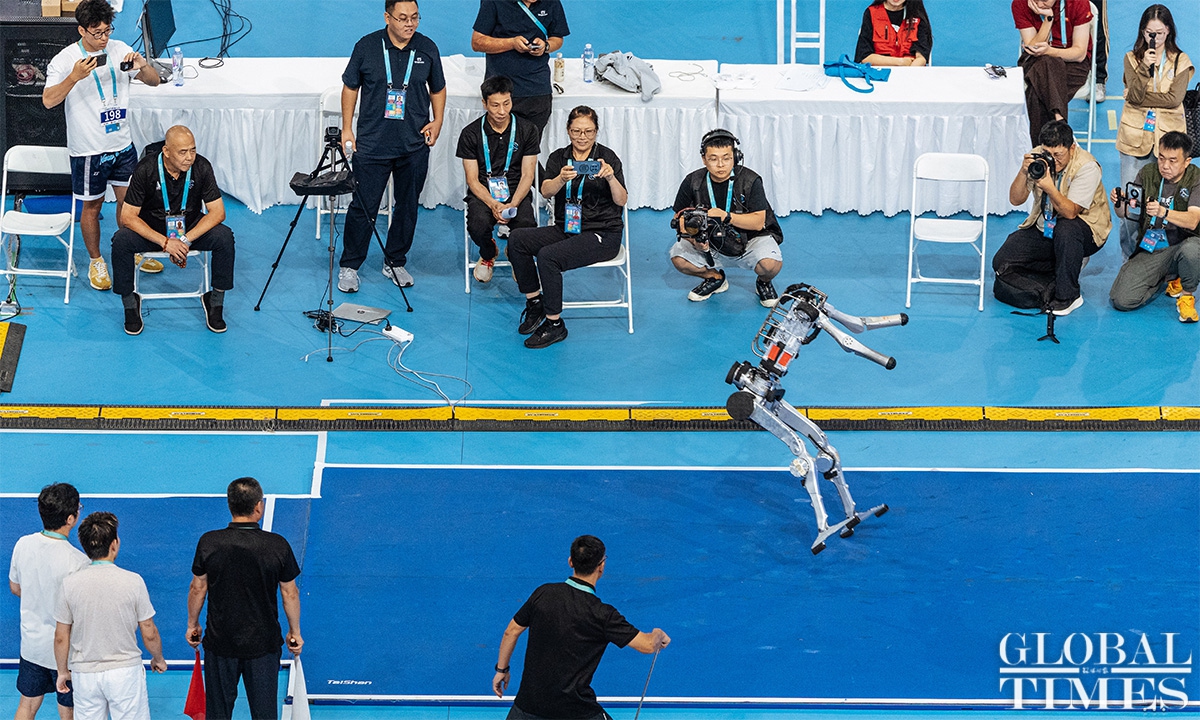
Photo: Li Hao/GT
From arena to real-world work
But what does running faster and jumping higher actually achieve?
"These competitions are essentially tests," Zhou Changjiu, president of the RoboCup Asia-Pacific Confederation (RCAP), told the Global Times. The 100-meter sprint tests speed, while a marathon also puts endurance, battery performance and thermal management to the test, he said. "If robots are eventually deployed in remote areas or agriculture, endurance will be crucial.
Football presents a more complex test. Robots must not only run, but also identify the ball, teammates and opponents, while making autonomous decisions and coordinating with one another in a dynamic environment. Zhou said such competitions test multiple capabilities at once, including intelligence, manipulation, interaction and safety - all essential for real-world deployment in homes, factories, hospitals and emergency response.
This year's Games raised the bar for robots' real-world capabilities, with 21 application-oriented events covering nine scenarios, including homes, hotels, industrial settings, emergency response and retail. Instead of performing a single task, robots were required to carry out continuous operations lasting up to 20 to 30 minutes.
In the home event, robots had to organize items, handle clothes and respond to new instructions before resuming interrupted tasks. In restaurant and retail events, they had to understand requests, use tools, pick and restock products, and handle unexpected situations. Rather than mastering a single action, the tests focused on whether robots could autonomously complete a sequence of tasks over an extended period.
Galbot robots won three gold medals in the home, restaurant and retail events. Galbot founder and CTO Wang He told the Global Times that this year's application events were significantly more challenging than last year's. In the home event, for example, a fully autonomous run took more than 20 minutes, with any interruption affecting the score.
"Such challenges give the industry a clearer picture of what today's models can actually do and where the cutting edge stands," Wang said. Galbot robots competed fully autonomously in the home, restaurant and retail events, winning all three.
But success on the competition floor does not mean robots are ready to enter homes tomorrow. Wang said robots can already perform tasks such as handling clothes after targeted data training, but their success rate may drop when faced with unfamiliar objects or environments.
Chen Jing, vice president of the Technology and Strategy Research Institute, told the Global Times that the sharp improvement in robot performance and the expansion of application-oriented events reflect China's embodied AI industry moving from laboratory proof-of-concept toward small-scale production and commercial deployment.
China's comprehensive manufacturing base and supply chains enable faster design, production and iteration at lower costs, Chen said, while diverse applications - from manufacturing and logistics to commercial and household services - provide real-world environments for testing and refinement.
Still, moving from competition to real-world deployment remains a challenge. Chen identified reliability, cost, dexterous manipulation and generalization as key hurdles to large-scale adoption, noting that real-world use requires robots to operate reliably over extended periods in complex and changing environments.
Zhou also highlighted an often-overlooked factor: trust. "Only when people truly believe robots are safe, reliable and controllable can they enter homes, factories, hospitals and emergency-response settings," he said.
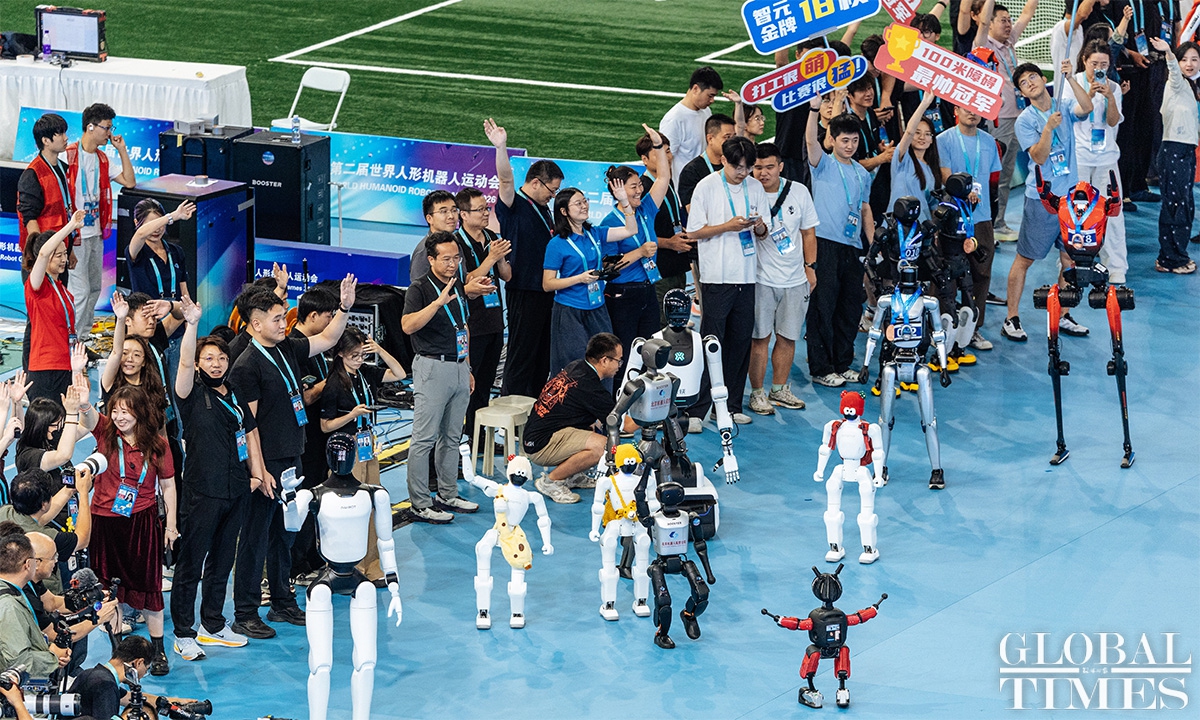
Photo: Li Hao/GT
At the Games, that distance between people and robots already seemed to be narrowing.
The Global Times saw many children cheering when robots scored a goal, completed a jump or crossed the finish line, and sighing in disappointment when they stumbled.
One 80-centimeter-tall robot, nicknamed "Little Milk Bottle," caught a young boy's eye. Tugging at his mother, he said, "I really want one!"
That wish is no longer entirely out of reach. Kang Haojie from High Torque Robotics told the Global Times that the robot weighs about 13 kilograms and is priced at 39,800 yuan ($5922), and is available to consumers. Despite its small size, it competed in multiple events, including the 100 meters, 400 meters, obstacle race, standing high jump and martial arts.
As robots began filing out of the arena and the spectators' cheers gradually faded, the real test was only beginning. Their next "track" will be the real world - one without marked lanes or predetermined answers.
RELATED ARTICLES